
WHEN POLICE LAWLESSNESS IS APPLAUDED: Capitol Police Officer’s Explanation for Shooting and Killing Ashli Babbitt Is Riddled With Problems.
Author Archive: Glenn Reynolds
August 30, 2021
JAMES WEBB: Afghanistan: A Requiem for an Avoidable Disaster.
In Washington Joe Biden, the president who had ordered that the evacuation of Americans and their allies be accomplished by August 31 so that his new Administration could celebrate finally ending the Afghanistan war on the twenty-year anniversary of the 9/11 attacks was, characteristically, remaining out of sight. His election campaign had largely taken place in the basement of his home in Delaware, minimizing his tendency to make public gaffes. After the American military was ordered to occupy the Kabul airport following a blitzkrieg of sorts by the Taliban that toppled the Afghan government, he disappeared for days inside the protected isolation of Camp David or at his home in Delaware, from whence he would appear from time to time to read a set of carefully prepared remarks and then again disappear without taking questions.
Vice President Kamala Harris was finishing up a quick trip to Singapore and Vietnam and skipped a stop in California on the way home where she had intended to campaign for its embattled governor as he fends off a voter recall to throw him out of office. At no point in her Asia trip did the Vice President speak directly about the ominous forced error in Afghanistan that had been initiated by the Biden Administration, although the world was waiting for reassurance from America’s top leadership as events on the ground morphed out of control. In a remarkable display of tone-deaf diplomatic naiveté, the Vice President was pictured sitting in front of a sculpture of Ho Chi Minh during a meeting with Vietnam’s President Nguyen Xuan Phuc at the very moment the rest of the world was comparing America’s humiliating and incompetent dilemma in Kabul with the 1975 fall of Saigon.
In Kabul, America’s capability to conduct an orderly withdrawal from Afghanistan had turned into a disgusting nightmare of incompetence that can only be rectified by holding those responsible accountable. A midnight abandonment of America’s most important airbase in Bagram on July 2 had put a double hex on a proper retrograde from the country, first by giving up a large-scale aviation platform whose massive runways and extensive outer perimeter made it eminently usable and defendable, and second by allowing the Taliban to release thousands of rabid terrorists who had been imprisoned there and were now on the loose. In Kabul, American military units were largely forbidden to leave the airport to rescue and escort Americans and allied Afghans back to the airport. An agreement was reached where the conquering Taliban controlled the checkpoints outside. To make matters impossibly worse, American officials in Kabul were reported to have given the names and locations of some of our citizens and close allies to the Taliban, supposedly for the purpose of expediting their efforts to leave the country but in reality, simplifying the Taliban’s search for the very people whose lives depended on escaping from their clutches in the first place.
In Washington and in command centers elsewhere, those who had concocted this planned withdrawal, both military and civilian, were filling the airwaves with the usual “not me” rhetoric that has sidestepped accountability and enabled promotions, advances, and post-career financial rewards for the past twenty years. The roots of how we reached this final imbroglio can be found in the decisions that were made not just at the end but all along the way. And in the painful events of these final weeks, there are blatant indicators as to how we must rid ourselves of this political pox and proceed into the future.
Failure must be punished, not rewarded, if you want less of it in the future.
Plus:
The military itself is increasingly being used by leftist activists as a social laboratory to advance extreme political agendas. Congressional oversight leans heavily toward social issues, with too many members struggling without success to focus on accountability at the very top when, for instance, good people at the bottom have to implement poorly conceived plans that might kill them.
This is not an exaggeration, and it is not just what has been happening at the Kabul airport and elsewhere in Afghanistan. Those situations merely provide us a microcosm, a symbolic moment in time, that allows us to see the implications of confused or distracted leadership, military and civilian alike, motivated by political machinations. In the American political system, we have the capacity to demand that this inequity change. What we need is the will to do it.
Why change? Our ruling class is doing just fine. Or at least it thinks it is, as the Russian nobles thought in 1909.

COMPARE AND CONTRAST. Via a friend.

THERE’S NOTHING THEY WON’T LIE ABOUT. NOTHING AT ALL. If Joe Biden’s Team Will Lie About His Dog Biting People, What Won’t They Lie About?
SEGREGATON NOW, SEGREGATION TOMORROW, SEGREGATION FOREVER! AU offers separate classroom, saying it’s a ‘safe space for Black Students.’
DON SURBER: The Harvey Weinstein-ed news. “While the news readers and guests on ‘Today,’ ‘CBS This Morning,’ and ‘Good Morning Amderica’ were condemning Harvey Weinstein for trading sex for movie roles, the shows themselves had for years anchors or bosses who were mistreating. The predators were Matt Lauer at NBC, Charlie Rose at CBS and PBS, and Michael Corn, the senior executive producer of GMA at ABC. . . . Mind you, all the while the lefty morning shows were promoting the feminist agenda, each of these shows showcased women co-hosts.”
FYI: On C-SPAN, Phil Magness talks about his book, Cracks in the Ivory Tower: The Moral Mess of Higher Education. “There are things that happen in universities that would make things like Enron look ethical by comparison.”
MARK JUDGE: COVID-19 Madness and ‘The Last Man on Earth.’
WELL, SURE, IT’S STRUCTURED FORMAL RACISM: Critical race theory in universities likely violates federal law: legal analysis. It creates, and is designed to create, a hostile educational environment on account of race.


KURT SCHLICHTER: Own Your Failure, Biden Voters.
HOUSTON STEPS UP: Mattress Mack prepares to send 30 trucks loaded with relief supplies to region ravaged by Hurricane Ida.
Flashback to four years ago:

Americans are so much better than their ruling class.
TO BE FAIR, IT WAS ALMOST PUDDING CUP TIME: Was Biden looking at his watch during ceremony for Marines killed in Kabul?
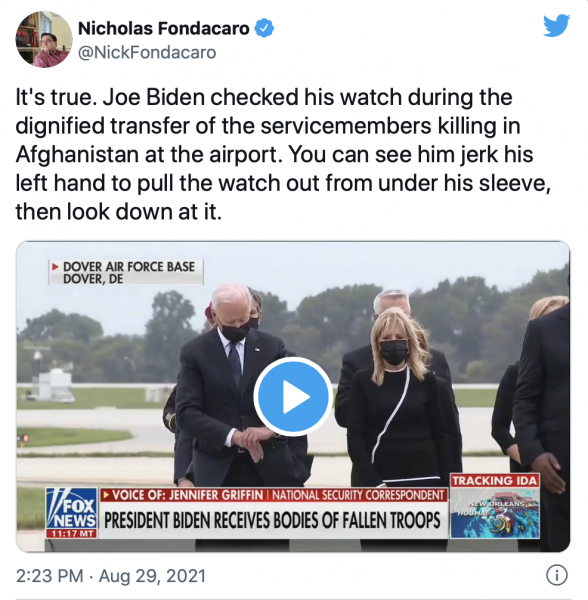
IN THE MIDST OF A White House Breakdown.
Related: Kamala Harris’ cackling is Joe Biden’s job security.
THEY LIED AND CHEATED TO GET RID OF TRUMP, AND SHOULD BE HELD FULLY RESPONSIBLE FOR THE RESULTING DISASTER:
Well done, mainstream media.
You put Biden in the White House.
The man is a total loser, unfit to lead America and the free world.
— Nigel Farage (@Nigel_Farage) August 29, 2021
Flashback: Time Publishes an Astonishing Story About a ‘Cabal’ and ‘Shadow Campaign’ That Helped Biden Win.
SALENA ZITO: The Restorative Power of the American People.
Turn on social media, cable news, or the national news networks, and you would be inclined to believe that we loathe those who are different than us. You would also be inclined to believe that everyone who lives outside the urban centers is backward, stupid, and racist.
Turn off social media, get off the interstates, and spend time in the overlooked neighborhoods, projects, and small towns. You will find, for the most part, the exact opposite of those sentiments. You will discover that many who live in the cities, no matter what the color of their skin is, want to find a way out, not because they don’t love their cities but because those who govern them have become so drunk with power, they find living there untenable.
They no longer trust them to make the right choices because every choice is based on their own political power.
Many of the people I listened to were eating at a diner, a place that some journalists look down on with disdain. Going to a diner when traveling, especially as a reporter, is essential. Our job as journalists is to go where people frequent, not to go where you wish they frequented. . . .
My best estimation of where Americans are culturally and politically is that we are much closer to an inside/outside moment in our history and not left/right. We have been so disrupted by our mistrust in school boards, political parties, unions, academia, institutions, and entertainment that it has strained our ties to our traditional cultural curators.
Whether it is in small towns such as Jordan, Kansas, or more cosmopolitan towns such as Bozeman, Montana, or Aspen, Colorado, multiple interviews taught me something new this year; the long-standing relationship between people and government is unsteady, even among the relatively well-off families.
Everywhere you look, our disconnect between the outside and our centers of power is both wide and deep — it is clear this will affect the party in power. What is unclear is if the party out of power can pull itself together and govern as the outsiders people are craving.
Yep. To paraphrase a famous man, never underestimate the GOP’s ability to f*ck things up.
SIDWELL FRIENDS, WHERE AMERICA’S RULING CLASS GOES TO LEARN PHYSICS:
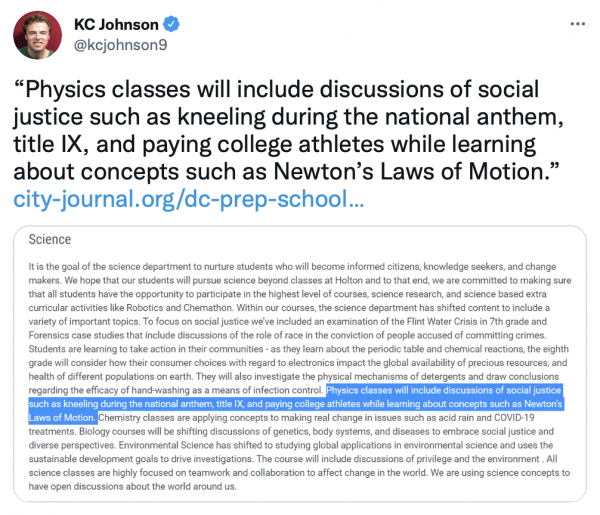
Article here.
Flashback: Trump And The Crisis Of The Meritocracy.
A lot of Americans resent the meritocrats’ insulation from what’s happening elsewhere, especially as America’s unfortunate record over the past couple of decades, whether in economics, in politics, or in foreign policy, doesn’t suggest that the “meritocracy” is overflowing with, you know, actual merit.
In the United States, the result has been Trump. In Britain, the result was Brexit. In both cases, the allegedly elite — who are supposed to be cool, considered, and above the vulgar passions of the masses — went more or less crazy. From conspiracy theories (it was the Russians!) to bizarre escape fantasies (A Brexit vote redo! A military coup to oust Trump!) the cognitive elite suddenly didn’t seem especially elite, or for that matter particularly cognitive.
In fact, while America was losing wars abroad and jobs at home, elites seemed focused on things that were, well, faintly ridiculous. As Richard Fernandez tweeted: “The elites lost their mojo by becoming absurd. It happened on the road between cultural appropriation and transgender bathrooms.” It was fatal: “People believe from instinct. The Roman gods became ridiculous when the Roman emperors did. PC is the equivalent of Caligula’s horse.”
Well, one end of the horse, anyway. Things have, of course, gotten much worse since this was written. And there’s every evidence that our ruling class intends to continue that trend as long as it is allowed to.
August 29, 2021
JONATHAN TURLEY: Shooter of Ashli Babbit Makes Shocking Admission:
“That’s my job.” Those three words summed up a controversial interview this week with the long-unnamed officer who shot and killed Ashli Babbitt on Jan. 6. Shortly after being cleared by the Capitol Police in the shooting, Lt. Michael Byrd went public in an NBC interview, insisting that he “saved countless lives” by shooting the unarmed protester.
I have long expressed doubt over the Babbitt shooting, which directly contradicted standards on the use of lethal force by law enforcement. But what was breathtaking about Byrd’s interview was that he confirmed the worst suspicions about the shooting and raised serious questions over the incident reviews by the Department of Justice (DOJ) and, most recently, the Capitol Police.
Babbitt, 35, was an Air Force veteran and ardent supporter of former President Trump. She came to Washington to protest the certification of the presidential Electoral College results and stormed into the Capitol when security lines collapsed. She had no criminal record but clearly engaged in criminal conduct that day by entering Capitol and disobeying police commands. The question, however, has been why this unarmed trespasser deserved to die. . . .
At the time, some of us familiar with the rules governing police use of force raised concerns over the shooting. Those concerns were heightened by the DOJ’s bizarre review and report, which stated the governing standards but then seemed to brush them aside to clear Byrd.
The DOJ report did not read like any post-shooting review I have read as a criminal defense attorney or law professor. The DOJ statement notably does not say that the shooting was clearly justified. Instead, it stressed that “prosecutors would have to prove not only that the officer used force that was constitutionally unreasonable, but that the officer did so ‘willfully.’” It seemed simply to shrug and say that the DOJ did not believe it could prove “a bad purpose to disregard the law” and that “evidence that an officer acted out of fear, mistake, panic, misperception, negligence, or even poor judgment cannot establish the high level of intent.”
While the Supreme Court, in cases such as Graham v. Connor, has said that courts must consider “the facts and circumstances of each particular case,” it has emphasized that lethal force must be used only against someone who is “an immediate threat to the safety of the officers or others, and … is actively resisting arrest or attempting to evade arrest by flight.” Particularly with armed assailants, the standard governing “imminent harm” recognizes that these decisions must often be made in the most chaotic and brief encounters.
Under these standards, police officers should not shoot unarmed suspects or rioters without a clear threat to themselves or fellow officers. That even applies to armed suspects who fail to obey orders. Indeed, Huntsville police officer William “Ben” Darby recently was convicted for killing a suicidal man holding a gun to his own head. Despite being cleared by a police review board, Darby was prosecuted, found guilty and sentenced to 25 years in prison, even though Darby said he feared for the safety of himself and fellow officers. Yet law professors and experts who have praised such prosecutions in the past have been conspicuously silent over the shooting of an unarmed woman who had officers in front of and behind her on Jan. 6.
In the eyes of the establishment — including those silent “law professors and experts” — she deserved to die because she was a Trump supporter. It’s all about that.
Plus, the usual apparatchik entitlement: “Politico reported that Byrd previously was subjected to a disciplinary review when he left his Glock 22 service weapon in a bathroom in the Capitol Visitor Center complex. He reportedly told other officers that his rank as a lieutenant and his role as commander of the House chambers section would protect him and that he expected to ‘be treated differently.'”
Well, he wasn’t wrong. But he should pay.