
Author Archive: Glenn Reynolds
November 19, 2021
DAVID LAT RESPONDS TO YALE LAW DEAN HEATHER GERKEN’S WEAK RESPONSE TO THE EMAIL SCANDAL:
The tone of her email is certainly understated; Dean Gerken is keeping calm and carrying on. Her message does not reflect the state of crisis at YLS—which might explain why it has garnered harsh criticism from certain online commentators. . . .
Notwithstanding her words, I think it’s clear to any objective observer that Yale Law School in 2021 is no longer a place where people can “discuss the unmentionable,” or anything even close to unmentionable. And it’s far from the only institution in higher education suffering from a chilling effect that could give Princess Elsa frostbite. . . .
I’m also glad that Gerken reiterated that the offended students in Trap House-gate “were told by administrators that the University’s free speech policy precluded disciplinary action of any sort.” That should go without saying, but I’m glad she said it.
But I do think part of this statement is… disingenuous, to put it mildly. Yes, the offended students were told that no disciplinary action would be forthcoming—but what about Trent Colbert? As we all know from the recorded conversations and correspondence, associate dean Ellen Cosgrove and diversity director Yaseen Eldik heavily hinted in their initial conversations with Colbert that the controversy might have implications for his application to the bar someday. Colbert wasn’t told until weeks later that no discipline would be forthcoming, after it was clear that he wouldn’t be giving them the apology they tried to squeeze out from him.
And wait, it gets worse. The most problematic part of this paragraph is item (3), in which Gerken claims that Cosgrove and Eldik were simply “attempting to carry out their obligations under University policy whenever discrimination complaints are filed.” Such doublespeak would make a totalitarian regime proud.5 Anyone with an ounce of familiarity with Trap House-gate knows that their conduct was, in the words of Professor Akhil Amar, “dishonest, duplicitous, and downright deplorable.” . . .
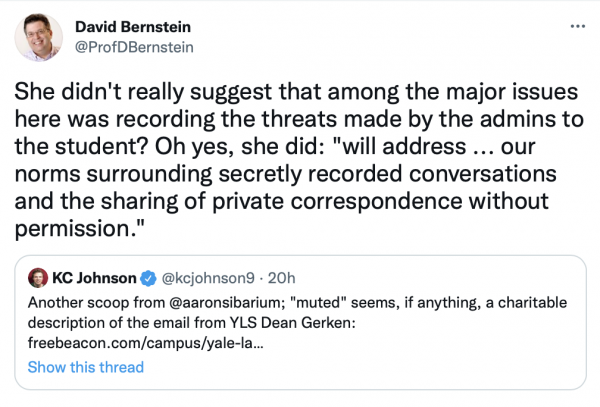
Now for the worst part of this paragraph: the reference to “our norms surrounding secretly recorded conversations and the sharing of private correspondence without permission.” Jeez. Was this really necessary, Dean Gerken? It reads discordantly with the rest of the message, which focuses on big-picture themes like intellectual freedom and the importance of community, and it comes across as petty and thin-skinned. Cf. her email announcing the Ayres Commission, complaining about “partial facts reported out in a charged media environment.”7
It’s gratuitous—nothing more than a passive-aggressive complaint about leaking from an administrator, i.e., someone who hates leaks. As Justice Brandeis famously wrote, “Sunlight is said to be the best of disinfectants”—and this reads like Gerken trying to pull down the blackout shades. It would have been so much better for her to have written something like this: “I expect the committee will address steps we can take as a community to create an environment in which people can disagree, even vehemently, while still treating each other with the utmost respect and dignity.”
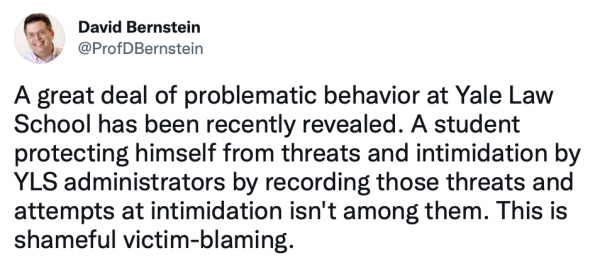
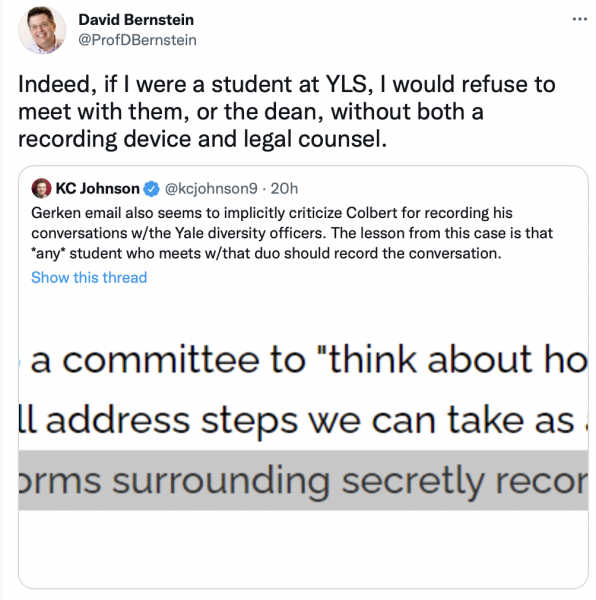
And also, let’s be honest: thank God Trent Colbert recorded his conversations with Yaseen Eldik.8 I agree with David Bernstein: “The student who recorded these conversations not only protected himself, he did a public service by revealing the bullying and attempts at intimidation by YLS administrators. But she’s suggesting, in effect, that the whistle blower is blameworthy!”
If Colbert had not taped the conversations, his version of events would have been seriously questioned, and his story would not have gotten the traction that it did. And we wouldn’t be where we are today—which is, after significant unpleasantness, hopefully the start of a new chapter at Yale Law School.
Well, hopefully.
November 18, 2021
YEAH, THIS WILL BOLSTER PEOPLE’S CONFIDENCE: FDA Says It Needs Until Year 2076 To Reveal Data Pertaining To Pfizer Vaccine Approval.
OPEN THREAD: Hop with the Jet Set.
MY NEW YORK POST COLUMN: Students suing Yale Law show America’s elites have a low opinion of minorities. “What can you say about an institution that is willing to break faith with its members and engage in blackmail and the subornation of false statements to wage a political vendetta? Sadly, you’d have to say that it’s pretty typical these days.”
ICYMI: OSHA suspends enforcement of Biden’s vaccine mandate. One of my former students is quoted:
Ben M. Rose, founder of Brentwood, TN-based law firm RoseFirm, PLLC, says he wasn’t surprised by the Fifth Circuit’s ruling or by OSHA’s response. “The constitutional basis for the initiative has always been suspect,” Rose says. “You can’t enforce a mandate like that through the OSHA rubric or otherwise as an instrument of the federal government something short of a federal statute. My view is that they all knew that and went forward with the idea to put it out there and implement it in hopes that many employers would institute it on their own. I don’t believe they ever thought they had the legal authority to do it in the first place.”
Well said.
EUGENE VOLOKH: What Happens if the Vice President Steps Down?
THUGGISHNESS AND DISHONESTY ARE A HALLMARK OF TODAY’S DEMOCRATS: Proof that AG Garland misled Congress about silencing parents who dissent.
WELL, THIS IS THE 21ST CENTURY, YOU KNOW: FDA approves virtual reality system to ease back pain.
JUST OUT: ARIZONA VOTERS HATE AMNESTY: Arizona Voters Oppose Amnesty for Illegals in ‘Build Back Better.’
Barely one-fifth of Arizona voters support efforts by Democrats to include an amnesty provision for illegal immigrants in the “Build Back Better” legislation currently pending in Congress, and most would vote against a member of Congress who supports the proposed amnesty.
A new national telephone and online survey by Rasmussen Reports and Numbers USA finds that just 21% of Likely Arizona Voters approve of a provision in the Build Back Better bill that would offer 10 years of work permits and legal status to approximately 8 million illegal immigrants. Another 16% would only support the proposed 10-year amnesty if it includes provisions to stop future illegal immigration. Thirty-one percent (31%) say no amnesty should be considered until the border is under control, while 26% oppose amnesty for illegal immigrants under any condition.
Open borders are only popular with the political class.
HACKING HAM RADIO FOR TEXTING.
LOCKDOWN MARYLAND! Maryland health officials confirm case of monkeypox in traveler.
AGE OF DISCOVERY 2.0: Episode 6 of a six-part podcast series I’m co-producing that looks a the past and future of human exploration. Will SpaceX Control Mars Like the British East India Company Controlled the Indian Subcontinent?
The British East India Company is perhaps the most powerful corporation in history. It was larger than several nations and acted as emperor of the Indian subcontinent, commanding a private army of 260,000 soldiers (twice the size of the British Army at the time). The East India Company controlled trade between Britian and India, China, and Persia, reaping enormous profits, flooding Europe with tea, cotton, and spices. Investors earned returns of 30 percent or more.
With SpaceX building reusable rockets and drawing up plans to colonize Mars, could we be seeing a new British East India Company for the 21st century? The idea isn’t that far-fetched. In the terms of service for its Starlink satellite internet, one clause reads the following: “For Services provided on Mars, or in transit to Mars via Starship or other colonization spacecraft, the parties recognize Mars as a free planet and that no Earth-based government has authority or sovereignty over Martian activities. Accordingly, Disputes will be settled through self-governing principles, established in good faith, at the time of Martian settlement.”
To answer the question of whether or not space tycoons will be able to control the Moon or Mars is today’s guest is Ram Jakhu, an associate professor at McGill University and a researcher on international space law.
In this episode we discuss:
How the East India Company’s control over India foreshadows SpaceX’s control over Mars and what happens when a corporation effectively controls a nation (or in this case, a planet)
Laws that apply to seasteading and their relevance to space colonies
Why some military strategists think space will inevitably be the new warfighting domain, and whether or not this is true
The past and future of the 1967 Outer Space Treaty, an international treaty that prevents any country from claiming sovereignty over outer space or any celestial body.
HIGHER EDUCATION BUBBLE UPDATE: Academics discuss how ‘pro-migrant, anti-capitalist’ activism is accomplished through research.
Taxpayers are starting to wonder why they should fund institutions that overtly favor the overthrow of the society on which they depend.
LIKE ALL RACISTS, SHE’S A BAD FIT FOR MLK: Critical Race Theorist Nikole Hannah-Jones should not be headlining an MLK event.
