
IF YOU KNOW A SMART CONSERVATIVE/LIBERTARIAN LAW STUDENT (OR A VERY SMART COLLEGE STUDENT): … who would like to spend the summer interning for Commissioner Peter Kirsanow and me at the U.S. Commission on Civil Rights in Washington for absolutely no pay, send him or her here. Thanks. We can use all the help we can get.
Author Archive: Gail Heriot
January 29, 2019
THE NOT-SO-FAMOUS ALBERT GALLATIN WAS BORN ON THIS DAY IN 1761: On the south side of the Treasury Department Building in Washington stands a statue of the first Secretary of the Treasury—Alexander Hamilton. No surprise there: Hamilton has been viewed as an important figure for a long time, and these days he’s a sexy Broadway star too. At the Pennsylvania Avenue entrance, stands a likeness of the fourth Secretary—Albert Gallatin—a man who has been mostly forgotten. On more than one occasion, I’ve noticed tourists peering at the statue from the street and asking something like, “Who’s that? Why isn’t that Hamilton?” Poor Gallatin.
The two Secretaries had a lot in common—both were foreign born (Gallatin was Swiss, Hamilton was born in Nevis), both were orphaned at a young age, and both were financial whizzes at a time when financial sophistication was rare in the US.
When Jefferson became President he was convinced that Hamilton and his successors had been up to no good while in charge of the treasury and that Gallatin was the only man with the financial acumen needed to expose their wickedness. To Gallatin’s credit, after a thorough examination of the records, he explained to Jefferson that it wasn’t corruption that was the problem.
To Gallatin—who has been described by a biographer as having “a small-shopkeeper’s sense of integrity”—the real problem was the $83 million national debt still left over from the Revolution. He wanted to pay it down, but without imposing onerous internal taxes. During the Whiskey Rebellion, his sympathies had been with the western farmers, who were being taxed heavily. On the other hand, he knew when debt was appropriate and worked hard to provide the financing for the Louisiana Purchase when opportunity unexpectedly knocked. By 1812, he had whittled the debt down to $45 million, which was a significant accomplishment, especially considering that he’d nixed the whiskey and other direct, internal taxes. (Alas, it ballooned again on account of the War of 1812. War is like that).
UPDATE (FROM GLENN): Thanks to taking an, um, more sympathetic role in the Whiskey Rebellion, Gallatin produced a much freer United States in L. Neil Smith’s alt-history novel The Probability Broach.
DEAR PRINCE CHARMING: Please leave Sleeping Beauty alone. You’re nothing but a rapist. Or so says a Chapman University group.
January 28, 2019
THE MARKETING GENIUS BEHIND STARBUCKS’ “RACE TOGETHER” CAMPAIGN WANTS TO BE YOUR PRESIDENT: Democrats figure that if he runs it will take away votes from their candidate.
IT’S A GOOD THING I DON’T LIVE IN CHICAGO ANYMORE: Brrrrrrrrrrrr.
CAN A NEW MODEL OF APPRENTICESHIPS SAVE CALIFORNIA?: Well … I’d be very happy if all 50 states could dramatically increase the number of opportunities for apprenticeships. There are certainly many skills that are better taught on the job than in the classroom, and there are many young people who prefer on-the-job learning to classroom learning. But it may be tougher to implement than some people realize.
January 27, 2019
NO. AND BY THE WAY YOUR EMPIRICAL STUDIES ARE BOGUS: Was [the Department of Education’s decision to rescind] the school discipline guidance a mistake?
THE OLD DOMINION’S COLORING: The once-red Commonwealth of Virginia has long since gone purple. Hans Bader argues that a recent court ruling imposing a political gerrymander on voters will turn Virginia blue.
WILLIE BROWN ATTACKS HIS OLD GIRLFRIEND KAMALA HARRIS: It’s going to be an interesting election.
January 23, 2019
THIS IS A REASON FOR PESSIMISM: It’s one thing to have a small number of people around the country who are totally out of their minds with hatred. It was ever thus. It’s another thing when they get elected to Congress, and the media write puff pieces about them.
January 22, 2019
I THOUGHT THAT WAS WHAT INCLUSIVENESS IS SUPPOSED TO BE ABOUT: American University students complain that its “Hub for Organizing Multiculturalism and Equity” is too inclusive.
REPOST: SUPER BOWL SEX TRAFFICKING: It’s that time of year again—when the Super Bowl host city starts assuring the public that it is doing everything possible to combat the expected explosion of sex crimes. It don’t really blame these cities for ramping up. If it were true that the Super Bowl brings with it the massive sexual exploitation of minors that would be very serious. But it is not true. Nor is it true that ordinary adult prostitution increases to unusual levels. The Super Bowl is mostly about … shock alert … a football game (and a few very expensive television ads).
A few years ago the U.S. Commission on Civil Rights issued an overwrought report entitled “Sex Trafficking: A Gender-Based Violation of Civil Rights.” I wrote a 30-page Statement that was critical of the report. A few pages of it deal with the Super Bowl myth. I also included a bit about the White Slavery Panic and about Filipina hostesses in Japan.
I reposted this with the links fixed. Sorry about that.
I CAN’T SAY I’M LOOKING FORWARD TO 2020: “Five reasons Kamala Harris is the Brand-New 2020 Democratic Frontrunner.“
January 21, 2019
WE LIVE IN RIDICULOUS TIMES: Just ask Pickles.
ON ORDERS FROM ND PREZ: Notre Dame to cover murals of Christopher Columbus.
NO COMPROMISE: It’s all about hating Trump.
January 20, 2019
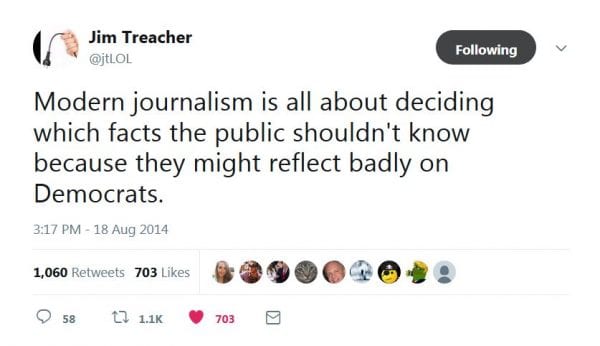
THIS STORY (AS ALREADY NOTED BY ED AND GLENN) IS ANOTHER NICE CASE STUDY OF “PERCEPTIONS OF NEWSWORTHINESS ARE CONTAMINATED BY A POLITICAL USEFULNESS BIAS”: If some anonymous teenager in a MAGA hat is rude (or maybe isn’t even rude!) to a Native American drummer, that’s a big story. But if a Democratic Congressional candidate (now a Congresswoman) has written “Israel has hypnotized the world, may Allah awaken the people and help them see the evil doings of Israel,” that’s not newsworthy.
DEMOCRATS’ PUERTO RICAN JUNKET WENT LARGELY UNREPORTED IN THE MEDIA … BECAUSE IT’S NOT WORTH MENTIONING WHEN IT’S DEMOCRATS WHO DON’T SHOW UP FOR WORK: This is a good example of the tendency Hal Pashler and I documented in Perceptions of Newsworthiness Are Contaminated by a Political Usefulness Bias. This tendency won’t come as a shock to any observant person who pays attention to politics, but it was fun to run an experiment that confirmed it.
UPDATE (FROM GLENN): As always:
January 19, 2019
THE MYTH OF CUBAN INFANT MORTALITY: The NYT gets it wrong again.
AS THE FEDERAL SHUTDOWN CONTINUES: I can’t help it. Yesterday morning when I ran across the shutdown notice on the web site of the U.S. Commission on Civil Rights (of which I am a member), I smiled so much I spilled my coffee. So far, I am enjoying the break from writing dissents.
If you’d like to get a sense of how the Commission works, check out my dissent on immigration detention centers or on environmental justice. My guess is that after reading them you won’t shed any tears over the Commission’s failure to issue reports over the last few weeks.
While I am waiting for things to start up again maybe I’ll have some time to tend to my cactus garden. Dealing with prickly plants is good practice for Commission work.
January 18, 2019
KAMALA HARRIS NOT LEFTY ENOUGH FOR THE LEFT?: An opinion piece in the New York Times complains that “Kamala Harris Was Not a ‘Progressive Prosecutor.’” The piece contains a litany of ways she fails to measure up to the author’s standard of Progressivism. Among the complaints is this one:
Ms. Harris also championed state legislation under which parents whose children were found to be habitually truant in elementary school could be prosecuted, despite concerns that it would disproportionately affect low-income people of color.
For me, that would be a reason to support Harris (though I have a feeling I am not the NYT’s target audience for this one). The attack on her is correct that this legislation would disproportionately affect low-income parents as well as African American and to a much lesser extent Latino parents. As I have written elsewhere about Harris’ empirical findings:
Among California students in kindergarten through 5th grade, the African-American rate of chronic truancy (i.e. 18 or more unexcused absences) is approximately five times the rate of white students. For example, former California Attorney General Kamala Harris (who is not among those who ignore the truancy issue) reports that, among kindergarteners, the rates are 7.9% (African American), 2.1% (Latino), 1.4% (white), and 1.1% (Asian). In the 5th grade the rates are 4.9% (African American), 1% (Hispanic), 1% (white), and 0.3% (Asian).
Harris rightly understood that making progress on closing the achievement gap requires making progress on closing the truancy gap. Good for Harris. If these “More Progressive Than Thou” types give a damn about actual low-income and minority students, they might want to cut her some slack on this.
JOHN FUND: Pelosi’s election “reform.”
MAX EDEN: “Restorative Justice Isn’t Working, But That’s Not What the Media Is Reporting.”
For more on the failure of the Obama Administration’s school discipline policy (which the Trump Administration recently withdrew), read, The Department of Education’s Obama-Era Initiative on Racial Disparities in School Discipline: Wrong for Students and Teachers, Wrong on the Law.
ON THIS DAY IN 1689: Charles-Louis de Secondat, Baron de La Brède et de Montesquieu, advocate of separation of powers, was born.
Montesquieu would likely have hated the modern administrative state, which liberally mixes the legislative, executive and judicial functions. I know I hate it. As Professor Gary Lawson wrote about the Federal Trade Commission in his well-regarded article The Rise and Rise of the Administrative State:
“The Commission promulgates substantive rules of conduct. The Commission then considers whether to authorize investigations into whether the Commission’s rules have been violated. If the Commission authorizes an investigation, the investigation is conducted by the Commission, which reports its findings to the Commission. If the Commission thinks that the Commission’s findings warrant an enforcement action, the Commission issues a complaint. The Commission’s complaint that a Commission rule has been violated is then prosecuted by the Commission and adjudicated by the Commission. This Commission adjudication can either take place before the full Commission or before a semi-autonomous Commission administrative law judge. If the Commission chooses to adjudicate before an administrative law judge rather than before the Commission and the decision is adverse to the Commission, the Commission can appeal to the Commission. If the Commission ultimately finds a violation, then, and only then, the affected private party can appeal to an Article III court. But the agency decision, even before the bona fide Article III tribunal, possesses a very strong presumption of correctness on matters both of fact and of law.”
This doesn’t work very well, you know. Just ask Montesquieu.
January 17, 2019
TRADITIONAL MASCULINITY: You’re going to miss it when it’s gone.