No one has done more to undermine the Biden administration’s vaccination strategy than Joe Biden. From his confusion over when to wear a mask and when not to wear a mask, to the lack of press conferences, on through the Delta variant, we arrive at Biden’s biggest optics crisis yet: 15,000 migrants flooding the southern border under a Del Rio, Texas, bridge in temperatures reaching 100 degrees.
Homeland Security secretary Alejandro Mayorkas confirmed last week that his department’s border officials did not test the some 12,000 to 15,000 migrants for COVID. He did say that some had fallen ill, but would not elaborate further. While appearing on Fox News Sunday, he told Chris Wallace that at least 12,000 of those same migrants were released into the country with a notice to appear in court, which is sure to be ignored by the majority of them, if history is any guide.
So to recap, thousands of migrants, who were not tested for COVID, and not vaccinated to anyone’s knowledge, were just released into the US and are most likely destined for urban city environments. This has been met with sympathetic shrugs from reporters, who have also made a point of highlighting when every mother or father of three who rejects the vaccine dies from COVID.
The scene this goddamn simpleton is talking about is in Thunderball, where Connery’s Bond is recovering at some sort of rest spa and seduces a luscious therapist into a tryst.
It’s not rape. It’s nothing close to rape. It’s doesn’t even graze rape. What it is is a complicated, adult, nuanced, and sexy seduction. And it is also a seduction that’s making a much larger social point.
Bond and the therapist obviously want one another, and the only reason she’s all “No, no, no” is because having sex with the customers is just not done. So this scene is not about James Bond forcing a woman to have sex with him. It’s about what much of the sixties was about, and that’s overcoming your sexual inhibitions.
Bond isn’t raping this woman. He’s not forcing himself on her. He’s sexually liberating her.
No, really, he is.
Dummies.
Are people really this stupid?
Or are they so insecure and neurotic, so desperate for approval that they just spout these simplistic moral bromides that make Joe McCarthy look like Timothy Leary?
The makers of the James Bond films have been trying to get back to the Connery days since The Spy Who Loved Me. Those films are considered the gold standard of the Bond franchise. Why on earth would the director of its latest chapter trash the man who started it all?
Reports say she will allow the House to vote on the bipartisan infrastructure bill on Thursday. The reason is that the $3.5 trillion bill has just not come together in the Senate. No one seems to know what Democratic Sens. Joe Manchin and Kyrsten Sinema will vote for, and without all 50 Democratic senators on board, the bill will go nowhere. At the very least, it will take a while to do.
Meanwhile, the $1.1 trillion traditional infrastructure bill has been passed by the Senate. All the House has to do is vote on it. Lawmakers can pass it anytime and send it to the president’s desk for signature. And they will do so; there is no way in the world Democrats will just leave $1.1 trillion sitting on the table. And why keep waiting for a $3.5 trillion pie-in-the-sky bill that might or might not happen and in any event will involve more infighting among Democrats? Pass the $1.1 trillion now. Take the win.
That is what Pelosi is doing. But of course, taking the win is actually a cave for Pelosi in the sense that she vowed not to do it this way and has now surrendered to the so-called centrists in her party — and to common sense. So now, when the House passes the bill, and Biden signs it, Democrats can go back to fighting among themselves about the $3.5 trillion.
Before that, though, Congress has to pass a bill to keep the government funded, and then, after that, a bill to raise the nation’s debt ceiling. That’s where Pelosi (and Senate Majority Leader Chuck Schumer) face some tough choices.
I dunno — a trillion here, and a trillion there, and sooner or later, you’re talking about real money.
JUST NBC THE HYPOCRISY: Chuck Todd, Glaring Conflict of Interest, Moderating 2nd Virginia Governor Debate. “The Virginia gubernatorial candidates engage in their second debate tonight on WRC, the local NBC station in Washington. The moderator is Chuck Todd. That’s an interesting choice, since Chuck’s wife Kristian Denny has been active in advising and donating to Democratic candidates in Virginia.”
I prefer American socialists to be a bit more secular. And as Jim Geraghty notes, “At this hour, despite the governor declaring that everyone in the state must listen to God and do as God wants, there is no complaint from Americans United for Separation of Church and State.”
THE MAGICAL MYSTERY TRUNALIMUNUMAPRZURE: Joe Biden’s history tour from hell — from 1970s gas lines to the 1918 pandemic, where will the President take us next?
The first stop was the late 1970s. This came back in spring after a ransomware attack on a major American pipeline resulted in a gasoline shortage that sent lines at gas stations snaking around the block. Throw in inflation as the economy began to reopen, and Biden suddenly looked a lot like Jimmy Carter, only without the beer deregulation and awesome stories about homicidal rabbits. Instead, this exhibit was all animatronic Karens filling Tupperware with regular unleaded while glowering at the unmasked mom headed into the grocery store to buy $4 milk.
The next stop was the autumn of 1918, hospitals filled to capacity, portentous static over the CNN wireless. The Spanish flu killed millions of people, but it wasn’t until the second wave in the fall that its true lethality was brought to bear. And while the delta variant hasn’t been quite so devastating, sheer exhaustion with this pandemic has nonetheless forced a comparison. Hot Vax Summer has been canceled. One in 500 Americans has now died from COVID. This is the part of the tour where Biden gets punchy and starts shouting ‘come on, man!’ in the direction of perceived vaccine skeptics.
And then it’s on to the third exhibit, Saigon circa Gerald Ford by way of Afghanistan. Here, docent Biden’s defensiveness only increases. Just how in the hell was he supposed to know that Afghanistan would fall apart?! Other than, you know, the endless intelligence reports over the eight months that he had to plan and coordinate our withdrawal? Cut to the passengers looking leerily at the emergency exit and contemplating a duck and roll.
* * * * * * * *
The risk isn’t so much that America is going to come apart tomorrow. It’s that Biden will prove one of those weak placeholder leaders — cheers again, Jimmy Carter! — who fails to sufficiently grapple with the issues of his time. So it is that we enter the last room on the tour, a dark tunnel where trippy images flash on the walls: Americans trapped in Afghanistan, Haitians squatting at the border, immigration agents on horseback, anti-vaccine protesters, Frenchmen in berets shaking their fists.
Suddenly, for just an instant, docent Biden looks more like Charon at the ferry helm. The President’s flashes from the past are just that, flashes. It’s his inability to meet the challenges of the present that’s far more ominous.
Did you catch that last part? Though citizens couldn’t exchange paper money for gold, foreign governments could. So the US dollar was still tethered to gold, which the US promised to redeem at an exchange rate of $35 per ounce. This meant the US couldn’t inflate the money supply without depleting its gold reserves.
Unfortunately, however, the US did inflate its currency, in large part to finance the escalating costs of the Vietnam War and LBJ’s Great Society. This is one reason, Newman explains, that the US depleted roughly 55 percent of its gold stock from the 1950s to 1971.
In that year—1971—facing depleted gold reserves and a dollar facing increasing inflationary pressure from government expenses, Nixon made a critical decision: he “temporarily” paused gold redemption.
Nixon and Connally would now present a policy package containing most of or all their ideas, a package so sudden and revolutionary, like Nixon’s decision to go to China, that it outclassed either the New Frontier or the Great Society for sheer drama. Shultz and Connally got in the spirit. “I think it’s the biggest thing in economic policy since World War II,” Shultz concluded, accurately enough. Nixon had always known he could out-Kennedy Kennedy and out-Johnson Johnson, and now he was going to do it.
And we’ve all paid the price ever since. Exit quote: “Monetary policy may be confusing and some may find it dull—though I no longer do. But one thing is clear: it’s monumentally important.”
Among the most contentious provisions, the bill gives a substantial funding boost to the Internal Revenue Service, which stands to gain an additional $78.94 billion over the next 10 years. The money would help the IRS strengthen tax enforcement activities, expand audits and modernize its technology. An additional $410 million would go to IRS oversight.
Democrats also are putting equity at the center of the bill. The Agriculture Committee has earmarked $3 billion for a tree-planting program “with a priority for projects that increase tree equity.” The legislation dishes out another $4 billion for “neighborhood access and equity grants.” Meanwhile, its “electric vehicle charging equity program” comes with a $1 billion price tag.
The bill generally doesn’t elaborate on the meaning of equity in this context, though American Forests defines “tree equity,” for example, as a tree-planting program that “identifies the cities that can gain the most significant health, economic and climate benefits by increasing tree canopy in places of high need.”
The legislation would add billions of dollars in climate change funding, starting with the “Civilian Climate Corps,” which would get at least $7.5 billion across multiple committee budgets. The organization, which President Biden has placed at the top of his climate wishlist, would employ thousands of young people to carry out conservation and climate change-related projects on public lands.
The effects of the decades-long systematic denial of mortgages to people of color, called redlining, are undeniably visible across the country. One effect has been the persistence of poverty in predominantly Black communities across the United States. Another is a distinct lack of tree cover in these communities. For the first time, the inequality in neighborhood vegetation has been quantified through the Tree Equity Score, developed by the nonprofit conservation organization American Forests.
Assessing nearly 500 municipalities representing more than 70 percent of the U.S. population, staff at American Forests found that neighborhoods consisting mostly of people of color have an average of one-third less tree canopy than majority white communities.
What’s the issue with tree equity, or lack thereof?
The prevailing problem with having too few trees in an urban area is the heat. Some neighborhoods have so much exposed concrete absorbing sunshine that they become heat islands, which can be up to 10 degrees Fahrenheit warmer than nearby areas with natural cover. One study found that urban heat islands can experience warming up to twice as strong as that caused by global warming.
In the face of elevating heat, the Tree Equity Score opens new opportunities for effective planting. Its tally puts an exact number on the trees needed to achieve equity amongst neighborhoods, leading to better health and livability. American Forests has calculated a total of 522 million trees needed nationwide, but not planted just anywhere. The online, publicly-accessible map shows exactly where cities need to plant trees — the goal, after all, is community uplift through equity.
“We don’t just need more trees in America’s cities. We need tree equity,” Jad Daley, president and CEO of American Forests, told Fast Company.
Not surprisingly, Twitter users had loads of fun dunking on the phrase “tree equity” this afternoon. Exit quote: “Spending $3B on ‘tree equity’ is really the perfect encapsulation of Democrats in 2021.”
Imagine a postapocalyptic world. Beside the ruined buildings of our own civilization – St. Peter’s Basilica, the Taj Mahal, those really great Art Deco skyscrapers – dwell savages in mud huts. The savages see the buildings every day, but they never compose legends about how they were built by the gods in a lost golden age. No, they say they themselves could totally build things just as good or better. They just choose to build mud huts instead, because they’re more stylish.
This is the setup for my all-time favorite conspiracy theory, Tartaria. Its true believers say we are those savages. We live in the shadow of the Taj Mahal, Art Deco skyscrapers, etc. But our buildings look like this:
[Snipped – a photo of a very 1970s-looking modern campus box, with the caption, “The headquarters of Google, one of the richest corporations in the world. A third-rate 1500s merchant would be ashamed to live anywhere as bare.” — Ed.]
So (continues the conspiracy) probably we suffered some kind of apocalypse a hundred-ish years ago. Our elites are keeping it quiet, and have altered the records, but they haven’t been able to destroy all the buildings of the lost world. Their cover story is that technology and wealth level haven’t regressed or anything, those kinds of buildings have just “gone out of style”.
People say that conspiracy theories are sometimes sublimated expressions of critiques of our society. No mystery what this one is criticizing. Some people don’t like modern architecture. How many? I sometimes see claims like “nobody really likes it”, and certainly it feels intuitively incontrovertible to me that the older stuff is more beautiful. But I know some people who claim to genuinely like the modern style. Are the modern-is-obviously-worse folks just over-updating on their own preferences?
The best source I can find for this is a National Civic Art Society survey, which finds Americans prefer traditional/classical buildings to modern ones by about 70% to 30% (regardless of political affiliation!). In a poll of America’s favorite architecture, 76% of buildings selected were traditional/classical (establishment architects said the poll was invalid, because you can’t judge buildings by pictures). A study of courthouse architecture determined that “[our] findings agree with consistent findings that architects misjudge public likely public impressions of a design, and that most non-architects dislike “modern” design and have done so for almost a century.”
Yet 92% of new federal government buildings are modern. So I think there’s a genuine mystery to be explained here: if people prefer traditional architecture by a large margin, how come we’ve stopped producing it?
Read the whole thing, which reads like an extension of Tom Wolfe’s 1981 book, From Bauhaus to Our House. As Wolfe wrote:
The compounds—whether the Cubists, Fauvists, Futurists, or Secessionists—had a natural tendency to be esoteric, to generate theories and forms that would baffle the bourgeoisie. The most perfect device, they soon discovered, was painting, composing, designing in code. The peculiar genius of the early Cubists, such as Braque and Picasso, was not in creating “new ways of seeing” but in creating visual codes for the esoteric theories of their compound. For example, the Cubist technique of painting a face in cartoon profile, with both eyes on the same side of the nose, illustrated two theories: (1) the theory of flatness, derived from Braque’s notion that a painting was nothing more than a certain arrangement of colors and forms on a flat surface; and (2) the theory of simultaneity, derived from discoveries in the new field of stereoptics indicating that a person sees an object from two angles simultaneously. In music, Arnold Schoenberg began experiments in mathematically coded music that proved baffling to most other composers, let alone the bourgeoisie—and were all the more irresistible for it, in the new age of art compound.
Composers, artists, or architects in a compound began to have the instincts of the medieval clergy, much of whose activity was devoted exclusively to separating itself from the mob. For mob, substitute bourgeoisie—and here you have the spirit of avant-gardism in the twentieth century. Once inside a compound, an artist became part of a clerisy, to use an old term for an intelligentsia with clerical presumptions.
Alexander asks, “92% of new federal government buildings are modern. So I think there’s a genuine mystery to be explained here: if people prefer traditional architecture by a large margin, how come we’ve stopped producing it?”
Former President Donald Trump’s attempt to favor classical architecture got the ax on Wednesday as part of a sweeping scrapping of Trump-era executive orders by President Joe Biden.
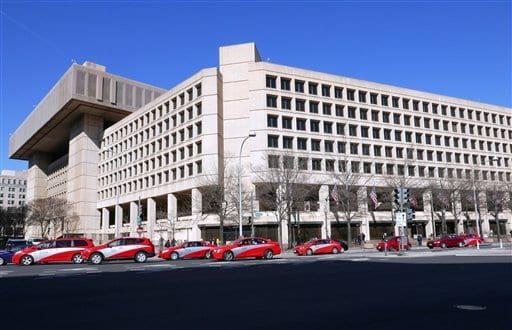
Trump’s executive order in December, titled “Promoting Beautiful Federal Civic Architecture,” disparaged the modernist architectural styles of some federal buildings as “ugly” and a jarring contrast with local architectural styles. The Trump administration hailed Greco-Roman-inspired buildings as an important homage to democracy in antiquity.
The executive order, signed in the final moments of the Trump presidency, promptly met condemnation from architects as aesthetically myopic, though it had relatively weak enforcement. The order only placed a preference for classical styles in future buildings and did not outright ban brutalism.
The lede of the article was “Brutalists, rejoice!”
Headquarters of the Federal Bureau of Investigation, FBI, The J. Edgar Hoover Building at 935 Pennsylvania Avenue NW in Washington, D.C., Thursday, March 23, 2017. Construction finished in September 1975, and President Gerald Ford dedicated the structure on September 30, 1975. (AP Photo/NewsBase)
It’s one thing when the media misses a key detail, or mishears a quote, or otherwise craps the bed. That’s just reporters screwing up. But this whole “whipping” thing is a deliberate lie. And now that the lie has been exposed, the media is workshopping alternate lies to replace it. It’s all garbage. Those Border Patrol agents did nothing wrong.
If you tell the truth about Hunter Biden’s laptop, you get banned by Silicon Valley. If you lie about the Border Patrol, you get quoted by the president.
If politicians and “journalists” will lie about what you’ve seen with your own eyes, what else will they lie about? An entire generation has been taught there’s no such thing as objective reality, and this is what happens when they enter the workforce.
Just think of the media as Democratic Party operatives with bylines, and it all makes sense.
Mayorkas finally got a rather obvious and long overdue question from the media. Fox’s Chris Wallace asked him why weren’t they building a wall to stop an obvious stream of people crossing, as happened in Del Rio? Suddenly, Wallace realized when he saw the pictures, how the wall can have great utility.
“It is the policy of this administration: we do not agree with the building of the wall,” Mayorkas said. “The law provides that individuals can make a claim for humanitarian relief. That is actually one of our proudest traditions.”
Apparently entering illegally is a “proud tradition” to the Biden administration.
As David Frum tweeted in 2018 regarding the left hurling the F-bomb at the Trump administration, “If liberals insist that enforcing borders is a job only fascists will do, then voters will hire fascists to do the job liberals won’t.” And American voters on the right have gotten used to be called fascists at election time for over 70 years. (By those wishing to impose socialism on a national scale, curiously enough.)
“It is the policy of this administration: we do not agree with the building of the wall,” might be very good GOP soundbite material for the midterms and/or the presidential election cycle.
AND THE HITS JUST KEEP ON COMING: John Hinckley, Who Shot President Reagan, to Be Granted Unconditional Release. “The Justice Department agreed to a settlement but will monitor Hinckley for nine months to ensure he remains mentally stable, as he will be living on his own for the first time in about 40 years and because one of his primary doctors is set to retire and dissolve Hinckley’s therapy group. The department said it would file a motion with the court before June if it had new concerns, according to NPR.”
The Norwegian government abruptly announced Friday that most of the remaining coronavirus restrictions would be scrapped beginning Saturday and that life in the nation of 5.3 million would return to normal.
The unexpected announcement by outgoing Prime Minister Erna Solberg to drop coronavirus restrictions the next day took many Norwegians by surprise and led to chaotic scenes in the capital, Oslo, and elsewhere in the country.
“It has been 561 days since we introduced the toughest measures in Norway in peacetime,” Solberg said on Friday at a news conference. “Now the time has come to return to a normal daily life.”
Rowdy celebrations by hundreds of citizens across Norway started Saturday afternoon and lasted until the early hours of Sunday. Police said unrest was reported in several places, including in the southern city of Bergen and the central city of Trondheim, but the situation was the worst in Oslo.
The photo accompanying the article, showing Norwegians politely queuing up and riding scooters on an Oslo street on Saturday night doesn’t exactly illustrate the “human sacrifice, dogs and cats living together — mass hysteria!” story AP is trying to sell.
A few months ago, Vox co-founder Ezra Klein excused [How to Blow Up a Pipeline author Andreas Malm’s] suggestions for terrorist bombings of oil pipelines in a New YorkTimescolumn titled “It Seems Odd That We Would Just Let the World Burn.” When asked whether Klein’s worries that poor people would be harmed by ecoterrorism on infrastructure are founded, Malm once again claimed the ends justify the means.
“If you engage in property destruction that causes such disruption to prices, you run a risk of alienating people, but I think that if people go about this in a careful fashion, and if they time property disruption of this sort to moments when the impact of the climate crisis are being felt, there would be a decent chance to also gain popular support for these kind of actions,” he said.
The host then asked how Malm would avoid Fox News labeling his actions as eco-terrorism, to which the author replied, “Well, I don’t think that we should adapt our tactics after the enemy’s script.”
Just as a reminder of how eco-terrorism is on the minds of many leftists, the LA Review of Books and the New Republic also wrote favorable reviews to Malm’s book.
In what appears to be another incident in a string of hate hoaxes in the past several months, the former part-time Emory staff member is accused of vandalizing the university’s Autism Center with racist and antisemitic graffiti in early August.
According to the Daily Wire, racial slurs were written near the workspace occupied by two African-American women. There was also a swastika painted near the office of a Jewish individual. In addition, a glass door had been ruined and nearby vending machines were damaged.
SOCIAL DEMOCRATS BEAT MERKEL’S PARTY IN TIGHT GERMAN ELECTION: “Germany’s Social Democratic Party (SPD) won a narrow victory in Sunday’s general election, topping the outgoing Chancellor Angela Merkel’s Christian Democratic Union (CDU) in the race to replace her after she stepped down following 16 years in power. It was the worst ever showing for the CDU. However, the slim margin of 1.6 percentage points separating the top two parties means that both could potentially form a ruling coalition and it could take weeks or months of horse trading before a new government takes shape.”
Along with suspense, horror, and romance, Hitchcock movies depict cinematically another basic human sentiment, and do so better than any other filmmaker has done: anxiety. Donat in The 39 Steps, Grant in North by Northwest, James Stewart and Doris Day in the remake of The Man Who Knew Too Much, and other characters in Hitchcock movies find themselves in a world whose physical features are familiar but in which they are buffeted by sinister forces that they do not understand and cannot control. Their world has suddenly and unexpectedly become both baffling and frightening. They have, somehow, to navigate their way to safety in a threatening environment.
This is the stuff of nightmares, and Hitchcock evokes them vividly. Truffaut observes at the end of their series of interviews:
It might be said that the texture of your films is made up of three elements: fear, sex, and death. These are not daytime preoccupations, like in films that deal with unemployment, racism, poverty, or in the many pictures on everyday love conflicts between men and women. These are night time anxieties, therefore, metaphysical anxieties.Hitchcock’s fundamental subjects are the distressing feelings that human beings, no matter how successfully they repress them when awake, cannot escape in their sleep. That is why, one hundred years after he began and forty years after he died, Alfred Hitchcock’s films remain, in their way, inescapable.
Hitchcock’s best films were built with bravura editing, such as the classic symphony orchestra scene in the remake of The Man Who Knew Too Much:
No wonder François Truffaut was so eager to interview him — these sorts of scenes became the textbook for future Hollywood editors. And as James Lileks would note, there’s an obligatory Star Trek connection as well in the above scene, courtesy of actor Reggie Nalder, the film’s sinister assassin.
InstaPundit is a participant in the Amazon Services LLC Associates Program, an affiliate advertising program designed to provide a
means for sites to earn advertising fees by advertising and linking to Amazon.com.