
PATRICK STEWART’S PICARD WAS LIBERALISM’S LOST PROMISE:
Patrick Stewart’s death at the age of 86 has prompted tributes to both the brilliant actor and the famous role that defined him: Star Trek’s Jean-Luc Picard. Matthew Yglesias, centrist liberalism’s inescapable pundit, today called the character “the single most compelling vision of progressive politics I am familiar with: secular, rational, compassionate, egalitarian, committed to abundance and self-improvement”. It’s an affectionate tribute with an awkward implication. Why does a television captain from the Eighties still offer a more ambitious political vision than the people governing us?
Picard ran a starship the way a certain kind of person imagines a good government should be run. He gathered his senior staff around a conference table, heard everyone out, weighed the ethics, and only then said: “Make it so.” He preferred negotiation to force, treating photon torpedoes as a last resort. With his Shakespearean quotations and patrician bearing, he embodied authority with authoritarianism apparently filtered out — intelligent, humane, cosmopolitan — and he arrived in September 1987, just in time for the end of history.
Two decades later, a good chunk of America thought it had elected a real-life version of Picard mixed with the West Wing’s Josiah Bartlet, another symbol of enlightened liberalism. Barack Obama has never hidden his Trekkie credentials. He once flashed the Vulcan salute in the Oval Office alongside Star Trek actor Nichelle Nichols. While guest-editing WIRED in 2016, he credited the show with influencing his worldview, particularly its optimism that people could overcome their differences and build a better future together. His Trek, to be fair, was the Sixties original, and pundits duly cast him as Spock, the unflappable Vulcan surrounded by hotheads.
Of course leftist pundits compared Obama to Spock, and Barry was happy to agree with the extremely flattering assessment. Back in April though, “George MF Washington” wrote: Misunderstanding Mr. Spock.
Spock is a Vulcan, an alien race which long ago physically and mentally rejected emotions, embracing stoic lives of pure logic. For the Vulcan, this lifestyle is not a choice, it is an evolutionary response to a devastating ancient war fueled by base emotions which almost destroyed the Vulcan civilization. Vulcans are, to coin a phrase, “born this way.” One way to look at this backstory is to see the Vulcan lack of emotion not as something aspirational, but as an unfortunate byproduct of civilizational trauma. In a very real sense, the Vulcan race has been fundamentally broken by its violent past.
And indeed, a recurring theme in the original series was Spock’s frustrating attempts to understand the complexity of human emotions and specifically why those emotions often seemed to give Captain Kirk an advantage in his dealings with the various “no-win” scenarios in which the crew of the Enterprise routinely found themselves. Throughout the now 60-year history of the original show, Spock understood that not being able to experience or express emotions could sometimes be a detriment to his ability to complete the mission, a realization which left him conflicted, both wanting to feel what humans feel while also being unable to allow himself to do so because of his unique ancestry. It was Spock’s stunted emotionality (Spock is actually half-human, having been born of a human mother) which often caused him to fail in scenarios where the highly-emotional Captain Kirk was able to succeed by virtue of his vital humanity.
And this, finally, is the beating heart of modern Progressives’ fundamental misunderstanding of what “Star Trek” is… Spock has never existed in the “Star Trek” universe to prove to the audience how important diversity is, or to “hold up a mirror to our society,” Spock exists to show the audience how awesome humans are by comparison. That is his purpose on the show. He is a storytelling device, there to show us through his emotional deficiencies that there is something special, something indefatigable about the innately emotional human race.
It has always struck me as darkly comedic when Progressives compare Barack Obama favorably to Mr. Spock, rejoicing in the wake of his 2008 election that finally the emotionless coldly rational science officer had replaced the cowboy Jim Kirk figure in the White House, because fans who actually know the show understand that Spock’s emotional deficiencies made him fundamentally unfit for command… the irony being that Mr. Spock himself understood this fundamental truth too, even if those who are currently in charge of the “Star Trek” universe do not.
While Obama may have been compared to Spock, while in office, he wasn’t exactly trying to transform American into Gene Roddenberry’s utopian vision of the United Federation of Planets: President Obama’s Disastrous Record on Race.
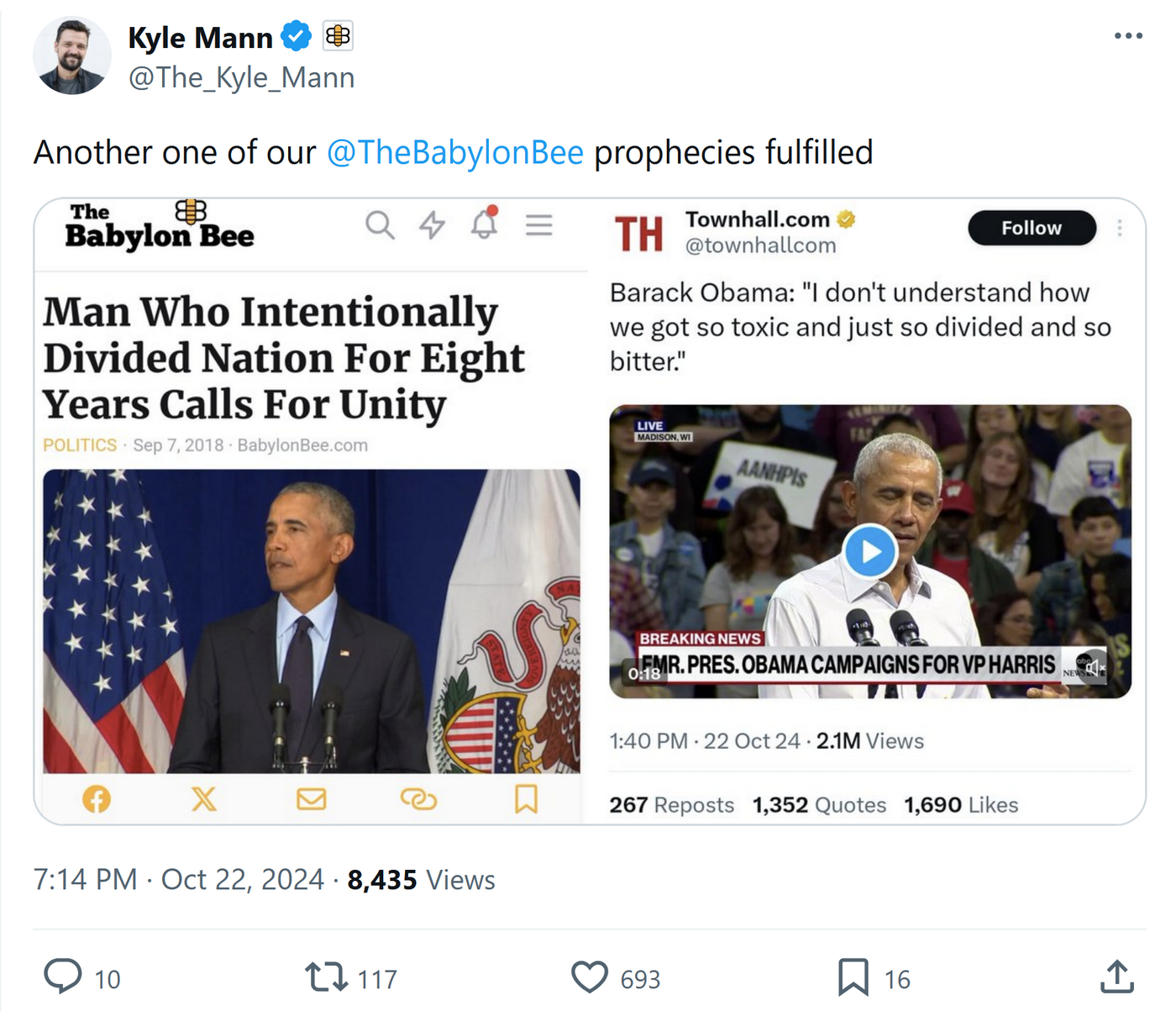
UPDATE:
BOOM! 🔥
Brandon Gill just EXPOSED Obama’s fake “unity” garbage:
He weaponized the IRS, spied on Trump, and insulted half the country—now he wants peace? Give me a break.
Gill is fearless, calls out the Democrat BS, and doesn't back down.
A massive rising star. More of this,…— Ryan Fournier (@RyanAFournier) October 31, 2026