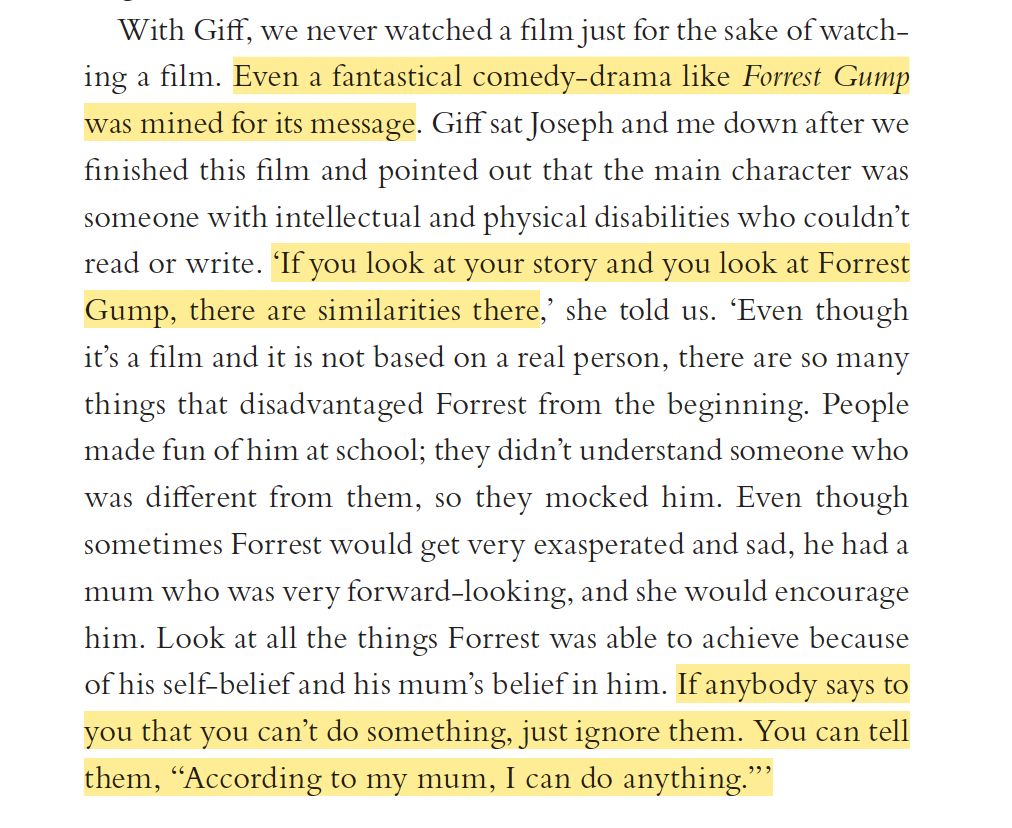
Perhaps the most obvious comparison between Arday’s story and a fictional tale concerns Forrest Gump. The classic 1994 film features a boy compromised by both mental and physical handicaps, who, thanks to the enduring love of an unflappable, aphorism-spouting mother who dismisses the doctors who write him off, breaks free of his shackles, becomes a long-distance runner, and goes on to secure his triumphant place in history. In his memoir, Arday directly compares his inspiring life story to the “fantastical” film. He cites his unflappable mother, who is herself a font of the sort of self-help sayings women embroider on pillows, pointing out the “similarities there.
Arday fully acknowledges in his book the remarkable parallels between his life and Forrest Gump’s, quoting his mother, Giff, pointing this out.
Prone to fixations, autistic people often become superfans of narrow slivers of pop culture and other arcana. Research shows they also have a tendency to engage in “scripting”—memorizing and rehearsing, for example, lines from films or TV and weaving them into their everyday lives—and can form strong parasocial bonds with fictional characters. This can help them mirror and better comprehend real-life emotions.
Referring in particular to the penchant among people on the spectrum for role-playing games, Liam Cross, an autism researcher at the University of Plymouth’s school of psychology, told the Free Beacon: “Not only can this act as a way to scaffold social learning, but we see what’s called ‘bleed,’ where parts of the character one is playing and the self start to merge together and overlap.”
Gray Atherton, who is Cross’s Plymouth colleague, said: “One possibility of an individual ‘confusing’ fantasy with reality could be that if an individual spends an inordinate amount of time engaging with a fictional world or characters, they may begin to relate to those characters or story in a way that can feel ‘real.'” But Atherton cautioned: “It would be a stretch to characterize autism as a condition that would mean an individual genuinely confuses their own lived experience with those in a TV show, movie or book.”
Newton is remembered now as a great genius, which he was. He was also a peculiar man. He was famously rude and antisocial, with little apparent interest in friendships or romantic relationships. He was obsessed with his work, which included theology as well as natural science, and he would labor on a problem for days without food or sleep. An assistant who worked for him for five years saw the great man laugh only once: when someone asked Newton why anyone would want to study the mathematics of Euclid. His was a mind that not only voyaged “through strange seas of thought,” but did so—as Wordsworth understood—alone, for all his life. Brilliant people are not like the rest of us.
I wonder how Newton would fare in the Cambridge of today. Would he be able to negotiate funding applications? HR? Student politics? Would he demonstrate social grace, prudence and a veiled but also irrepressible drive toward acquiring power within the institution? Would he use the correct pronouns, honor the correct identity groups and keep perfectly within the confines of the Overton Window at all times? Would he succeed as a 21st-century academic? Something tells me he wouldn’t.
Nahh, Sir Isaac would be right at home in 21st century Cambridge. The Grauniad assures me that Arday was simply a strange one-off who somehow beat the long odds against him and stumbled into the university (albeit with the BBC there to videotape his arrival, along with the head of the university’s faculty of education declaring him, “the best in the world in terms of the research that you do.”)
Now the Guardian is obsessively delving into the backstory of the Arday saga, to reinforce the ‘one bad apple’ theme and quietly obscure the structural problem of which the paper is itself a part: the ideological capture of culture and intellectual life. https://t.co/yjJ2s0eGrX
UPDATE: Grauniad still continues to assume Arday was a one-off. Tweet continues, “Did they not consider that students were doubtlessly being damaged and — when it eventually came out — so would sociology and the reputation of black academics? It seems second and third order consequences weren’t their strong points.”
InstaPundit is a participant in the Amazon Services LLC Associates Program, an affiliate advertising program designed to provide a
means for sites to earn advertising fees by advertising and linking to Amazon.com.