WHAT DO YOUNG PEOPLE REALLY WANT? The Suburbs.
Suburbs serve a critical role in the American system. They are our way of reconciling our competing aspirations. The U.S. was imagined as an extended, commercial republic. That is kind of like asking for a “jumbo shrimp land mammal.” How to combine ancient republican virtue with modern industry, across a vast continent? And yet, to a surprising extent, our double oxymoron has worked.
A lifestyle once reserved for royalty can now be attained by used-car dealers and advertising executives. A typical American may never become president or a CEO, but can vote, run for city council or school board, own a single-family home in a safe neighborhood, buy a pickup truck, and even start a business out of the garage. And in stark contrast to our European counterparts, we can even enjoy working air-conditioning while we’re at it. We are kings and queens of the cul-de-sac.
This is a beautiful, even noble thing. And besides, what’s the alternative? A rural lifestyle may appear attractive on a screen. Yet these days, it seems like you need to be a large corporation or an Instagram influencer just to make the economics work. Cities are a good place to get ahead, but settling down and raising a family in one presumes a kind of competent urban governance that is shamefully rare in the U.S.
In the end, the American dream simply is suburbia. And if we want Americans to keep believing in the American dream, policymakers at all levels must stop inhibiting young people’s suburban aspirations.
As Tom Wofe wrote in his epochal 1976 article on “The ‘Me’ Decade:”
I can remember what brave plans visionary architects at Yale and Harvard still had for the common man in the early 1950s. (They actually used the term “common man.”) They had brought the utopian socialist dream forward into the twentieth century. They had things figured out for the workingman down to truly minute details such as lamp switches. The new liberated workingman would live as the Cultivated Ascetic. He would be modeled on the B.A.-degree Greenwich Village bohemian of the late 1940s—dark wool Hudson Bay shirts, tweed jackets, flannel trousers, briarwood pipes, good books, sandals and simplicity—except that he would live in a Worker Housing project. All Yale and Harvard architects worshiped Bauhaus principles and had the Bauhaus vision of Worker Housing. The Bauhaus movement absolutely hypnotized American architects, once its leaders, such as Walter Gropius and Ludwig Miës van der Rohe, came to the United States from Germany in the 1930s. Worker Housing in America would have pure beige rooms, stripped, freed, purged of all moldings, cornices, and overhangs—which Gropius regarded as symbolic “crowns” and therefore loathsome. Worker Housing would be liberated from all wallpaper, “drapes,” Wilton rugs with flowers on them, lamps with fringed shades and bases that looked like vases or Greek columns. It would be cleansed of all doilies, knickknacks, mantelpieces, headboards, and radiator covers. Radiator coils would be left bare as honest, abstract sculptural objects.
But somehow the workers, incurable slobs that they were, avoided Worker Housing, better known as “the projects,” as if it had a smell. They were heading out instead to the suburbs—the suburbs!—to places like Islip, Long Island, and the San Fernando Valley of Los Angeles—and buying houses with clapboard siding and a high-pitched roof and shingles and gaslight-style front-porch lamps and mailboxes set up on top of lengths of stiffened chain that seemed to defy gravity and all sorts of other unbelievably cute or antiquey touches, and they loaded these houses up with “drapes” such as baffled all description and wall-to-wall carpet you could lose a shoe in, and they put barbecue pits and fish ponds with concrete cherubs urinating into them on the lawn out back, and they parked 25-foot-long cars out front and Evinrude cruisers up on tow trailers in the carport just beyond the breezeway.
And the left are still furious about what Wolfe later dubbed the “Escape to Islip,” as Russ Greene notes in his Free Press article:
And the theft of the suburban dream has even more to do with local policy than state and federal regulations. NIMBYism, or local opposition to new development, has reduced and sometimes zeroed out the amount of developable land in many areas, driving home prices skyward.
It gets worse. Environmentalists and urbanists are often explicitly opposed to pillars of suburbia, such as sprawl and cars. And the surging Democratic Socialists of America are prone to seeing American suburbs as the root of all evil. The left-wing vanguard’s ideas may not be broadly popular, but thanks to our political system, it can exert outsize influence on policy outcomes.
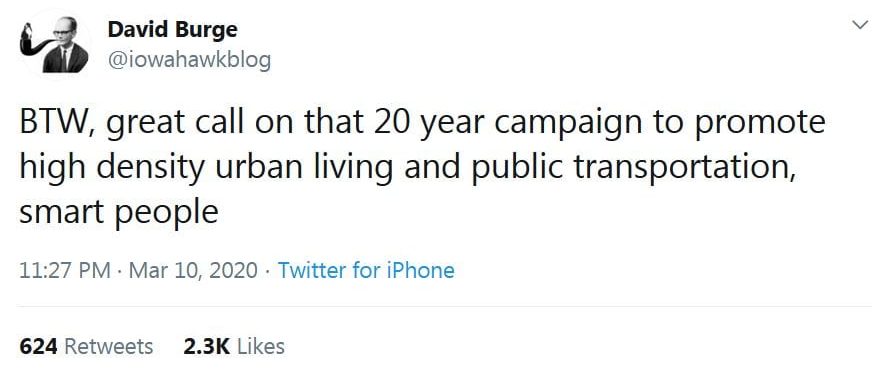
Yes, that worked out well in 2020: