
KONSTANTIN KISIN: How America’s Racial Politics Poisoned Britain.
To understand how we got here, you have to understand what the post-Floyd “reckoning” actually did to British institutions—especially the police. The response to Floyd’s death wasn’t merely emotional, nor was it just symbolic. It was ideological, and it was systematic. Police forces across the country, including the one that attended Henry’s murder, underwent mandatory diversity and anti-racism training. A page still on the force’s website today states that its officers are committed to “ensuring Hampshire & Isle of Wight Constabulary . . . is anti-racist in all it does.”
The principle drilled into officers, explicitly or implicitly, was that accusations of racism must be taken with the utmost seriousness—that the historic failure of institutions to believe minority victims of racism was the original sin, and it needed atoning for.
Racism is bad. Attempting to address it is good. The problem is what happens when you apply the concepts of anti-racism without real-world judgement: You train officers to weigh an allegation of racism so heavily that it overrides the evidence in front of their eyes. You produce exactly the outcome we saw in Southampton—a man bleeding to death on the pavement, begging for help, being told by the officers who should be saving his life that they don’t think he’s been stabbed.
What is particularly striking about this case is the way it mirrors, almost exactly, the injustice that movement was supposedly designed to prevent. George Floyd died saying “I can’t breathe” while a police officer knelt on his neck. Henry Nowak died saying “I can’t breathe” while police officers, kneeling on his back, handcuffed him. The British establishment that wept for Floyd has been conspicuously quiet about Nowak. Politicians who marched through London’s streets in 2020 have not rushed to the cameras. The corporations that changed their logos and funded diversity initiatives have not issued statements.
In his 2000 book, The Abolition of Britain, Peter Hitchens wrote:
Too often this era is dismissed lightly with the old cliché that the American troops were ‘overpaid, oversexed and over here’. Thanks to David Reynolds’ book Rich Relations: The American Occupation of Britain 1941–45, we now have a serious account of this immensely influential period in the national life, one which changed the British people’s view of themselves and turned the eyes of millions towards America as a place where life was more abundant and less bound in by history, tradition and class. More than fifty years after the American forces left, the radical journalist Jonathan Freedland urged in Bring Home the Revolution that this country should introduce American democratic methods and become a republic on the U.S. model. But what the British common people actually liked about America was its way of life, its food, its music, its language and its classlessness, not its way of choosing its town council, its judges or even its head of state.
They had already been exposed to a rather lurid idea of America through the cinema—even in the 1920s and 1930s it was noticeable that working-class audiences preferred American movies, while the middle class were happier with British-made films. Now real Americans, in huge numbers, arrived to live amidst the British.
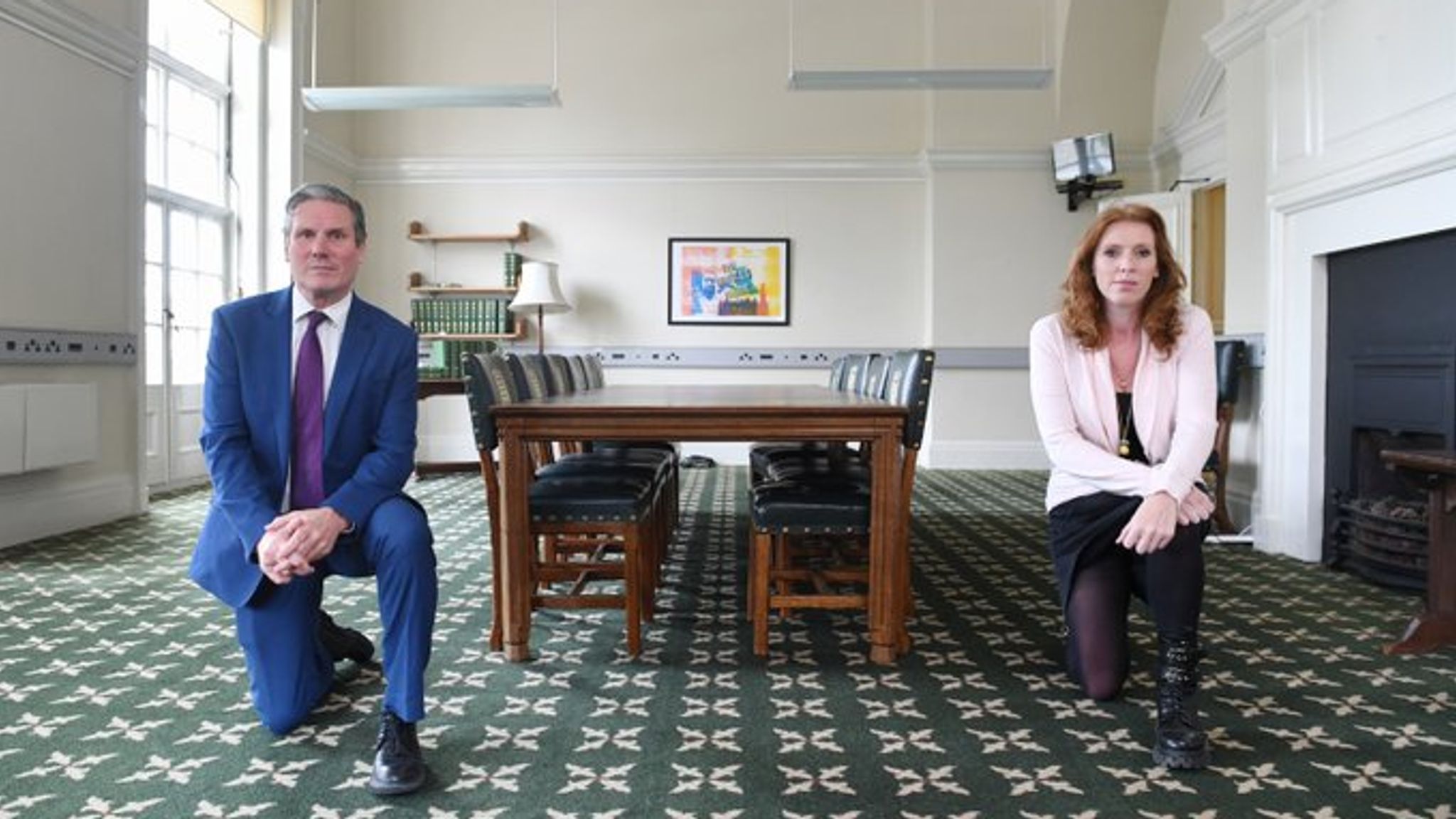
Fast-forward to 2020: George Floyd death: Labour leader Sir Keir Starmer takes a knee in support of Black Lives Matter movement.
UPDATE: “The race card would not have been used by the perps — indeed it would not even have been imagined by them — had it not been manufactured and indeed subliminally advertised,” Richard Fernandez tweets. “Two knives were plunged into the dying student that night. First the physical blade now in some evidence room. But there is a second political one and it is still loose on the streets.”
The reason Digwa's family played the race card in the Nowak murder was because they knew they it would likely work. And it did. They were aware the card existed as did everyone who has not been living under a rock.
That is why this incident should not only or even primarily be…
— wretchardthecat (@wretchardthecat) June 2, 2026
MORE:
The live streams just went dark.
British citizens protesting the death of Henry Nowak. YouTube shut them down mid-broadcast. Starmer's government is actively censoring protests about a child who died in police handcuffs while his killer walked free.
This is happening now.… pic.twitter.com/CRP9REuT7p
— Christian (@InTheTrenchesUK) June 2, 2026
Tweet concludes, “This is happening now. Real-time suppression. The cover-up is not history. It is happening in front of you. A British Prime Minister is silencing his own people to protect a narrative that kills children. Let that sink in. Then scream.”
UPDATE (June 3rd, 12:45 am): And thus, 2020 comes full circle:
This is the first time in my life I’ve seen protesters chant this and it’s actually been valid. https://t.co/PiXuN7lFIC
— Savanah Hernandez (@Savsays) June 2, 2026
We did it. We've gone full circle. The left is now unironically saying "all lives matter". Only 6 years on from George Floyd.
10/10. https://t.co/onaHOccm7t
— Loïc (@Fremond_) June 2, 2026