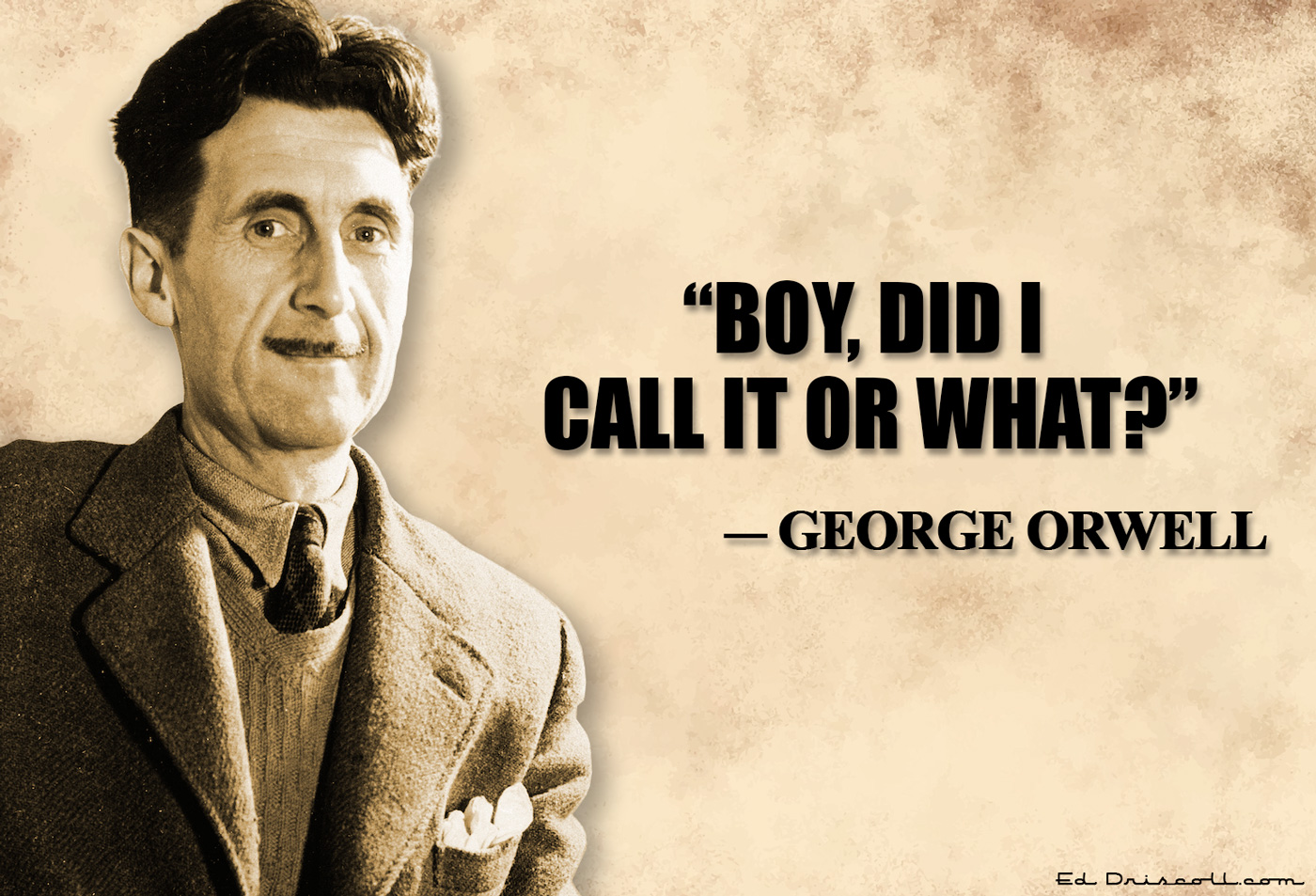
STEVEN PINKER IN THE AIRSTRIP ONE LONDON TIMES: 1984 revisited: George Orwell would be relieved at how we’ve done.
When I first read Nineteen Eighty-Four in 1967 at the age of 13, I was intrigued by its implied prophecy. This futuristic novel specified the year in which it was set in its title, a year I would live to see. What would life be like in 1984? And how would the novel be received once the year had elapsed, set in a future that then would be past?
We are now more than 40 years past the time in which the book was set and almost 80 years after it was written. This raises an irresistible question: how much is the world of 2025 like the world of 1984 as imagined in 1948?
Of course, Orwell wrote Nineteen Eighty-Four not as a prophecy but as an extrapolation and a warning. As he explained: “I do not believe that the kind of society I describe necessarily will arrive. But I believe, allowing, of course, for the fact that the book is a satire, that something resembling it could arrive.”
Did it arrive? It’s instructive to assess Orwell as a prophet. For one thing, it can be a reminder of the limits of prophecy. Even the predictions of the world’s most accurate forecasters, when tested against prespecified dates and outcomes they can’t weasel out of, fall to chance levels about five years out. It would be unreasonable to expect Orwell to do much better.
Comparing 1948 with 1984 and 2025 is also a way to understand the history we’re living through beyond the short time horizon of journalism. If the news came out once every 50 years instead of every day, it surely wouldn’t cover celebrity gossip and politicians’ gaffes but rather sweeping developments we might be oblivious to as they gradually unfold. Looking back at the future is a way to see our era in historical perspective.
Given that the British police routine arrest people for posing with a shotgun in Florida, writing anti-immigration tweets, confiscating their kid’s iPad, insulting their school board on WhatsApp, or calling someone a “faggot” in a text message, while looking the other way at massive grooming scandals, I think Orwell would have some serious questions about the state of England in 2025. But there’s no doubt that economically, and especially technologically, it’s moved far beyond the immediate postwar scarcity in which Orwell wrote his novel. Which was why, in 2007’s Liberal Fascism, Jonah Goldberg concluded:
The twentieth century gave us two visions of a dystopian future, Aldous Huxley’s Brave New World and George Orwell’s 1984. For many years it was assumed that 1984 was the more prophetic tale. But no more. The totalitarianism of 1984 was a product of the age of Stalin, Lenin, Hitler, and Mussolini, the dictators of a continent with a grand tradition of political and religious absolutism. Brave New World was a dystopia based on an American future, where Henry Ford is remembered as a messiah (it’s set in the year “632 A.F.,” after Ford) and the cult of youth that Huxley so despised defines society. Everything is easy under the World State. Everyone is happy. Indeed, the great dilemma for the reader of Brave New World is to answer the question, what’s wrong with it?
There’s a second important difference between the two dystopias: 1984 is a masculine vision of totalitarianism. Or rather, it is a vision of a masculine totalitarianism. Huxley’s totalitarianism isn’t a “boot stamping on a human face—for ever,” as described in 1984. It’s one of smiling, happy, bioengineered people chewing hormonal gum and blithely doing what they’re told. Democracy is a forgotten fad because things are so much easier when the state makes all your decisions. In short, Huxley’s totalitarianism is essentially feminine. Orwell’s was a daddy-dystopia, where the state is abusive and bullying, maintaining its authority through a permanent climate of war and the manufacture of convenient enemies. Huxley’s is a maternal misery, where man is smothered with care, not cruelty. But for all our talk these days about manliness, individualism, and even the “nanny state,” we still don’t have the vocabulary to fight off nice totalitarianism, liberal fascism.
In 2020, we could have used it.