EVERGREEN: The next Republican will always be ‘scarier’ than the last.
The previous looming threat to American democracy not named Trump was Gov. Ron DeSantis (R-FL), who seemed, at one point, to be a serious contender for the role of commander in chief. Back when this seemed like a reality, HuffPo, which declared Trump in 2017 to be the “Most Dangerous Man in the World,” warned that “No One Is More Dangerous For The White House Than Ron DeSantis — Including Donald Trump.” This was similar to when Washington Post columnist Max Boot wrote that “DeSantis is smarter than Trump,” which “may make him more of a threat,” but that was also after he claimed in 2020 that Trump was “the worst threat to our democracy since the 1930s.”
When it wasn’t DeSantis, it was Romney, the great pussycat of American politics, whom Psaki’s old boss once accused of conspiring to put black people “back in chains.”
The former Massachusetts governor was also accused of homophobia, bullying, and cruelty to animals. Romney was even blamed for supposedly allowing the death of a woman who had been diagnosed with cancer.
In 2008, it was GOP nominee Sen. John McCain, who was accused of being possibly more dangerous than even President George W. Bush. The Arizona senator was portrayed as more hawkish, possibly more militant, a “man of the hard right,” and “as slippery and evasive as” Bush. This was a hell of a thing to read even at the time, considering that, up until the 2008 election, McCain had enjoyed a great deal of positive media coverage for his tendency to break with the GOP. But that was then. Now, there was an election to win, and McCain, the onetime maverick of the United States Senate, was supposedly as bad, if not worse, than Bush the “moron” dictator, according to the news media.
John McCain: Worse than a fascist dimwit!
(It’s fascinating now to review such takes, given that McCain has experienced a sort of retrospective image rehab in the press following his defeat and eventual passing in 2018.)
Every Republican president or presidential candidate is Hitler, until he either lost the election or left office, at which point he is rehabilitated, given a new suit, and allowed to leave the Furherbunker — including Eisenhower, who merely defeated the Nazis — as this October 20th, 1952 AP article spotlights:
A letter from Financier Bernard Baruch to Dwight D. Eisenhower expressing admiration for the “high purposes that have motivated you in all circumstances” was made public today by the Republican presidential candidate’s national headquarters.
Baruch, a long time advisor to U. S. presidents, discussed the letter with newsmen by telephone. Newsmen asked Baruch if it meant he was endorsing the Eisenhower candidacy. Baruch called their attention to the fact that he had signed the letter “affectionately,” and said:
“I might have something to say later.”
The letter was dated Aug 7.
After he had said he “might have something to say later” about how he was going to vote, Baruch was asked how he felt about the Truman administration. Without elaboration, Baruch replied: “There can’t be any doubt of what I think of them.”
BARUCH DISAGREES
Newsmen then called Baruch’s attention to a statement by President Truman last Friday Imputing to Eisenhower the condoning of anti-Catholic immigration policies.
Baruch was asked if he agreed with President Truman on this and he replied:
‘I certainly don’t agree.”
In a letter to the Jewish Welfare Board’s national leadership Mobilization for G.I. and community service. Truman said of Eisenhower: “Today, he is willing to accept the very practices that identify the so-called ‘master race.’”
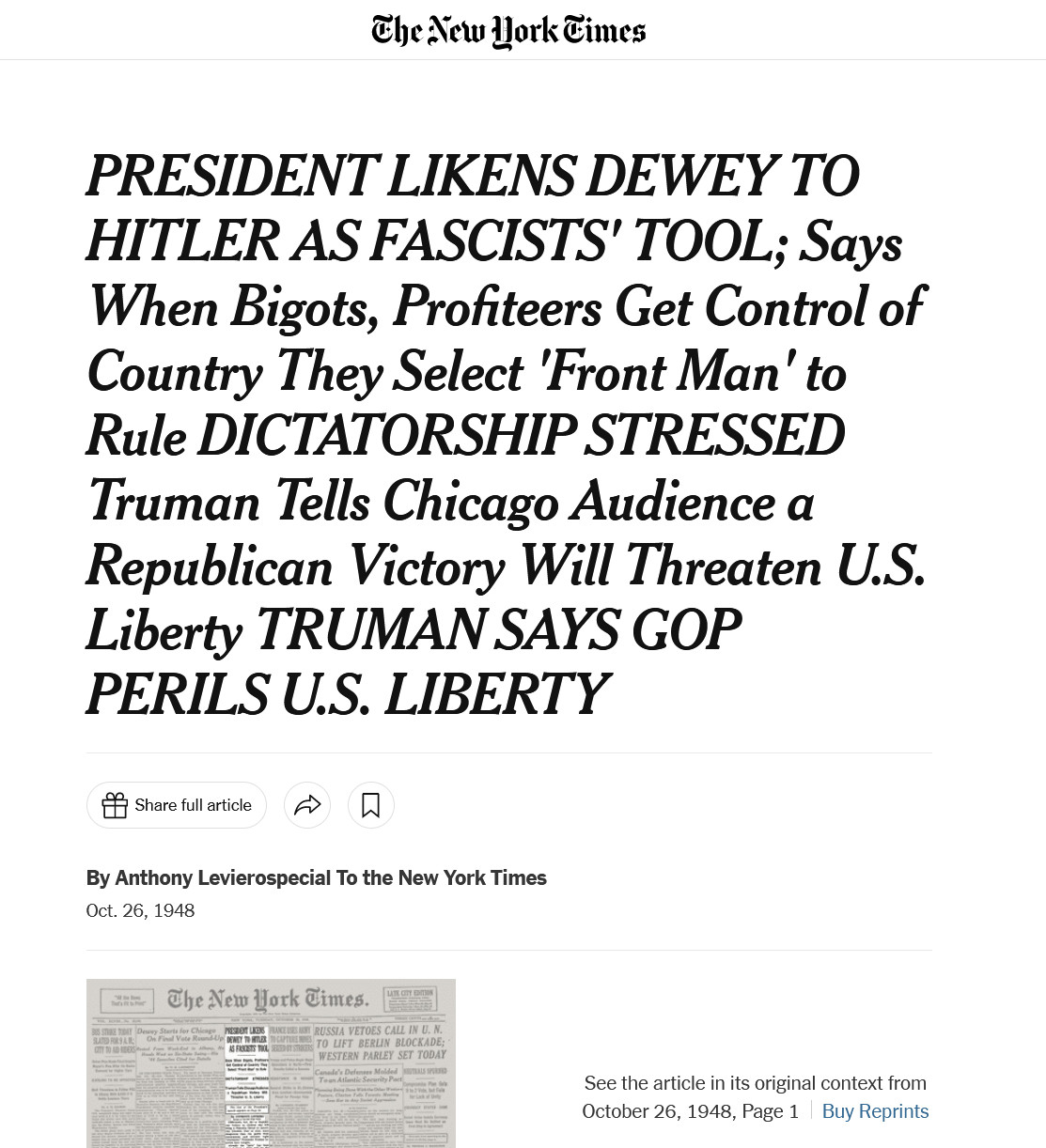
But then four years earlier, Truman trotted out that same smear against that year’s liberal Republican nominee, with of course, ultimately successful results: