
BIG CITY DREAMS: Gayle Chong Kwan is a Brit who is expressing her “political and ecological positioning through [a] fine art practice,” according to the London Observer, which is also allowing Kwan to complain about how expensive a city can be for artists like herself.
As David Thompson adds, “At which point, readers may suspect that the imperative is not so much being creative, but being creative in London, a notoriously expensive city, but in which one can draw attention to the fact that one lives and works in London, a notoriously expensive city. Thereby glowing with a kind of location status.” Thompson also adds that the Observer fails to mention the exciting new artistic medium that Kwan works within. That medium is, err, piles of milk bottles, which she has photographed on her Website, such as these:
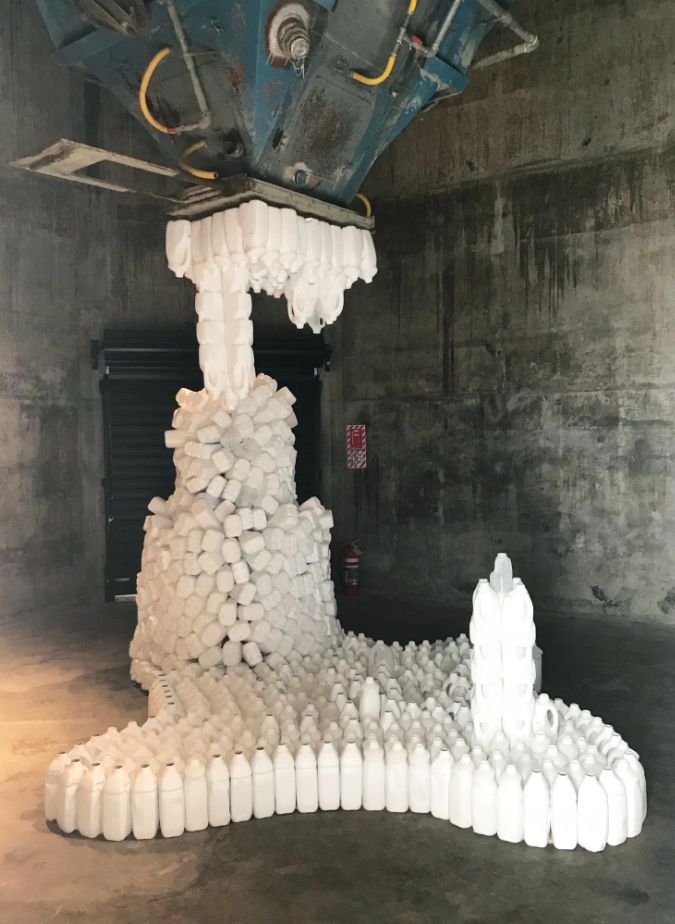
More from Thompson:
Given the aesthetic uplift conjured into being via piles of plastic milk cartons, it is of course astounding that Ms Kwan and her equally high-minded peers, all doubtless schooled in political “positioning,” aren’t feeling sufficiently rewarded.
“It is like a hostile environment now,” says Ms Kwan. A sentiment that may conceivably be shared by those members of the general public who venture to art venues in search of aesthetics and objects of wonderment, but who find only unattractive tat, ponderous press releases, and piles of plastic milk cartons.
If the basic thrust of the Observer article sounds familiar – the need to be seen being creative in a suitably happening city, while living above one’s means – you may be thinking of this Guardian article. In which, a self-exalting novelist named Brigid Delaney tells us that creative people, people much like herself, must live in locales befitting their potential and importance, not their budget. And hence the imperative for public subsidy.
You, taxpayer, come hither. And bring your wallet.
As Tom Wolfe wrote about the deep-seated desire of the American artist to move to Manhattan in The Painted Word:
By 1900 and the era of Picasso, Braque & Co., the modern game of Success in Art was pretty well set. As a painter or sculptor the artist would do work that baffled or subverted the cozy bourgeois vision of reality. As an individual—well, that was a bit more complex. As a bohemian, the artist had now left the salons of the upper classes—but he had not left their world. For getting away from the bourgeoisie there’s nothing like packing up your paints and easel and heading for Tahiti, or even Brittany, which was Gauguin’s first stop. But who else even got as far as Brittany? Nobody. The rest got no farther than the heights of Montmartre and Montparnasse, which are what?—perhaps two miles from the Champs Elysées. Likewise in the United States: believe me, you can get all the tubes of Winsor & Newton paint you want in Cincinnati, but the artists keep migrating to New York all the same … You can see them six days a week … hot off the Carey airport bus, lined up in front of the real-estate office on Broome Street in their identical blue jeans, gum boots, and quilted Long March jackets … looking, of course, for the inevitable Loft…
I’m no expert on all things British, but I’ll take a chance and go waaaaay out on a limb and say that you can all of the milk bottles you want outside of London, as well.