
THE VIEW OF THE WORLD FROM 9th AVENUE, 2026 EDITION: How Problematic Is Patriotism? National pride in America has plummeted in the Trump era. Is it worth trying to salvage?
I did not grow up loving America—not because I thought it didn’t deserve love but because I didn’t think about it. America was the Pledge of Allegiance and “The Star-Spangled Banner.” It was “Maverick” and “Gunsmoke.” It was Ed Sullivan and high-school dances and big cars with big fins. It was soda fountains and Elvis and stickball. It was Valley Forge and George Washington. It was also white, mostly male, and invincibly middle class, and I hardly gave a thought to race or class or much else for that matter.
Depending on where you hail from, America could be the evening sky above Northfield, Connecticut, or the fields of bluebonnets in Ennis, Texas. To a teen-ager living in New York in the nineteen-sixties, America was pretty great. It had saved the world from fascism and now stood as a bulwark against communism. Mickey Mantle, good; Nikita Khrushchev, bad. My memory may be faulty, but I can’t recall anyone I knew declaring a love for America—not, anyway, until I was twenty-five and living in Charleston, South Carolina.
It was the winter of 1973, and the words were spoken by a sixty-eight-year-old Brooklyn native named William McKissack Chapman. Tall and narrow, with stiff gray hair and a thin gray mustache, Bill had been a reporter for the long-defunct Brooklyn Eagle, an editor at Time-Life, and a founder of Sports Illustrated. He’d been too young to fight in the First World War but reported from Europe during the Second. In Paris in 1945, he’d got drunk with Ernest Hemingway, whom he considered a blowhard. Now, nearly thirty years later, in his elegant, slightly shopworn home, at 30 King Street, he was ruminating about Vietnam and Watergate, both of which dominated the news at the time. After a minute or two, he put down his drink and said in a tone at once wistful and firm, “God, I love this country.”
Alas, the New Yorker doesn’t, and apparently, on Memorial Day 2026, wishes, nudge, nudge, wink, wink, that Trump supporters would just get it over with and stab themselves:
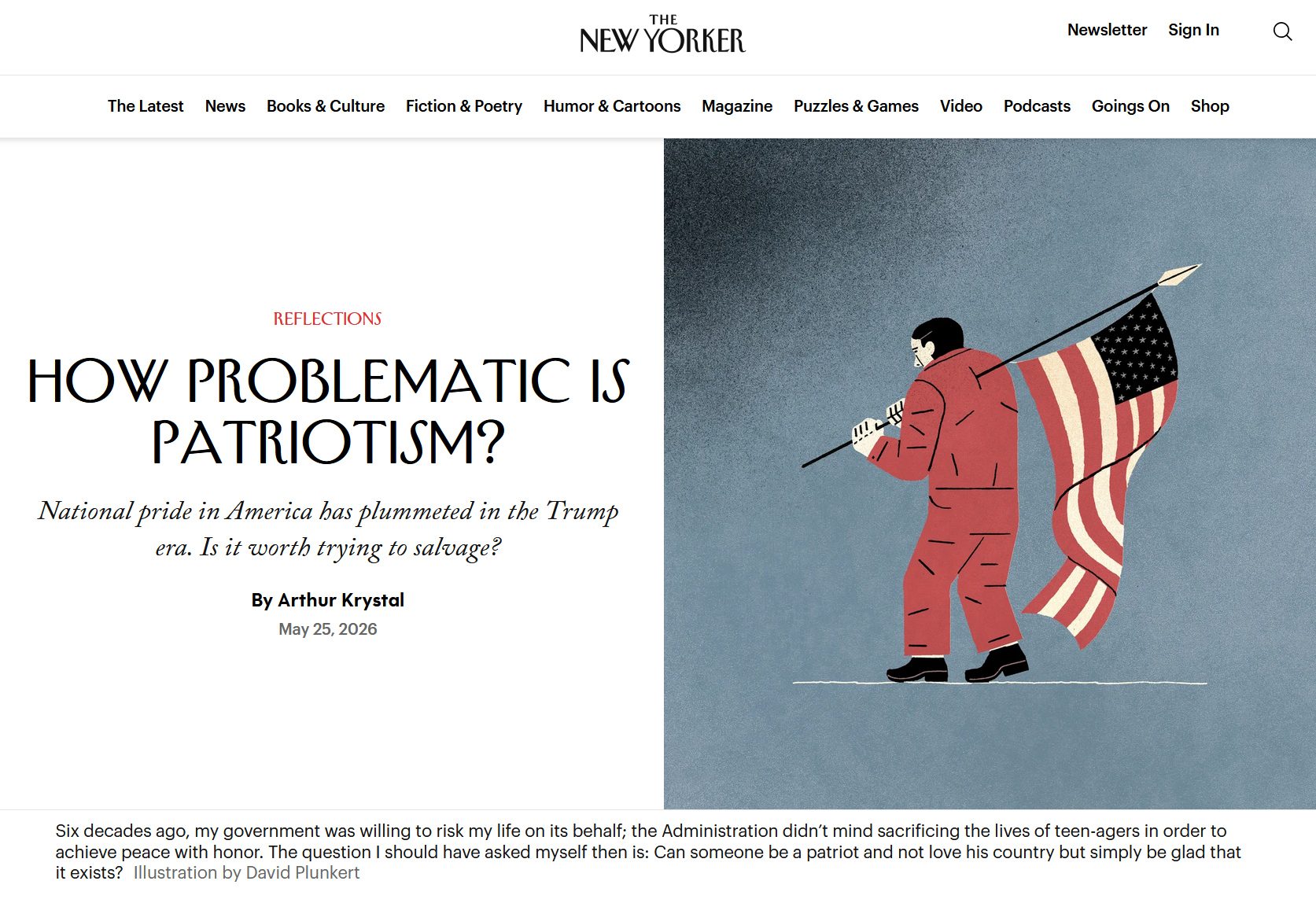
Which seems an odd choice of images, considering the multiple assassination attempts against Trump, and the events of last year:
New Yorker writer claims, astonishingly, to be unaware of a single leftist celebrating Charlie Kirk’s murder pic.twitter.com/MCfnaPVzKT
— Peter J. Hasson (@peterjhasson) September 15, 2025
But actually, for the New Yorker, this may progress of a sort. In the early 1970s, their film critic could scarcely acknowledge that what we would now call Red State voters even existed:
On Friday, on the New Yorker’s website, the magazine’s film editor Richard Brody offers what may be the first accurate version of the quote I’ve ever seen (I’m assuming it’s accurate because it comes from the New Yorker itself): “Pauline Kael famously commented, after the 1972 Presidential election, ‘I live in a rather special world. I only know one person who voted for Nixon. Where they are I don’t know. They’re outside my ken. But sometimes when I’m in a theater I can feel them.’”
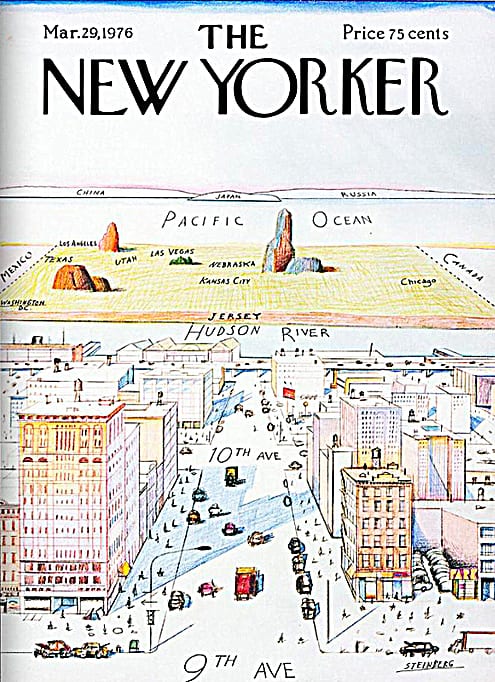
In 1976, Saul Steinberg, the New Yorker’s cover author, summed up that worldview perfectly, with a reminder that most Manhattan residents don’t think that the flyover country that Nixon voters lived in existed, either:
“How Problematic Is Patriotism?” It certainly is for the person(s) who run the Democrats’ X account:
This was take two. The Democrats deleted this, no apology. https://t.co/GJR8YnBNsY pic.twitter.com/hl9WhHmORL
— Brent Scher (@BrentScher) May 25, 2026