
FROM BAUHAUS TO TOM’S HOUSE: James Lileks on architect Louis Kahn.
While browsing through an Architectural Record from 1977, there was a gushing review of the incredibly brilliant Yale Center for British Art by the incredibly brilliant Louis Kahn.
* * * * * * * * *
The British Center’s special site and function surely had something to do with these surprising developments. Directly across the street from it stands the earliest of Kahn’s mature buildings: the first in his great sequence of inventive designs. It is Yale’s Art Gallery of 1953.
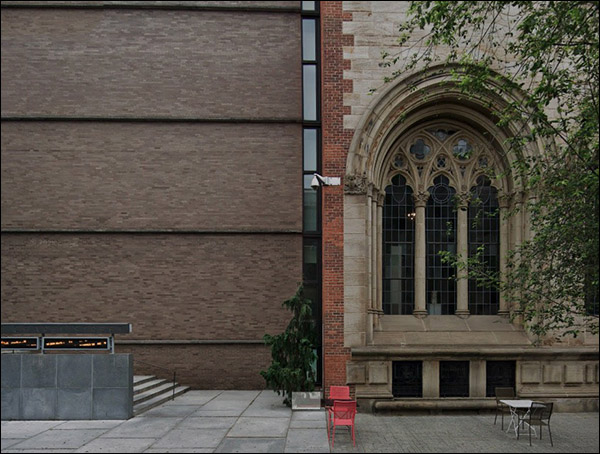
Ah yes. That one. The building that gave us one of the best examples of life before and after the Second World War.
Hint: Kahn’s building is on the left.
You know how many years separate those two structures?
Nineteen.
The building on the right was completed in 1928. The building on the left was begun in 1947.
In From Bauhaus To Our House, Yale man Tom Wolfe wrote:
Yale’s administrators were shocked. Kahn had been an architect for twenty years but had done little more than work as assistant architect, under Howe, among others, on some housing projects. He was not much to look at, either. He was short. He had wispy reddish-white hair that stuck out this way and that. His face was badly scarred as the result of a childhood accident. He wore wrinkled shirts and black suits. The backs of his sleeves were shiny. He always had a little cigar of unfortunate hue in his mouth. His tie was always loose. He was nearsighted, and in the classrooms where he served as visiting critic, you would see Kahn holding some student’s yard-long blueprint three inches from his face and moving his head over it like a scanner.
But that was merely the exterior. Somewhere deep within this shambles there seemed to be a molten core of confidence … and architectural destiny … Kahn would walk into a classroom, stare blearily at the students, open his mouth … and from the depths would come a remarkable voice:
“Every building must have … its own soul.”
One day he walked into a classroom and began a lecture with the words: “Light … is.” There followed a pause that seemed seven days long, just long enough to re-create the world.
His unlikely physical appearance only made these moments more striking. The visionary passion of the man was irresistible. Everybody was wiped out.
Kahn stared at the administrators in the same fashion, and the voice said: What do you mean, “It has nothing to do with the existing building”? You don’t understand? You don’t see it? You don’t see the string courses? They express the floor lines of the existing building. They reveal the structure. For a quarter of a century, those floors have been hidden behind masonry, completely concealed. Now they will be unconcealed. Now the entire structure will be unconcealed. Honest form—beauty, as you choose to call it—can only result from unconcealed structure!
Unconcealed structure? Did he say unconcealed structure? Baffled but somehow intimidated, as if by Cagliostro or a Jacmel hoongan, the Yale administration yielded to the destiny of architecture and took it like a man.
As Wolfe concluded his chapter, “Administrators, directors, boards of trustees, municipal committees, and executive officers have been taking it like men ever since.”