
SMART CITIES WILL KILL FREEDOM:
This same urge might explain the impatience of the smart city urbanist, née venture capitalist, who told The New York Times that “human beings currently live in cities that are the equivalent of flip-phones”. There’s a keen sense of waste; our sheer lack of optimisation offends. Another investor-urbanist, a Mr Huh, complains: “We have not affected the fundamental building blocks of infrastructure and society.” The Times reporter writes that Mr Huh gestured to his laptop and said: “We’ve made this better. We’ve made the new things better. We haven’t made the old things better.” In a helpful gloss, the reporter points out that in thinking about how to make the old things better, “people in tech prize ‘first principles’, a concept that suggests that historical awareness and traditional expertise can get in the way of breakthrough ideas”.
Here we see the old drama of modernism playing out one more time. The urban blank slater reminds us of Thomas Hobbes’ disgust with the customary or common law, that body of precedents and practices that ordered English life, but which appeared to his impatient mind as a sediment of inherited mindlessness. For him, life needed to be governed by laws that would be excogitated from scratch (by him), according to clear principles, not by the haphazard accumulation of informal usages and understandings. Rather than seeking the reasons latent in our unthought practices, and from them trying to reverse-engineer the logic of a city, the smart city epigones of Hobbes place their trust in their own powers of a priori reason.
But governing by syllogism doesn’t work very well. For one thing, the sovereign forfeits that easy, habitual law-abidingness that custom secures. As Thomas Schrock said in his critique of Hobbes: “We follow customary laws, not out of fear, but because they are here with us, our own, part of us.”
Governing by syllogism, on the other hand, requires heavy police work. Call Security!
It sure does, particularly when the smart cities’ residents’ lifeclocks start blinking red:
The 15-minute city idea trades freedom for a life of routine drudgery, mating high-tech with urban density:
This is the horror movie they are bringing to life in your city soon. #15MinuteCity https://t.co/rQXNju2Dzl
— James Woods (@RealJamesWoods) April 1, 2024
But as we saw in 2020, at quite a cost:
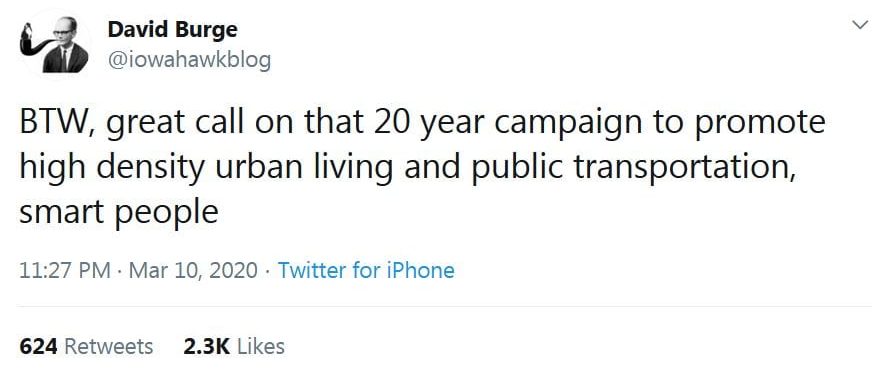
As Glenn wrote in 2020: Coronavirus lessons on density, mass transit, bureaucracy and censorship: They kill.