THE LAST TIME NEW YORK HIT ROCK BOTTOM: “Jonathan Mahler’s first book, the 2005 Ladies and Gentlemen, the Bronx Is Burning, was a work of historical journalism that re-created the summer and fall of 1977… Now Mahler, a staff writer for the New York Times Magazine, is out with a kind of sequel titled The Gods of New York: Egotists, Idealists, Opportunities, and the Birth of the Modern City, 1986-1990:”
Mahler spends a good deal of time on the infamous 1987 Tawana Brawley case, where a young black woman was found in upstate New York covered in feces with racial slurs written upon her body and claiming to have been raped by four white men. The case brought a little-known Brooklyn preacher named Al Sharpton to the public’s attention. Sharpton championed Brawley’s allegations and put pressure on the state’s legal and political authorities to bring her alleged attackers to justice. It all turned out to be a hoax, with Brawley having fabricated the whole story.
Mahler does not shy away from presenting the case in its ugly details, with Sharpton likening Governor Mario Cuomo to the notoriously racist Mississippi politician, Theodore Bilbo, accusing the state’s attorney general, Robert Abrams, of masturbating onto a photo of Brawley, and framing a white New York prosecutor named Steven Pagones of perpetrating the ugly deed. Yet Mahler strangely absolves Sharpton and his allies of guilt, presenting them as victims of white racism, leaving the last word on the hoax to a black Catholic priest from Harlem: “If you create a monster in your lab and then it acts like a monster, I don’t think the creator is in a position to complain.”
If there was a flaw to Mahler’s first book, it was the lack of a larger analysis to accompany the vivid journalistic narrative. With The Gods of New York, Mahler tries to make some larger thematic points, and it is here that the book stumbles. He talks about the decline of the city as a “great working-class city,” which is true up to a point, but The Gods of New York is almost entirely a story of white and black; that millions of immigrants were arriving in New York in the 1980s and 1990s and making lives for themselves during these years goes unsaid.
Most strangely, one could read this book and not realize a renaissance in New York’s fortunes was just a few years down the road under first Giuliani, and then Michael Bloomberg. Giuliani is a main character in The Gods of New York and comes across, not entirely unfairly, as an attention-seeking and politically ambitious U.S. attorney whose prosecutions of white-collar cases often fell apart in the courts. Casual readers might draw an inference from the unflattering portraits of Giuliani and Trump—who during this time was knee-deep in an embarrassing money-losing venture with Atlantic City casinos—that there is a straight line from the politics of the late 1980s, with its corruption, racial tensions, and emphasis on financial capitalism at the expense of the working class, to the era of Donald Trump.
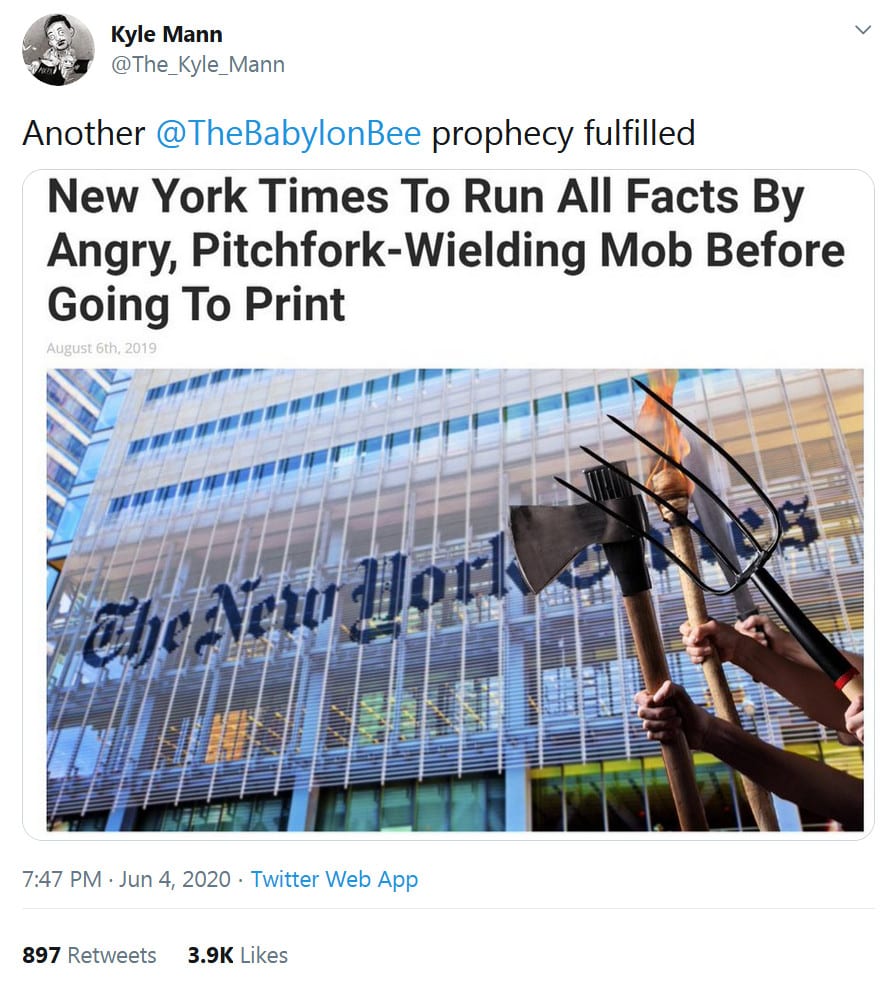
That’s not strange at all. Why would Mahler risk offending his fellow writers in the Times’ bullpen? They had a collective aneurysm over Tom Cotton’s “send in the troops” op-ed in 2020 and railroaded editor James Bennet, Covid expert Donald McNeil and Bari Weiss off the paper that year. As with other Mamdani supporters, they likely share the belief that the Giuliani-Bloomberg era was actually the city’s nadir, not the 1970s, and as the Babylon Bee joked in 2020:
Twenty years ago, when Mike Bloomberg was still its mayor and had carried over most of Rudy Guiliani’s broken windows police methods, Dan Henninger of the Wall Street Journal wrote:
The actor John Leguizamo: New York in the ’70s “was funky and gritty and showed the world how a metropolis could be dark and apocalyptic and yet fecund.” Fran Lebowitz, a contributing editor for Vanity Fair: The city “was a wreck; it was going bankrupt. And it was pretty lawless; everything was illegal, but no laws were enforced. It was a city for city-dwellers, not tourists, the way it is now.” Laurie Anderson, a well-known New York artist and performer, admits the ’70s were considered “the dark ages” but “there was great music and everyone was broke.”
More recently, as Steve wrote in August, thanks to 2025-era Democrats: Yep, Mamdani Will Be NYC’s Next Mayor.
If so, as Michael Goodwin writes at the New York Post this weekend: A Zohran Mamdani mayoralty would mean a long, sour decline for NYC.
It was only after Rudy Giuliani became mayor in 1994 that the police force was fully funded and smartly used.
Giuliani and his team, including top cop Bill Bratton, used the new officers in targeted enforcement campaigns under the revolutionary “broken windows” theory of policing.
The results came fast and were dramatic.
Within four years, the number of murders fell by 60%, with huge declines in other crimes, too.
The pattern continued through Giuliani’s second term and all through Mike Bloomberg’s subsequent three terms as Bloomberg and his top cop, Ray Kelly, kept the same policies and extended and improved them.
The result was a 20-year Golden Age of public safety and economic expansion that transformed New York into the safest big city in America and the world capital of capital.
Jobs and population booms followed, with the city gaining even more people than it had lost.
As I wrote at the time, an elderly friend who had spent his entire life in New York said he had never seen it shine as it did at the end of Bloomberg’s tenure.
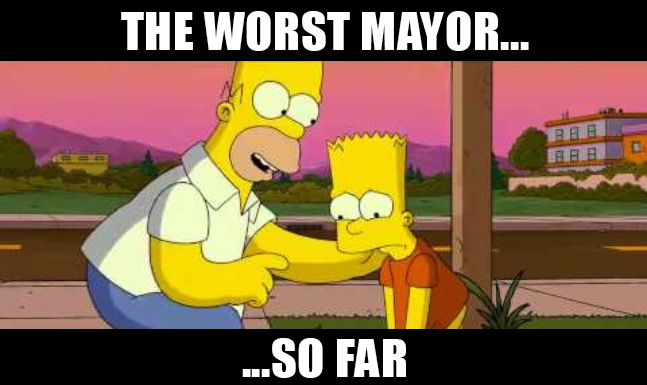
Unfortunately, he was followed by Bill de Blasio, the worst mayor since Beame.
Insert Homer and Bart “worst so far” meme here: