
MARK HEMINGWAY: Hollywood’s Inability To Create Masculine Stars Is Officially A Problem.
Two of the biggest movies this summer are Mission Impossible: The Final Reckoning and F1, starring Tom Cruise and Brad Pitt, respectively. The two movies have something interesting in common — both are star vehicles for men in their sixties. Brad Pitt will be 62 later this year, and Tom Cruise just turned 63 last week.
Pitt and Cruise aren’t exceptions, either. The biggest male movie stars are all aging. Clooney is 64 and McConaughey is 55. Ben Affleck, also out with a big action film this year, is 53 next month, and his buddy Matt Damon turns 55 later this year.
Just a few decades ago, it would have been genuinely hard to imagine that our most viable male movie stars would be so old.
* * * * * * * *
Speaking of Harrison Ford, last week there were reports that Disney will be doing a complete reboot of the Indiana Jones franchise. And interestingly, there was a surprising chorus of responses online to the news: For the love of all that is holy do not cast Pedro Pascal as Indiana Jones, culminating in “has anyone posted a pedro pascal becoming the new indiana jones tweet yet, because i haven’t seen it 500 times in the last two hours already?”
* * * * * * * * *
Setting politics aside, there are other, um, issues. I don’t know what Pascal’s private proclivities are, and I don’t care. Cary Grant, Montgomery Clift, and Rock Hudson were all, uh, not conventional heterosexual actors — but they were discrete and convincingly masculine onscreen. I know a big part of the problem is that Hollywood is now dominated by female executives who think that it’s disarming and cute that Pascal spends all his time on press junkets obsessing over the nail polish of his interviewers. But the memo should probably go out that this guy absolutely cannot be, say, the next Indiana Jones:
To some extent, the problem is a broader cultural shift. You don’t see many men anywhere that even look like tough-as-nails male icons of yesteryear, let alone earned their image for being hard men long before they started acting. If they were around today, Lee Marvin, Robert Mitchum, or Charles Bronson would probably be rejected out of hand for poor Q Score potential or something.
But to put this in terms that liberal Hollywood will understand, masculine men are an underrepresented community that is being discriminated against. We deserve representation and we’re not getting it.
In her 2013 book, Sleepless in Hollywood: Tales from the New Abnormal in the Movie Business, the late Lynda Obst had a chart that laid out in no uncertain terms the type of product that Tinseltown had recently been churning out:
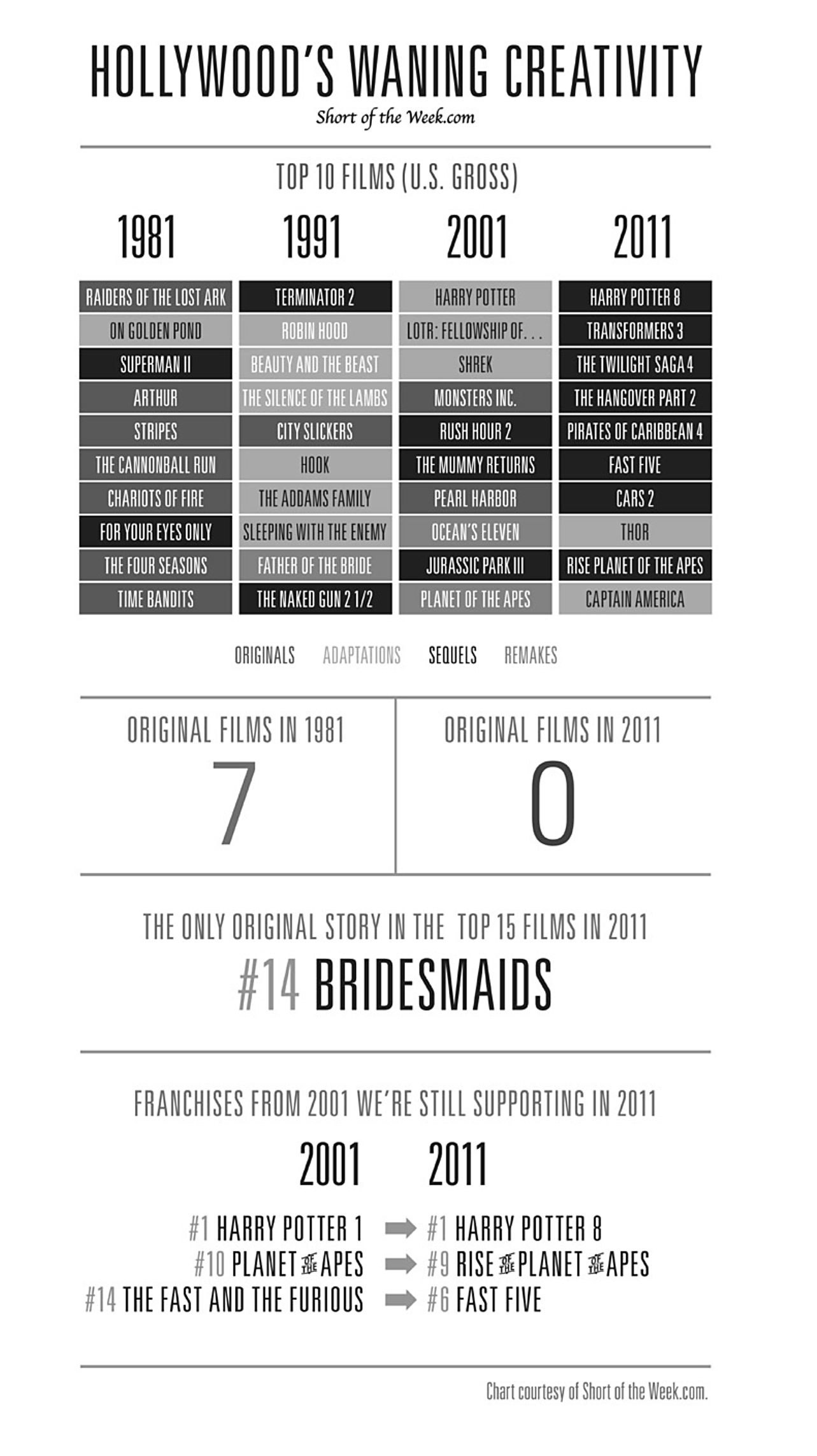
Focusing on sequels and comic book franchises made sense from a business point of view – they’re presold with audiences, and with hundreds of millions of dollars on the line, mitigating the risk that a movie will bomb makes sense. But as late as the 1990s, stars were the insurance that a blockbuster was going to do well in the summer – people still went to see a Schwarzenegger movie, a Stallone movie, a Harrison Ford movie, a Tom Cruise movie, a Clint Eastwood movie, etc. (And did so every summer, like clockwork.)
As they became obsessed with franchises, apparently, the corporations who run Hollywood forgot that they might want to develop some younger stars as well who could carry a movie based on name alone.