
ROLLING STONE’S ‘FACT CHECK’ ABOUT ZOHRAN MAMDANI IS EXACTLY THE PROPAGANDA YOU’D EXPECT:
The Democrats know they have a problem with a guy who says out loud what many of them do actually believe, which is where some in the media are helping them run cover when the commies in their midst say the quiet parts out loud.
The Left can always count on Rolling Stone for assistance with the gaslighting. According to RS, claims about Mamdani having communist leanings are among the “viral and persistent lies” about the possible next mayor of NYC:
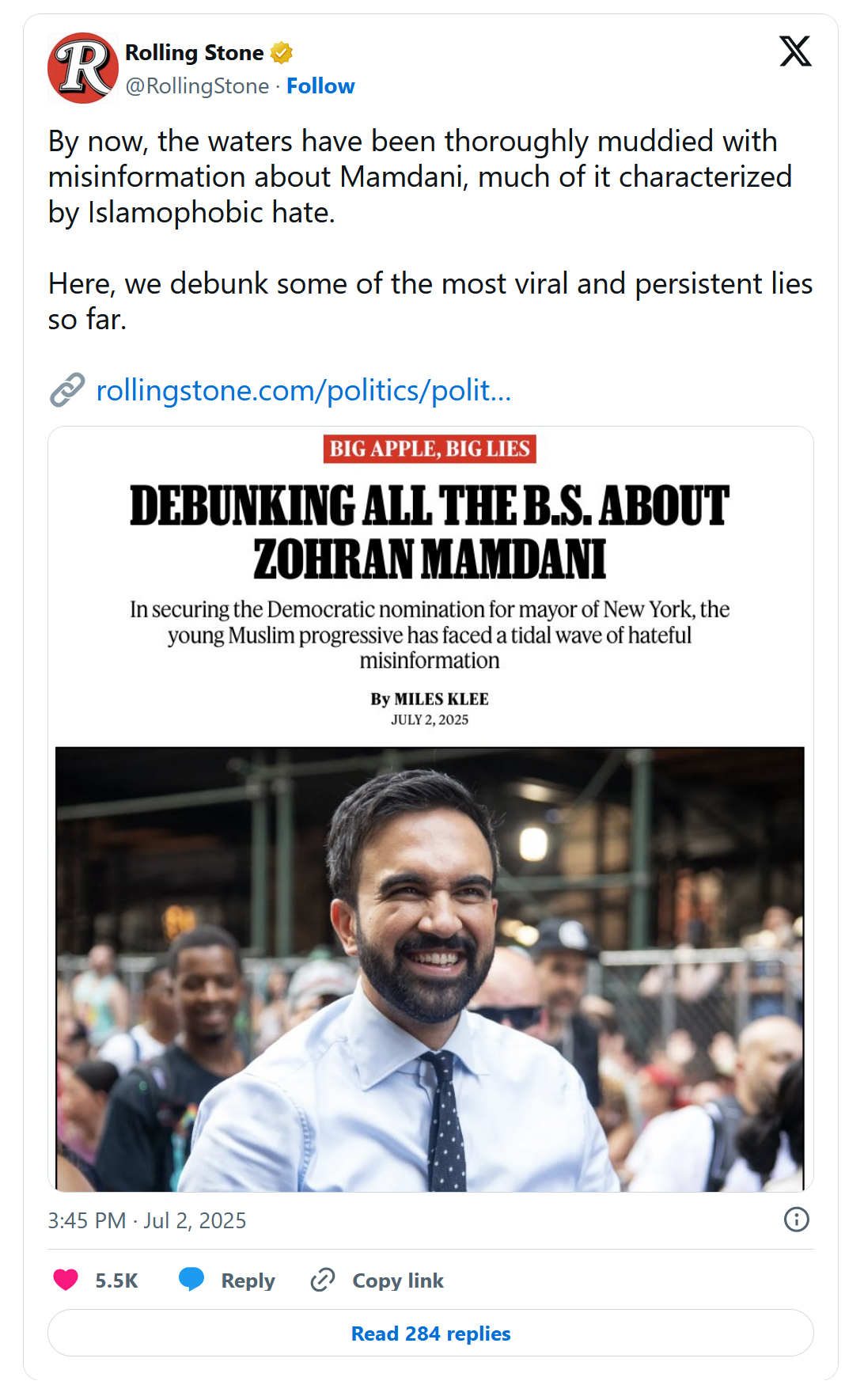
While today’s zombie version of Rolling Stone is happy to inflict Mamdani’s radical chic politics on its readers, even its founder was smart enough to know when to get out of Dodge, as Joe Hagan wrote in Sticky Fingers, his 2017 biography of Jann Wenner:
Wenner said it was [his then-wife] Jane who ultimately catalyzed Rolling Stone’s move to New York [in 1977]. Her paranoia and anxiety had spiked to uncomfortable levels in the wake of the Patty Hearst episode. “San Francisco got very tricky at one point, because you had the Zodiac, the Zebra, and the SLA,” she said. “It was too small. There were too many people that were just too closely removed from the SLA and the Mansons…there was something creepy happening at that point.”
* * * * * * * *
Wenner once told Town & Country magazine that he would never take Rolling Stone out of San Francisco. Wasn’t the Bay Area the very essence of Rolling Stone, its integrity, its history, its point of view? But Ralph Gleason was dead, and the success of the Patty Hearst story had rocketed Wenner to a bigger stage, where he could hear the blare of [then-Saturday Night Live bandleader] Howard Shore’s sax. When Rolling Stone published a complete history of the Haight-Ashbury in 1975, by Charlie Perry, it was both an homage and a tombstone. The Hearsts were the last bit of glamour left in town, and Wenner had already done the backstroke in their pool, his visit captured for posterity by Garry Trudeau, who caricatured the scene in Doonesbury. Indeed, San Francisco was the Old World; New York was the New. Despite the recessionary gloom and high crime rate, New York slushed with ad dollars and teemed with Mailers and Wolfes and Ephrons who vied for choice checkered tables at Elaine’s, the hub of intellectual and literary life operated by the rotund matron Elaine Kaufman. Wenner was halfway there, so why not go all the way?
As Conquest’s First Law of Politics states, “Everybody is conservative about what he knows best.”