THE CRUMBLING GIANT: How Germany’s Economic Might Was Squandered.
Angela Merkel served as Germany’s chancellor from 2005 to 2021, a tenure marked by her reputation as the “crisis chancellor.”
Her administration skillfully navigated Germany through the 2008 financial crisis and the Eurozone debt crunch. But beneath the surface, problems fermented.
Merkel’s government emphasized consensus over confrontation and caution over overcorrection. She deferred essential reforms in labor markets, pensions, and energy, passing the burden to her successors.
Perhaps her most damaging legacy* was the Energiewende, or “energy transition.”
Germany abandoned nuclear power after the Fukushima disaster in 2011 without a viable replacement strategy. This created an overdependence on Russian natural gas, a mistake that would become crippling after the 2022 invasion of Ukraine.
Green Dreams, Gray Realities
While green advocates championed the end of nuclear and the rise of renewables, the reality is that solar and wind couldn’t fully cover Germany’s industrial energy demands.
Germany now has some of the highest electricity prices in the world. As a result, companies such as BASF and Volkswagen have scaled back their operations or moved production abroad.
By 2024, even die-hard supporters of the green transition had to admit that industrial giants were packing their bags. A Handelsblatt editorial asked flatly: “Can Germany still be saved from deindustrialization?”
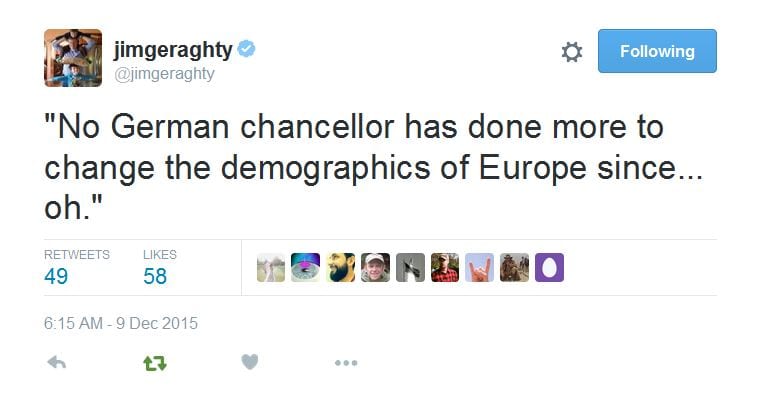
* But not her only damaging legacy. As Jim Geraghty tweeted a decade ago: