
UNEXPECTEDLY! How COVID Pushed a Generation of Young People to the Right.
For decades, America’s young voters have been deeply—and famously—progressive. In 2008, a youthquake sent Barack Obama to the White House. In 2016, voters ages 18 to 29 broke for Hillary Clinton by 18 points. In 2020, they voted for Joe Biden by 24 points. In 2024, Donald Trump closed most of the gap, losing voters under 30 by a 51–47 margin. In one recent CBS poll, Americans under 30 weren’t just evenly split between the parties. They were even more pro-Trump than Boomers over 65.
Precisely polling teens and 20-somethings is a fraught business; some surveys suggest that Trump’s advantage among young people might already be fading. But young people’s apparent lurch right is not an American-only trend.
“Far-right parties are surging across Europe—and young voters are buying in,” the journalist Hanne Cokelaere wrote for Politico last year. In France, Germany, Finland, and beyond, young voters are swinging their support toward anti-establishment far-right parties “in numbers equal to and even exceeding older voters.” In Germany, a 2024 survey of 2,000 people showed that young people have adopted a relatively new “gloomy outlook” on the future. No surprise, then, that the far-right Alternative für Deutschland has become the most popular party among Germans under 30. Like most interesting phenomena, this one even has a German name: Rechtsruck, or rightward shift.
What’s driving this global Rechtsruck? It’s hard to say for sure. Maybe the entire world is casting a protest vote after several years of inflation. Last year was the largest wipeout for political incumbents in the developed world since the end of the Second World War. One level deeper, it wasn’t inflation on its own, but rather the combination of weak real economic growth and record immigration that tilled the soil for far-right upstarts, who can criticize progressive governments on both sides of the Atlantic for their failure to look out for their own citizens first.
There is another potential driver of the global right turn: the pandemic.
Pandemics might not initially seem to cash out in any particular political direction. After all, in the spring of 2020, one possible implication of the pandemic seemed to be that it would unite people behind a vision of collective sacrifice—or, at least, collective appreciation for health professionals, or for the effect of vaccines to reduce severe illness among adults. But political science suggests that pandemics are more likely to reduce rather than build trust in scientific authorities.
Yes, why could that be?

And then in June, after the public went along with the lockdowns because of that message being constantly hammered home by Fauci, Birx, videos of celebrities singing “Imagine” from their mansions and yachts, and the somber repetitive “We’re all in this together” television commercials, the entire health care profession did a 180 that was worthy of Oceania:
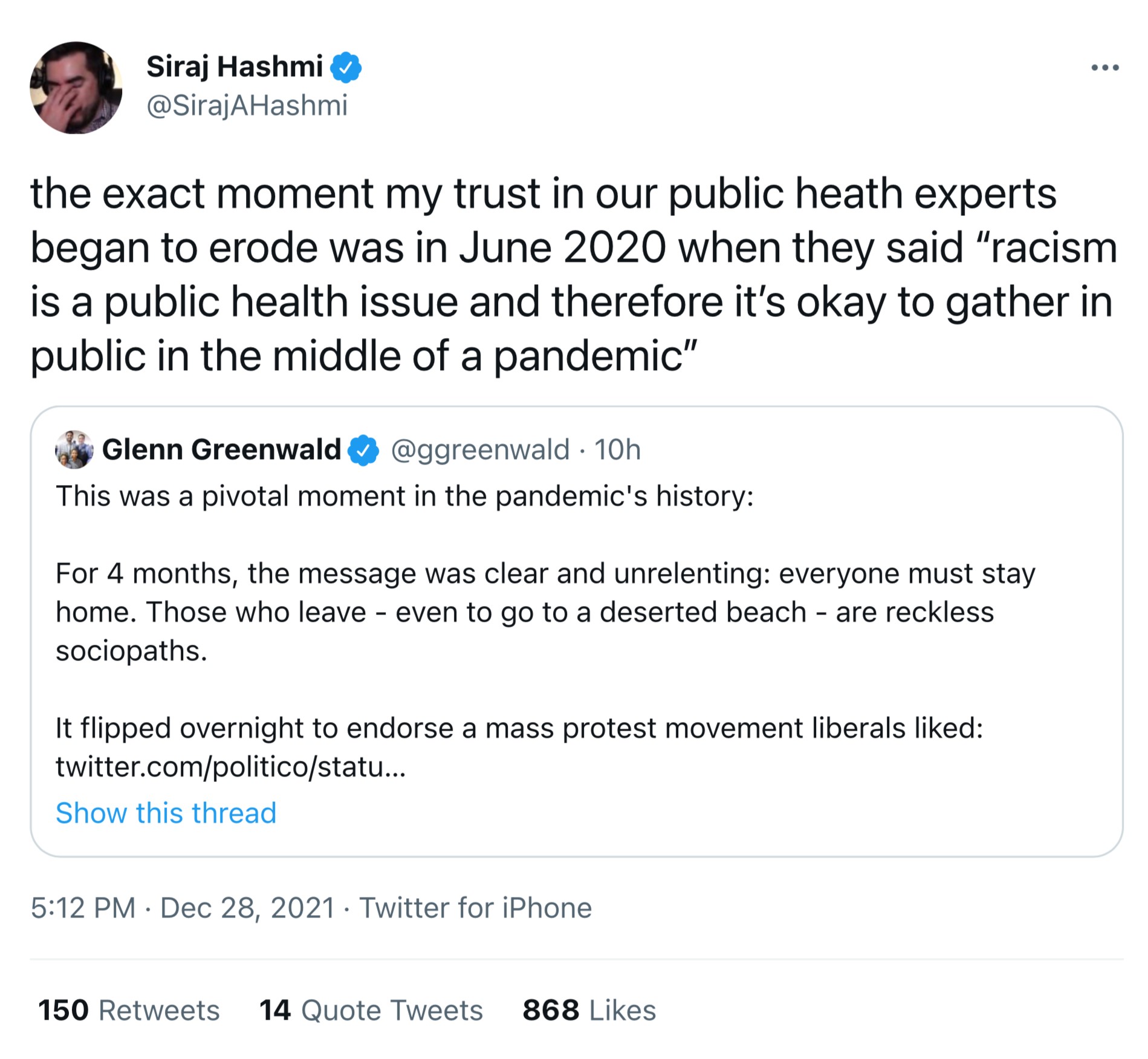
As Greenwald writes in his follow-up tweet, “That episode single-handedly destroyed trust in public health officials, proving they’d politicize their expertise when convenient. Corporate media celebrated a douchebag-lawyer shaming families at deserted beaches, then — overnight! — cheered densely packed street protests.”
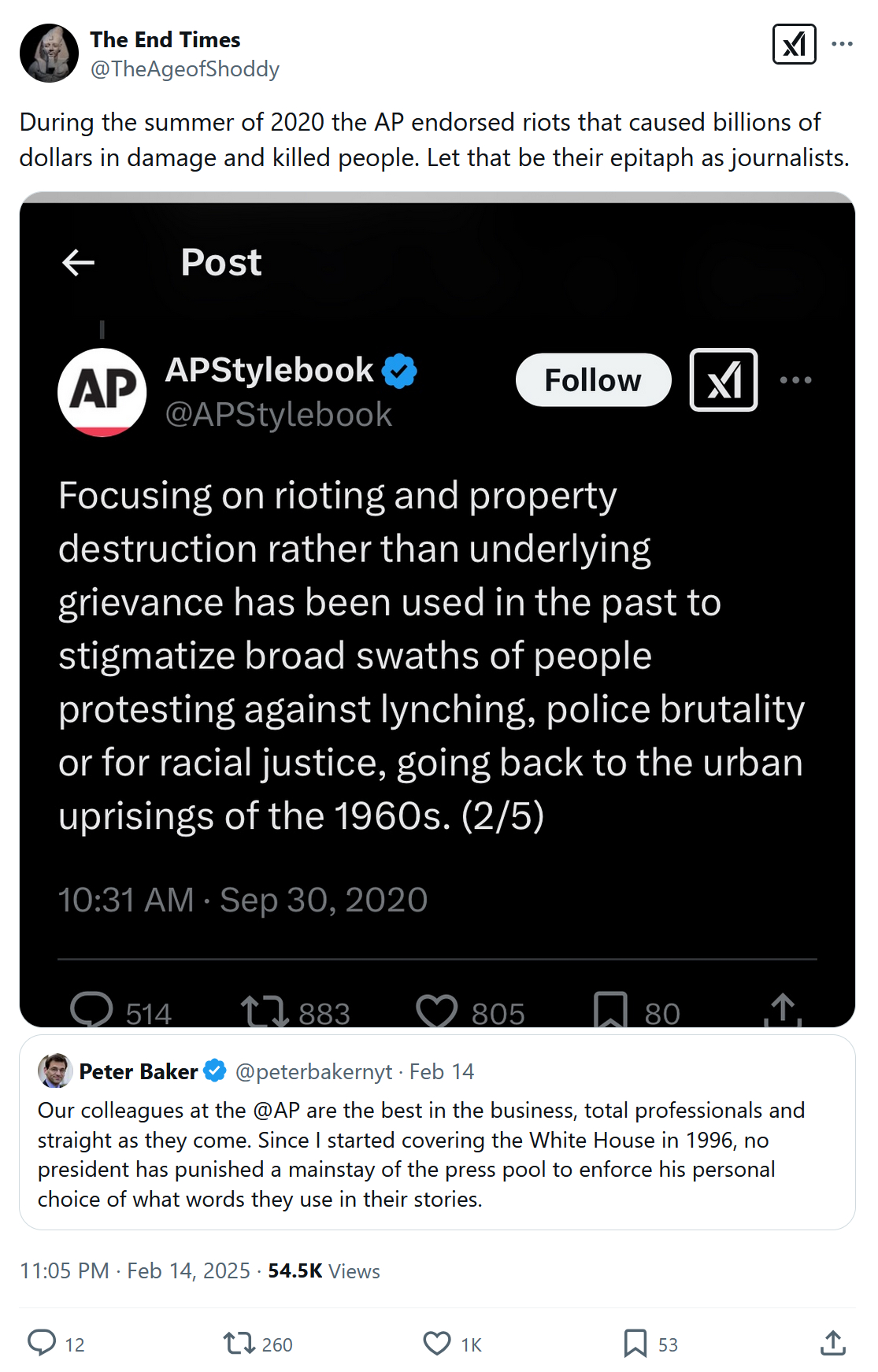
After spending the previous four years gaslighting about Trump and imaginary Russian collusions, 2020 was also the year the media fully imploded as well:
So will the left use this period in the wilderness to reflect on what wrong for them, and how insane they became starting in 2016, and then really firing the afterburners in 2020? No of course not: Democrats Keep Convincing Themselves Their Problem Is Podcasts (It’s Their Policies).
Over the next month, The New York Times is running conversations with Democrat leaders on one of its podcasts about how the party will “win back the voters who moved toward” Donald Trump. I’ll just go ahead and summarize what each subject is likely to say, which is some variation of “We need better messaging and media strategy, and regarding our policies, no changes necessary.”
Such was the series’ inaugural episode, in which freshly sworn-in Democrat Senator Ruben Gallego of Arizona did the same dance his party has been doing since November. On the one hand, he claimed that Democrats failed to “meet the moment,” and on the other, he didn’t name a single one of his party’s policies that voters rejected.
Like every other Democrat leader, Gallego hung the party’s defeat on everything but its grotesque policies that directly ignited wild inflation, flooded the country with millions of destitute migrants, and sparked two foreign hot wars that are sucking enormous U.S. attention and resources.
My favorite parts of the interview were when Gallego, who won his election by less than 100,000 votes (against Kari Lake), theorized on the best ways for his party to speak with voters — which is always described by Democrats as if they’re trying to learn how to communicate with nonverbal prehistoric tribesmen. “I mean, so one of the things I did is I would host morning tacos at work sites, right, during the election,” he said. “So I would go set up, knowing when the 5:30 a.m. shift was coming off, and I’d set up tacos. And I’d hand out tacos to the dudes, and I’d talk to them about life. And we have to understand where they are. We have to understand what they’re hearing.”
Some employees of ABC News aren’t even willing to go that far: Whoopi Goes Full ‘Basket Of Deplorables,’ Says She Can’t Even Talk To Trump Supporters.