
Both the Vietnam anti-war movement and today’s growing anti-Israel war movement started on college campuses. They were galvanized by narratives of oppression. In 1965 it was the South Vietnamese who were allegedly oppressed by rich landlords and corrupt generals. Now in the Holy Land it is the alleged one-sided, unilateral oppression of one religious community by another.
In both wars, the issue to be decided by blood and iron is sovereignty: who will rule the land? Vietnamese Communists or Vietnamese Nationalists? Palestinians or Jews?
But what may start on campus can spread to embroil the body politic. In 1972 the movement against the war in Vietnam took over the Democratic Party under the leadership of George McGovern. Now it seems the anti-Israel movement is similarly gaining strength in the very same Party, causing President Joe Biden to backtrack on his previous support for Israel.
Following the dissemination modality of the anti-Vietnam War movement, consider the current article by Jon Hoffman of the Cato Institute titled: “Israel Is a Strategic Liability for the United States.” The anti-Vietnam War movement precursor was the March 25, 1964 speech (expanded later into a book) by Senator William Fulbright with the title “Old Myths and New Realities”.
In a similar vein, Hoffman suggests that we turn away from “old myths” to seriously consider “new realities” in our relationship with Israel asking: “What exactly the United States gets in return for this unidirectional relationship remains unclear.”
He seeks to weaken the hold on us of the “old” narrative: “Proponents claim that unfaltering support is critical for the advancement of U.S. interests in the Middle East. Sen. Lindsey Graham, for example, once referred to Israel as the “eyes and ears of America” in the region. While intelligence-sharing may have some strategic value, the past five months of war in Gaza have made clear the numerous negative effects of the relationship, namely how Washington’s emphatic embrace of Israel has undermined its strategic position in the Middle East while damaging its global image.”
Today, the toxic “from the River to the Sea” narrative is collecting adherents thanks to a powerful ancient prejudice – antisemitism. That pernicious narrative about Jews proposes that they are always outsiders, on their own, not deserving of our sympathy, or “ally-ship.”
What conflates the two antiwar narratives of 1965 and 2024 is a mythos about the compelling morality of liberation coupled with a false narrative about who is oppressed. Those who are said to be oppressed need liberation and so to support them is righteous. End of analysis.
During Biden’s disastrous bugout of Afghanistan, some pointed out how Biden was obsessed with replaying how the Vietnam War ended for America:
During a 2012 eulogy for George McGovern, Joe Biden recalled a confrontation he had with President Gerald Ford over pulling troops out of Vietnam. Ford had agreed to meet with the Senate Foreign Relations Committee, which included then-freshman Joe Biden, to discuss the administration’s military funding requests during the fall of South Vietnam on April 14, 1975.
According to Biden’s account: “I said, ‘Begging the president’s pardon, but I’m sure if the president were in my position, the president would ask the president the following question.’ I swear to God, it’s in the transcript. And Ford looked at me very graciously, and he said, ‘Yeah?’ I said, ‘With all due respect, Mr. President, you haven’t told us anything.’ They were talking about Sector 1, Sector 2, Sector 3, and with that the president turned and said, ‘Henry, tell them.’ And that was the first time it was decided that we were not going to try to sustain our presence [in Vietnam],” said Biden.
But Biden’s alleged statement, and the response from Ford, do not appear in the classified minutes of the meeting, which have been released by the Ford Library Museum. According to the transcript, Biden did speak up at the meeting to oppose military aid to help evacuate South Vietnamese allies alongside the U.S. troops. “I am not sure I can vote for an amount to put American troops in for one to six months to get the Vietnamese out. I will vote for any amount for getting the Americans out. I don’t want it mixed with getting the Vietnamese out,” said Biden, according to the transcript.
Found via Fred Bauer, who notes, “Biden has never made any secret of his tremendous admiration for McGovern, whom he views as a transformational and inspirational figure.” Which brings us to 2021:
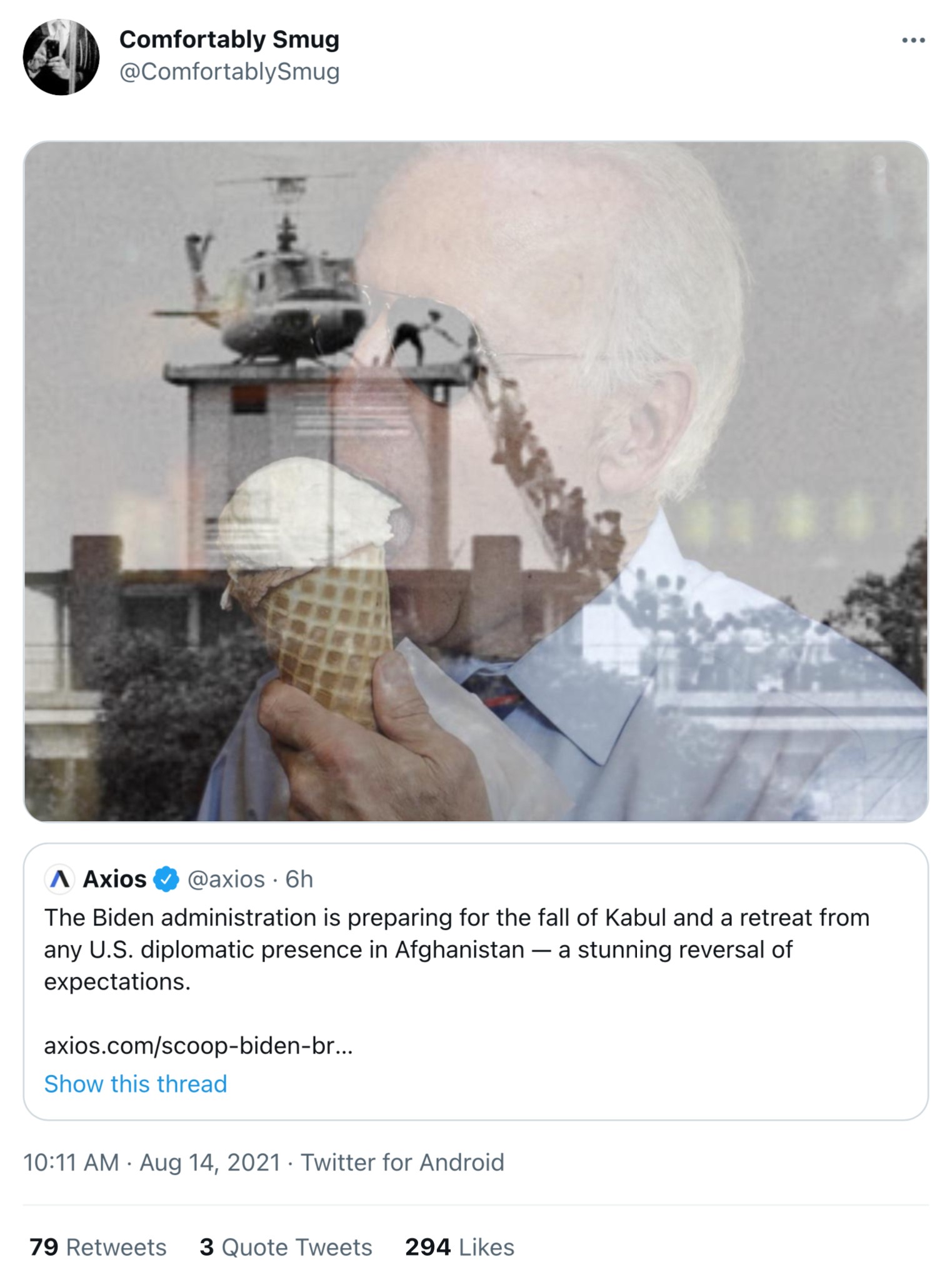
In 2024, what’s left of Joe’s brain is still back there in Full Metal Jacket land:
BIDEN: "I hope the legacy is that I kept my word that I said the reason I was running was to … reduce the prospect of war because of Vietnam" 😬 pic.twitter.com/sJgIiodtN2
— RNC Research (@RNCResearch) April 10, 2024