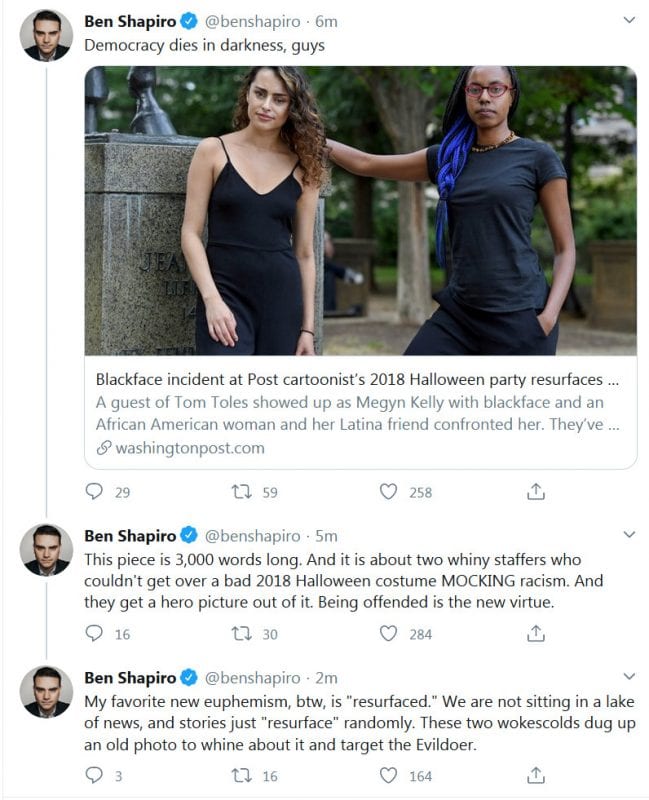
WHY DID THE WASHINGTON POST GET THIS WOMAN FIRED?
In the hours after publication, the story started to receive widespread criticism from journalists on social media on the grounds that it got its subject fired while lacking news value. (Readers had to get 85 percent of the way through the story to even learn that Schafer had lost her job when she told her employer the story would be running.) The article now has drawn over 2,000 web comments, which are overwhelmingly negative in nature. Yet aside from PR statements to outlets covering the Post’s coverage, the Post’s response to the criticism of this story has been silence. If this is a story with “nuance and sensitivity” that the Post felt “impelled” to run, why is a spirited defense of the Post’s journalism coming only from a non-journalist spokesperson for the paper? The answer we reached, after interviewing ten current Post journalists for this story, is that the paper’s staff generally does not consider the story to be defensible.
“My reaction, like everybody, was, What the hell? Why is this a story?” a feature writer at the Post told New York. “My second reaction was, Why is this a 3,000-word feature?” The feature writer added, “This was not drawn up by the ‘Style’ section.”
Employees at “Style” — the paper’s premiere location for long-form storytelling — were confused and displeased to see the piece running on their turf, two Post employees with knowledge of the situation said. Neither Fisher nor Trent works for the “Style” desk, though as newspapers have gotten increasingly focused on digital distribution, the walls between newspaper sections have become more porous.
While the piece failed as a journalistic investigation of the culture of Washington, D.C.’s “media figures,” it succeeded by a different metric: It ensured that Schafer bore the brunt of the criticism in the piece — for example, describing her insensitive interaction in the taxi en route to the party, an incident that occurred outside the presence of any media figures — with minimum organizational exposure to the Post. If it had leaked that the Post had neglected to pursue a story about blackface, or if the women who brought the tip to the Post had taken it to another outlet or simply tweeted about it, who knows what direction the story might have taken.
Related: The WaPo editor behind the Megyn Kelly blackface story has a history of outing random people.