
HOME HARDENING AND DEFENSIBLE SPACE ARE AMERICA’S FUTURE, I SUSPECT: Home hardening and defensible space can halve wildfire damage, study finds.
Archive for 2025
August 29, 2025
EASY RIDERS, RAGING OEDIPAL RESENTMENT:
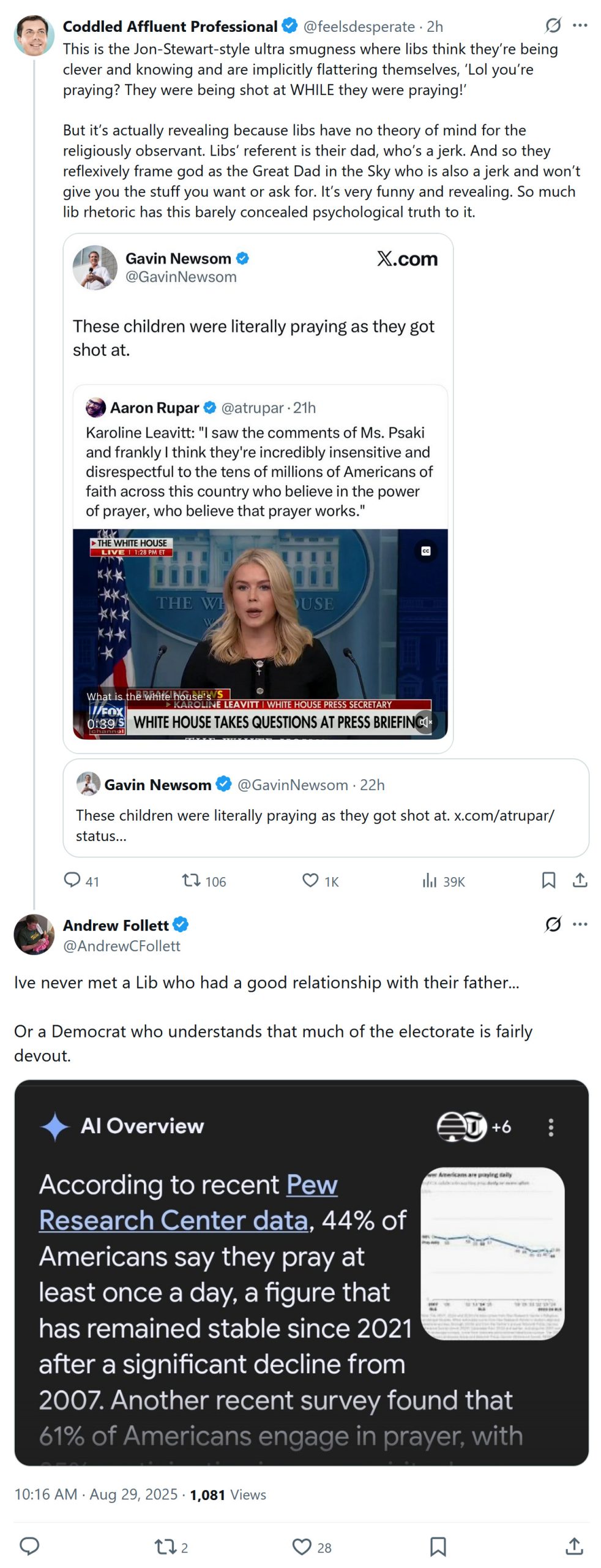
This isn’t a very new development of course. In a 2007 article by Norman Podhoretz, he quoted a Commentary staffer who said at a (very early) anti-Vietnam War protest in 1960, “Do you realize that every young person in this room is a tragedy to some family or other?”
It was of an evening in the year 1960, when I went to address a meeting of left-wing radicals on a subject that had then barely begun to show the whites of its eyes: the possibility of American military involvement in a faraway place called Vietnam and the need to begin mobilizing opposition to it. Accompanying me that evening was the late Marion Magid, a member of my staff at Commentary, of which I had recently become the editor. As we entered the drafty old hall on Union Square in Manhattan, Marion surveyed the 50 or so people in the audience and whispered to me: “Do you realize that every young person in this room is a tragedy to some family or other?”
The memory of this quip brought back to life some sense of how unpromising the future had then appeared to be for that bedraggled-looking assemblage.
Not least of which, conquering a heretofore conservative Hollywood. The estranged relationships between the leftist movie brats who became the “New Hollywood” of the late ‘60s and ‘70s and their more conservative “Greatest Generation”-era fathers is a theme that repeats frequently in Peter Biskind’s 1998 retrospective, Easy Riders, Raging Bulls:
[Candice] Bergen was deeply sympathetic to the antiwar movement, embarrassed by her father, Edgar Bergen’s, friendship with the Old Hollywood right—Ronald Reagan, Bob Hope, Charlton Heston, as well as the fact that he had made his living throwing his voice into wooden dummies.
* * * * * * * *
Carmine [Coppola] had been a child prodigy, whose instrument was the flute. He hit his peak in his twenties, and went downhill from there, once bottoming out by playing the piccolo at the track with a Nedick’s hat on his head. Like many people who flee from what they’re best at, Carmine took his talent for the flute for granted, and longed to spread his wings, compose symphonies or conduct opera.
Carmine was the “maestro,” and his wife, Italia, catered to his every whim. The emotional life of his family turned on what Francis later called the “tragedy” of his father’s career. Coppola once said of his father, he was “a frustrated man who hated anybody who was successful.” Remembers Talia, “All of us felt guilty, about being young, about having our own lives. I thought, How can I go to school, how can I be happy, how can I be anything, with my poor father not doing well. It’s a terrible thing when you feel that your success is occurring when someone close to you is experiencing failure.”
* * * * * * * * *
Once again, like Star Wars, The Godfather, and Taxi Driver, Apocalypse revolved around the issue of parricide. The New Hollywood directors were created in the crucible of generational conflict, and the highly charged relationship between fathers and sons became their core theme. Like the other Vietnam films, Apocalypse was less an attempt to grapple with the war in any realistic way than an occasion to hold up a mirror to the home-front struggles it provoked. Brando, of course, was the ur-father of this generation, the actor whose performances and rebellious example inspired its best work, yet who now stood a colossus astride the road to greatness, an obstacle Coppola—who long enjoyed a complicated love-hate relationship with the actor—had to overcome. Kurtz, lurking in shadow, clad in black, at once model and caution, became his Darth Vader, another incarnation of Charlie Manson, the scourge figure who had gone native and now, unchallenged, ruled over his family. The compound was his Spahn ranch. From another angle, Kurtz was one more incarnation of Coppola himself, or at least the monster of self-indulgence he had become.
* * * * * * * * *
The script [to Chinatown that Robert] Towne finally handed in told a long, intricate tale, teeming with characters and scenes, chock-full of detail and small touches that limned the texture of America in the ’30s. It contained a startling subplot, in which the theft of water and the rape of the land were mirrored by an unspeakable family crime, incest between Noah Cross, a rapacious developer, and his daughter, Evelyn. In the portrait of Cross, Towne may have been settling some family scores. Cross displayed a passing resemblance to Towne’s own father, Lou. Both were developers. According to Towne’s wife, Julie Payne, “Lou wanted him to go into the building business, which neither Robert nor his brother, Roger, had any interest in. I think his father hated Robert. He didn’t pay any attention to him until he became successful.”
Steven Spielberg and George Lucas eventually saw a different path forward in the plots of their movies, which were essentially 1950s b-movies and 1930s Republic serials shot on zillion-dollar budgets, rather than the dark European-inspired fare their friends had been churning out during the 1970s:
Spielberg’s father buried himself in his work, and was usually absent. He clashed with Steven over his son’s indifferent performance in school. Steven was an underachiever. He hated reading, watched TV instead, became, along with Lucas, one of the first directors of the TV generation. His great love was movies, and he occupied himself making elaborate productions in Super-8—sci-fi and World War II pictures using his classmates and contriving elaborate and resourceful do-it-yourself special effects.
* * * * * * * *
Because as much as Spielberg and Lucas wanted to indulge their Peter Pan complexes, return the boomers to the sandbox, much as they backed kids against adults, Spielberg’s movies in particular are colored by longing for the absent dad, a nostalgia for authority. His families are often fatherless; the plots are set in motion by the moral and emotional vacuum at the center of the home, and resolved by father surrogates. Both the Star Wars trilogy and the Indiana Jones trilogy end on a note of generational harmony, with the revelation that the repentant Darth Vader is Luke’s father, and the reconciliation of Indy with his father in Indiana Jones and the Last Crusade. Indy’s final words are, “Yes, sir!” In Close Encounters, Neary-the-child, entering the mother ship in a trancelike daze, surrenders himself to the superior power of idealized grown-ups, grown-ups as they appear to children, in the same way that Star Wars ends with the famous parody of Triumph of the Will. The evil over-thirties of the Nixon era would become the avuncular adults of the Reagan era—Reagan himself in particular. Lucas and Spielberg finally succeeded in turning the counterculture upside down.
Not coincidentally, Lucas and Spielberg ended up ruling the industry in the late ‘70s and early ‘80s.
ASKING THE IMPORTANT QUESTIONS: Should you wear underwear at night? I feel like I need the support.
UGH: Like Parkland, Police Had Been Called to Minnesota Killer’s Home Twice Prior to Shooting. “The heavily redacted police report NBC News obtained from the police department in Eagan, Minnesota, is dated Jan. 26, 2018, and it includes a two-word description explaining why an officer was dispatched to that address: mental health.”
NO FORM OF GOVERNMENT WILL SURVIVE A RULING CLASS THAT’S THIS BAD.
Let’s check in on Western liberal democracy https://t.co/rnmUezVFxU
— Auron MacIntyre (@AuronMacintyre) August 29, 2025
MOVE YOUR MUSCLES: Heartbeat irregularities linked to lack of exercise in the middle-aged.
HMM:
WOW
In recent decades in the U.S. and across the developed world, birth rates have barely changed for right-wingers.
The more left-wing, the more fertility rates have fallen! pic.twitter.com/gFjziEJTp9
— Crémieux (@cremieuxrecueil) August 29, 2025
Related: Harrison Butker, Harbinger?
Plus:
In order to survive, an ideology that fails to reproduce itself must necessarily infect the minds of the children of those who do reproduce.
That’s why they push so hard to control education.
It is a vampire cult. https://t.co/cuaYUbz5t9
— Elon Musk (@elonmusk) August 29, 2025
STEPHEN GREEN TAKE NOTE: Study suggests diet and exercise safeguard liver from alcohol damage.
MORE NUKES IS GOOD NUKES: America’s first modular nuclear reactor begins construction near Idaho lab.
The facility, called Aalo-X, is being built next to the Idaho National Laboratory’s Materials and Fuels Complex in Idaho Falls. Aalo expects to complete construction and reach criticality by July 4, 2026, a timeline the company says demonstrates the speed at which small, modular nuclear reactors can be deployed.
The groundbreaking comes just two weeks after the Department of Energy (DOE) selected Aalo to participate in President Trump’s Nuclear Reactor Pilot Program, announced in June 2025.
The initiative is designed to fast-track the testing and approval of next-generation nuclear designs outside of national labs, clearing a quicker path toward commercial deployment.
Would it be rude to add a “Faster, please,” anyway?
KURT WARNED THEM ABOUT THEIR NEW RULES, TIME AND TIME AGAIN:
Democrats pulled security from several Trump 1.0 officials who the Iranians threatened to murder.
There’s only going to be one set of rules, and this is why you should think carefully about which ones you select. https://t.co/KFbgnM3vgU
— Kurt Schlichter (@KurtSchlichter) August 29, 2025
MORE ANTICOMMUNISM PLEASE: ‘Freedom’s Fury’: An Anti-Communist Documentary From Tarantino and Liu. “There’s a reason why the ‘blood in the water match’ is an ‘untold’ story. The political left, which is still putting up socialists for public office, does not like to remind people of the brutality of the old Soviet Union. It might offer a parallel to the crazy modern left in the West and warn people off of this evil pseudo-religion.”
Plus: “We told the Soviets we didn’t want to live a lie. We wanted to live a human life.”
The Left’s worst nightmare.
RAGE FOR THE MACHINE: ‘Dark money’ group paying pro-Dem influencers up to $8K a month.
The “Chorus Creator Incubator Program” is said to be funded by the “Sixteen Thirty Fund,” a nonprofit sometimes portrayed as the left’s answer to the Koch network and which has funneled money to dozens of Democratic-friendly influencers, according to WIRED magazine.
The names attached to the program span some of the most recognizable liberal voices online.
They include Olivia Julianna, the Gen Z activist who spoke at the 2024 Democratic National Convention; Loren Piretra, a former Playboy executive turned Occupy Democrats YouTuber; and Barrett Adair, the content creator who runs a viral American Girl Doll–themed meme account.
Nice work if you can stomach it, I suppose.
SCARIER THAN TIM WALZ? Meet the Latest Gun-Totin’ Christian Democrat Who Has Republicans Running Scared! “Now, in the 2026 midterm elections, the left imagines it will win back normal men with their latest great white hope, Iowa State Auditor Rob Sand. Sand is running as a Democrat to replace retiring Gov. Kim Reynolds, a Republican who has held the office since 2017.”
NICE GIFT: Leather Trifold Wallet for Men Slim: Rfid. #CommissionEarned
INSURRECTION, STRAIGHT UP:
Another Democratic member has called for people to "rise up" against the federal government and analogized the conduct of ICE to "the SS and the Gestapo.” Connecticut Rep. John Larson's comments come at a time when there has been an 830% surge in assaults on federal agents.
— Jonathan Turley (@JonathanTurley) August 29, 2025
CIVIL RIGHTS UPDATE: Gun buyer licensing law giving some Colorado sheriffs heartburn.
Not enforcing it, [Weld County Sheriff Steve Reams] said, makes it harder on his constituents, not easier.
“If I ignore this and don’t issue these permits, I’m creating a bigger barrier for them to exercise their constitutional right to buy a gun,” Reams said. “I’m just trying to get out of the way. It is unconstitutional. But until someone sues, I can at least not be a roadblock. Sheriffs are squarely in the middle of a gun conflict that we didn’t ask to be in.”
Reams was referring to the steps added to purchase semi-automatic guns that accept detachable magazines, which amounts to a huge number of commonly owned handguns and rifles.
Hopeful buyers must first get fingerprinted to prove eligibility to own a gun, then taking that proof to the local sheriff, who then gives them a card that approves them to take a special class by a certified instructor (the details of which are not yet in place). Once the applicant passes that test, they will be put into a statewide database for five years, which gun dealers will then need to access to confirm the person is legally able to purchase the firearm.
However, the added workload and costs to sheriff’s offices across the state are what are of concern for many – but not all – sheriffs. Reams said at this point he’s planning to request two more full time employees to manage the increase. But those numbers are not guaranteed. He said it could be more.
“Weld County has 27,000 concealed-carry permit holders,” Reams said. “That keeps my front office staff busy enough as it is. My guess is there will be four to five times as many people who will want to exercise their right to take that class to go buy a gun.”
I imagine that underfunding/understaffing the required two-day class might prove to be another one of Denver’s infringements.
SCOTT PINSKER: How Liberals Lost the Gerrymandering PR War.
LIGHTNING DEAL: True Classic Workout Shirts for Men. #CommissionEarned
SCHLICHTER: Which Democrat Will Merge Into the 2028 Sane Lane?
What does the Sane Lane look like? Well, it looks a lot like the way we ended up with Bill Clinton. For those of you who weren’t around when Bill Clinton came out of nowhere in 1992 – he had been the governor of a southern state and was known primarily for giving the longest and most boring Democrat convention speech in history. He did it despite having a libido limited only by the angle of his Peyronie’s disease. He did it because he had some charisma, and he took the radical position that crime is bad and people should work instead of getting welfare.
Yes, at the time, most Democrats were saying the same kind of thing that the Democrats now are saying about crime and people working instead of being on welfare. They were for crime and against people working instead of being on welfare. But Bill Clinton understood that normal Americans did not see things that way.
Like Clinton in 1990, if there’s a “sane lane” Democrat for 2028, they might not be on many people’s radar yet.