
FIGHTING RACISM AND BIGOTRY: Rhode Island district discriminated against white teachers, Justice Dept alleges.
Archive for 2025
October 12, 2025
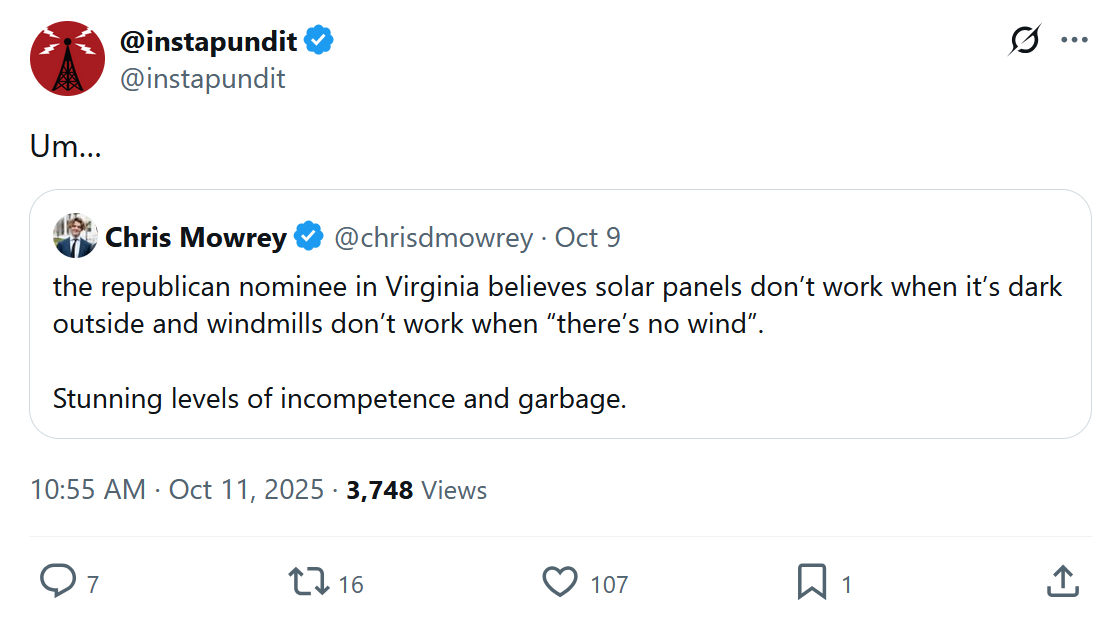
OUT ON A LIMB: Solar panels are a waste of money.
I was ready to start beating my car with a tree branch by the time the last of them checked out, and we were just left with the solar-panel fitter, booked in for two weeks while he fits panels to a house on a large country estate down the road. He works all day in the driving rain and returns at night drenched and exhausted.
We’ve been in a white-out of squally storms for the past week, and solar guy is unable to explain how his clients will be powering their house off the eye-wateringly expensive equipment he has fitted.
“It all works beautifully,” he announced, coming back in his day-glo work anorak the other day, and sitting down at the kitchen table to a plate of his favorite jumbo sausage rolls.
But when I asked whether that meant the millionaire’s house would be powered by solar, he pulled a face. “I mean the system works, as in I’ve wired it all up correctly,” he said, munching. Then he laughed, as though the next bit was obvious: “But it won’t produce any power without direct sunlight, obviously.” And at that moment the wind howled, and we all stared out the kitchen patio door at the driving rain and the thick soup of a turbulent sky.
The weather comes pounding off the sea here, and while there are sunny days, it’s hard to remember a time when there was a run of them together.
Rain and sun, rain and sun, rain and sun all summer, that’s Ireland. And in the winter, it’s like living in a bowl of mushroom chowder. There are days when you come out the door and you can’t see a few feet in front of you.
But despite the almost permanent lack of direct sunlight, Ireland is mad for solar energy. Incentives galore scream at you from advertising hoardings, and roofs everywhere get clad in shiny panels so they can be pounded by the endless rain.
Well, that’s what they want you to think:
WHY IS HIGHER EDUCATION SUCH A CESSPIT OF RACISM? Popular professor fired at HBCU files lawsuit alleging anti-white discrimination.
#JOURNALISM:
Virtually every photo taken of me I’m smiling. I’m a chill guy. They had to look forever to find something menacing. It’s not by accident.
Also, @NBCNews is implying I deserved it for being close to Trump and Charlie Kirk. https://t.co/8MeRnlaUC9
— Benny Johnson (@bennyjohnson) October 12, 2025
I dunno, I kinda like Menacing Benny Johnson.
THEY’RE KIND OF GIVING THE GAME AWAY HERE, AREN’T THEY?
But I was told electronic voting machines were safe and secure https://t.co/ues4gv7Z3U
— Jack Poso 🇺🇸 (@JackPosobiec) October 12, 2025
EVERYTHING OLD IS NEW AGAIN: Young People Are Falling in Love With Old Technology.
The Luddite Club, a nonprofit group that supports taking smartphone breaks, has 26 chapters, nearly all of them at high schools or colleges. Jackson is a board member.
Musicians with younger listeners, including Taylor Swift, Sabrina Carpenter, Alex Warren and Chappell Roan, sell on their websites multiple forms of nostalgic physical media—CDs, vinyl records and tape cassettes. Some, like Carpenter and Troye Sivan, even sell CD “singles,” a format largely forgotten since the early 2000s.
Carpenter, Icelandic singer Laufey and Roan, all Gen Z-ers, have recently topped Amazon’s CD charts. Older artists appear on the charts too, but listeners of John Fogerty, for example, probably aren’t digital natives buying discs for the fun of it.
Even TikTok is full of videos for Bluetooth CD players, flip phones and digital cameras.
“People, especially in Gen Z, are just tired of not owning anything,” said Hunter White, a 25-year-old data engineer and self-described member of “the music nerds of the internet.” White said he collects CDs to escape the domination of streaming services, which he believes underpay artists and have inconsistent offerings. He sources discs from garage and estate sales, thrift shops, record stores and vendor events, and listens at home on a player Sony introduced in 2002.
It’s relative, I guess. The older 21st century hipsters of lore became obsessed with LPs in the 2000s. But all of the gadgets described above, when they began appearing in the mid-1980s through the 1990s were seen as something akin to Star Trek props by my Greatest Generation-era parents, who grew up with 78 RPM records, AM radio, Kodak cameras, and after WWII, three commercial TV networks and Polaroid instant cameras.
Last year Virginia Postrel wrote:
Since the 1980s, technological progress has enjoyed a few flickers of glamour, notably around the singular figure of Steve Jobs, who brought computing power into the everyday lives – and eventually the pockets – of ordinary people. Jobs fused countercultural allegiances with modernist design instincts, technological boldness, and capitalist success. Most important, he gave people products that they loved.
The outpouring of public grief at his death in 2011 demonstrated his power as a symbol. As Meghan O’Rourke wrote in The New Yorker, ‘We’re mourning the visionary whose story we admire: the teen-age explorer, the spiritual seeker, the barefoot jeans-wearer, the man who said, “Remembering that you are going to die is the best way I know to avoid the trap of thinking you have something to lose.”’ Jobs embodied a new ideal of progress, at once uncompromising and humanistic, a vision of advancing technology that artists could embrace. (That the hippie capitalist could be a tyrannical boss and neglectful father were details obscured by his glamour.)
Jobs also helped to deliver on one of the touchstone technologies of twentieth-century progress glamour, a technology almost as evocative as flying cars. The twenty-first century kept the promise of videophones, and they turned out to be far better than we imagined. Instead of the dedicated consoles of The Jetsons, Star Trek, and the 1964 World’s Fair, we got multifunctional pocket-sized supercomputers that include videophone service at no additional cost. ‘I like the twenty-first century’, I tell my husband on FaceTime. But, like refrigerators, videophones aren’t glamorous when everybody has one. They’re just life. We complain about their flaws and take their benefits for granted.
Today’s nostalgic techno-optimists want more: more exciting new technologies, more abundance, and more public enthusiasm about both. Mingling the desires of the old modernists for newness, rational planning, and speed with those of the old nerds for adventure and discovery, they long for action. Their motto is Faster, please, a phrase popularized by Instapundit blogger Glenn Reynolds and the title of James Pethokoukis’s Substack newsletter.
20 years ago, James Lileks wrote:
Sometimes I think you have to be middle aged to realize how cool things are. You grow up with MP3s and iPods, as my daughter will, and it’s the way things are. If you remember the KUNK-KUNK of an 8-track tape, having a featherweight gumpack that holds a billion bits of music is really quite remarkable. (Metheny was followed by something from the “Run Lola Run” soundtrack, which was followed by “I Apologize,” by some nutless 30s warbler, followed by “Dawn” by Grieg.) And then there’s the cellphones and the tiny cameras and the widescreen TVs and home computers that sing to each other silently across the world; wonders, all. This really is the future I wanted. Although I expected longer battery life.
For those who wish to really be on the bleeding edge of hipsterdom, the Lonestar State has you covered: Move Over, Vinyl Trend: North Texas Produces 8-Track Tapes for Major Labels.
ACTUAL JOURNALISM:
🚨BREAKING NEWS: Following evidence uncovered by Project Veritas, the FBI and Florida police raided the hotel rooms of two illegal immigrants, Janaina Toledo (32) and Leonardo Corona Ramos (42), today.
The Brazilian nationals, linked to Tren de Aragua, face charges of underage… pic.twitter.com/5QVKtnpU89
— Project Veritas (@Project_Veritas) October 11, 2025
LIMITED TIME DEAL; KMM Handheld Car Vacuum Cleaner. #CommissionEarned
FAFO: TV Station Employee Arrested by ICE Agents, Who Go On to Swipe an SUV Blocking Their Exit.
FAFO🤣🤣pic.twitter.com/QvmcuPbIkb
— NO CONTEXT VIDEOS (@Viralvid_89) October 11, 2025
Listen to what the communist says at 0:11 and realize where we are. https://t.co/FaxuBjBY2w
— Oilfield Rando (@Oilfield_Rando) October 11, 2025
“‘Hopefully, your wife and children make it home.’ That sounds like a threat from the Jay Jones School of Political Discourse.”
LOL, JOHN MEARSHEIMER:
This is correct. John Mearsheimer, who has a huge following of brainless Mini-Mees at DC think tanks & the Pentagon, went on a recent media blitz saying that Hamas didn’t target civilians. But he’s wrong on this point, like every other point about the Mideast. https://t.co/NAzjYG28l3
— Max Abrahms (@MaxAbrahms) October 11, 2025
Related:
The @nytimes has obtained a handwritten memo by Yahya Sinwar with plans for the October 7 Massacre & intercepts of Hamas communications.
The cruelty was premeditated.
Burning houses with people inside.
Stomping on people’s heads.
Filming it all for the whole Islamic world. pic.twitter.com/06BK8bT1HS— Eylon Levy (@EylonALevy) October 11, 2025
It was just a simple plan; to build a water-powered sawmill on the banks of a river, a river which ran through a tranquil and almost empty paradise. That was California in 1848; once a Spanish colony on the far side of the continent, on the edge of the wide Pacific Ocean – thousands of miles from anywhere significant.
Nine year old Jon Kettering came along with his father and his adopted older brother Henry to help with the work. And one morning, the boss of construction found some bright gold pebbles in the millrace. That chance finding meant the shattering of one world, and the beginning of another, as the world rushed in, mad for gold, at any cost.
The tumultuous first year of the California gold rush, the old wild west observed through the wide eyes of a boy; this is the second in the continuing saga of the Kettering family, the sequel to West Towards the Sunset.

HAVE A ROUSING CLANKER SONG FOR YOUR SUNDAY MORNING: Strains of Earth!
HOWIE CARR: The tide is turning for Boston’s left-wing rioters.
Take a close look at this photograph — it captures the exact moment when alleged hippie rioter Haley Macintyre finally learns, at age 24, that even a pampered Beautiful Person with a fashionable neck tattoo can still suffer adverse consequences for a violent, unprovoked assault on working people.
Even in Massachusetts.
As the picture was taken, in Boston Municipal Court, the judge had just slapped a $7,500 bail on Little Miss Muffet for her sinister role in fomenting that far-left riot that left four Boston cops hospitalized.
Seventy-five hundred bucks?
Do you know how many cool neck tattoos Haley could buy with that much dough?
She allegedly started the insurrection Tuesday night by kicking a BPD cruiser.
And now you might say this low-IQ blonde (of course she goes to Emerson) is experiencing a FAFO moment.
FAFO. (Bleep) Around, Find Out.
Notice the tattoo on the little debutante’s neck. It reads “SONDE”, which in tattoo terms supposedly means: “Each random person you pass has a complex life as vivid as your own.”
Does that include the random Boston cop who suffered a broken nose confronting the street fightin’ they/thems? That police officer now faces reconstructive surgery.
Exit quote: “In his prophetic novel, 1984, George Orwell perfectly described Haley, Styx and all the rest of these female fascists: ‘It was always the women, and above all the young ones, who were the most bigoted adherents of the Party, the swallowers of slogans, the amateur spies and the nosers-out of unorthodoxy.’”
DEMOCRATS GONNA DEMOCRAT:
Once again, another Democrat candidate has wished death on an elected Republican. They did it in a group chat named "ThisBitchNeedsToDie" with other prominent Dems also in the chat. They only got caught because someone took photos as he was texting the chat in public. Sickening. https://t.co/uoXrOImkC9
— Robby Starbuck (@robbystarbuck) October 11, 2025
EXPOSING HAMAS BRUTALITY SHOULD BE ON THE AGENDA: Trump set to fly to Israel to mark historic peace deal while preparing public for grim hostage release.
TRANSFERRING WEALTH FROM THE YOUNG TO THE OLD ONLY WORKS IF THE YOUNG FEEL A CONNECTION TO THE OLD: Want more babies? Then reform the pensions system.
DON’T HOLD YOUR BREATH; HE’S TRYING TO BLAME THE PRIOR TORY GOVERNMENT: Starmer must go over China security scandal.
THEY AREN’T HAPPY MUSK WON’T CENSOR AS THEY WISH: The New World Order machine is gunning for X.
Someone should tell them they’re really the (very) old world order. Pre-historic, really.
MAYBE THEY DON’T KNOW? CBS Journos Shocked That New Boss Wants to Know What They Do.
ALL SO ILLEGAL ALIENS GET THEIR HEALTH CARE PAID? GOP Leaders Unite in Fury: Democrats’ ‘Schumer Shutdown’ Leaves Military Families Hungry and Desperate.
WHO’S BEEN VACCINATED FOR COVID? A WaPo Reporter Did Not Just Email This to Members of Congress…
A PR FIRM REPRESENTING HOLLYWOOD CONSERVATIVES? I GUESS IT’S A START: Politics Is Downstream of Culture, and a Conservative Hollywood PR Firm Hopes to Capitalize on That.
Can they open a junior branch for novelists?