“EVERYTHING TWITTER TELLS THE PUBLIC, THE GOVERNMENT, AND ITS INVESTORS … IS A LIE.” Twitter thread from Grabien founder Tom Elliott:
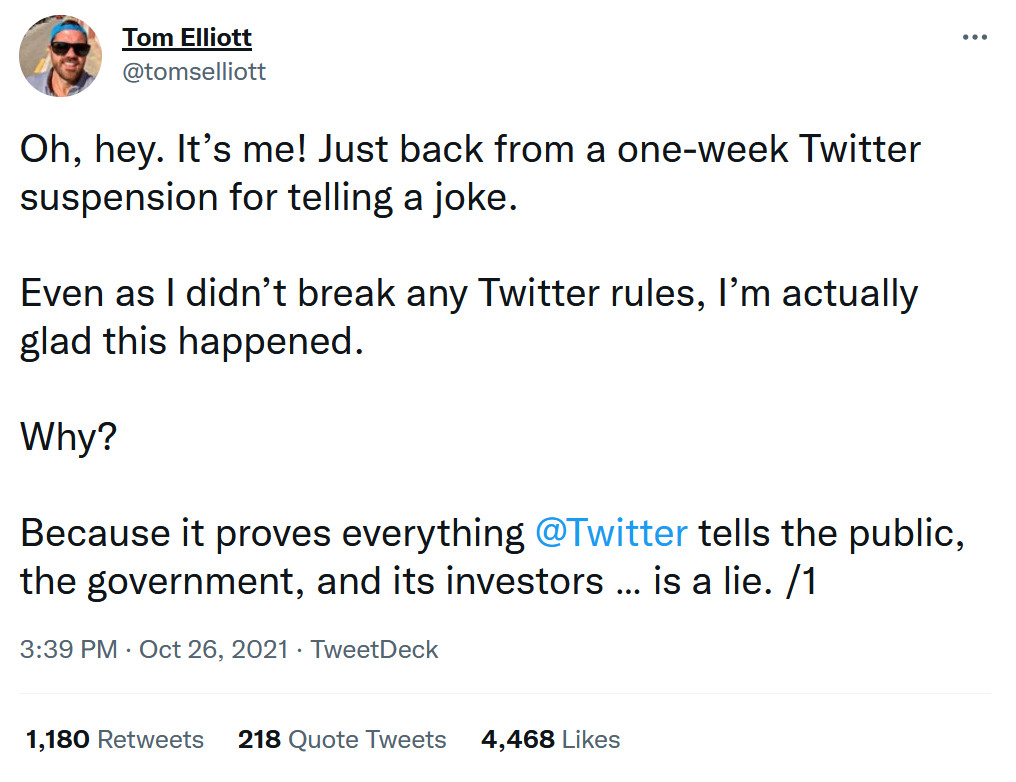

“EVERYTHING TWITTER TELLS THE PUBLIC, THE GOVERNMENT, AND ITS INVESTORS … IS A LIE.” Twitter thread from Grabien founder Tom Elliott:
IT’S COME TO THIS: State Department Issues First Gender-Neutral Passport.
In keeping with the Biden administration’s newly announced gender inclusivity strategy, the State Department has printed its first gender-neutral passport, marked with an “X” designation.
The State department confirmed the news Wednesday, although the identity of the person to whom the passport was issued was not revealed. The U.S. special diplomatic envoy for LGBTQ rights, Jessica Stern, told the Associated Press that the new option for the document reflects the “lived reality” that increasingly more people identify with a gender different than the one they were assigned at birth.
“When a person obtains identity documents that reflect their true identity, they live with greater dignity and respect,” Stern said.
It’s Dave Chappelle’s world; we’re just living in it.
Or as Jim Treacher writes: You Can’t Say a Man Isn’t a Woman, Because Science Is Bad Now. “You’re not allowed to say Rachel Levine is a man, even though she is. It doesn’t matter what biology says. Jack Dorsey loves science, except when it’s not trendy. So obey the rules, and quit asking what the rules are. Don’t say the wrong thing, which can change at any moment and for any reason. As Titania McGrath puts it: ‘If all opinions that I disagree with were made illegal, fascism would be over.’”
REVENGE IS A DISH BEST SERVED ON THE HOME FIELD: Braves Fans Rejoice as MLB Backpedals.
PLAYING CATCH-UP WITH STARLINK: Verizon wants to use Amazon satellites to bring broadband to rural areas.
HERE’S ANOTHER CRISIS BY DESIGN: Email Shows Biden Ordered Afghanistan Evacuation Flights Be Filled With Unvetted Refugees.
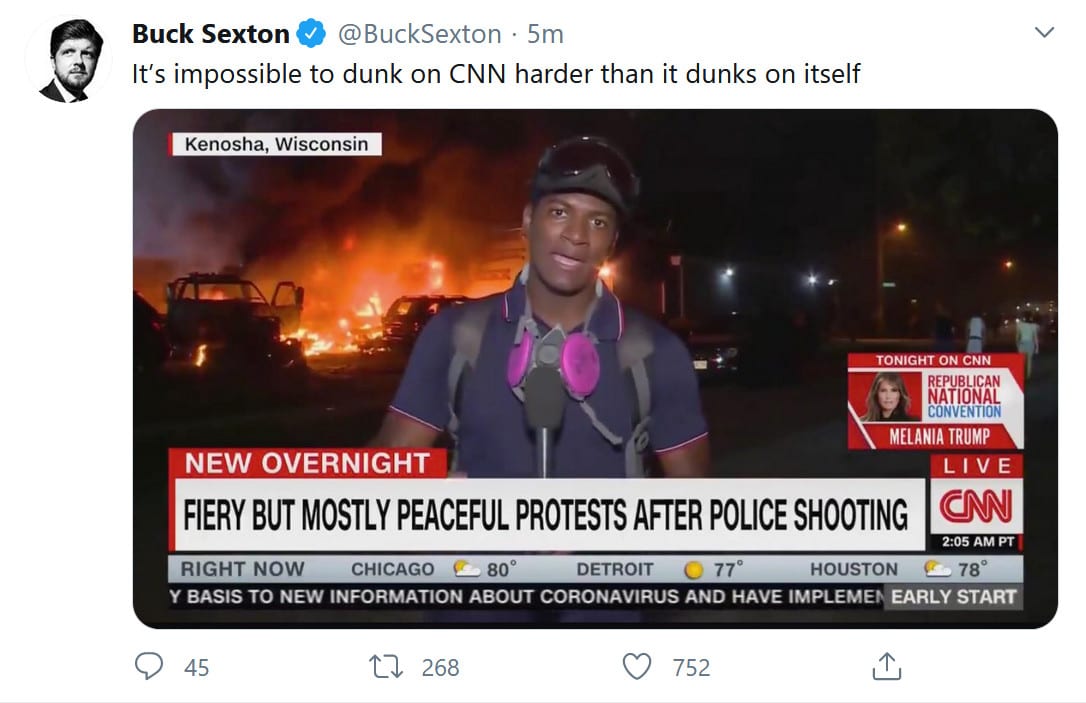
YOU’RE GONNA NEED A MUCH BIGGER BLOG: CNN Host Angry Conservatives Don’t Trust the Media, But Here’s a Few Examples Why.
It wasn’t that long ago that CNN was falsely trying to tell you that Joe Rogan was treating his COVID-19 sickness with horse de-wormer and now a host on the same network is complaining that the right is somehow in the wrong for not believing the media.
This is, of course, right after they dedicated a segment advocating that the mainstream media should, indeed, discriminate against the right when it comes to reporting.
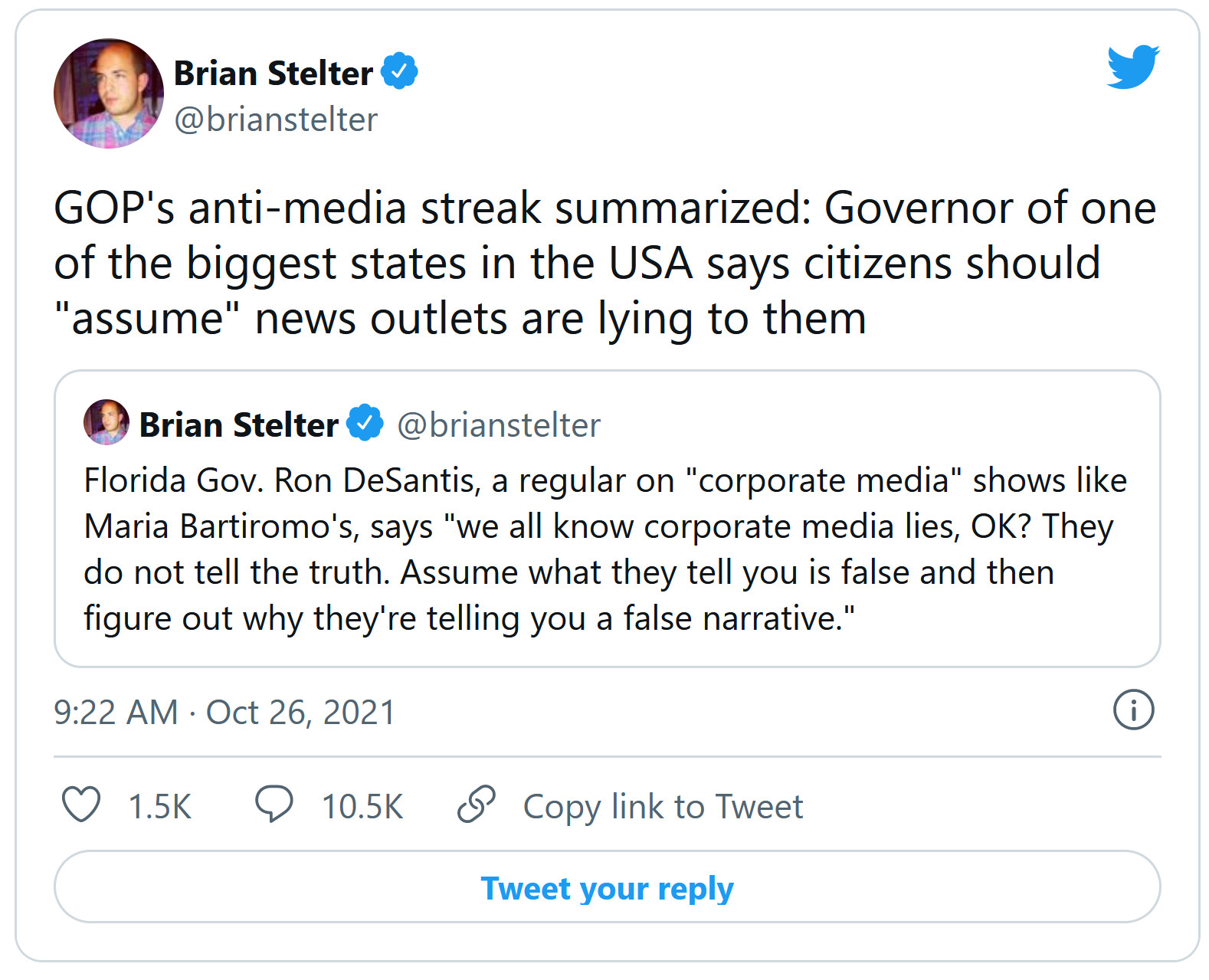
To give you some background, the drama started when Florida Governor Ron DeSantis appeared on Fox News and told Maria Bartiromo that the corporate media lies its head off that it’s pretty much a given at this point to not believe much of what they say.
This apparently upset the host of CNN’s ironically named “Reliable Sources,” Brian Stelter, who began ringing the alarm bell about the “GOP’s anti-media streak and made it seem as if people should be aghast that a leader of conservatives should be telling conservatives that the biased media controlled by the left lies about conservatives.
Gee, Brian, where to begin?
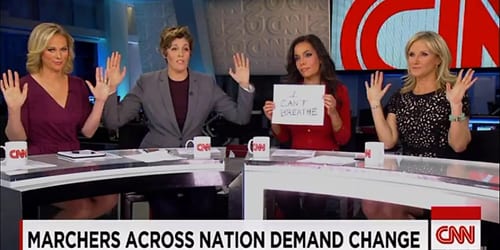
Dana Loesch: How CNN Set Me Up For The Near-Riot Parkland Town Hall.
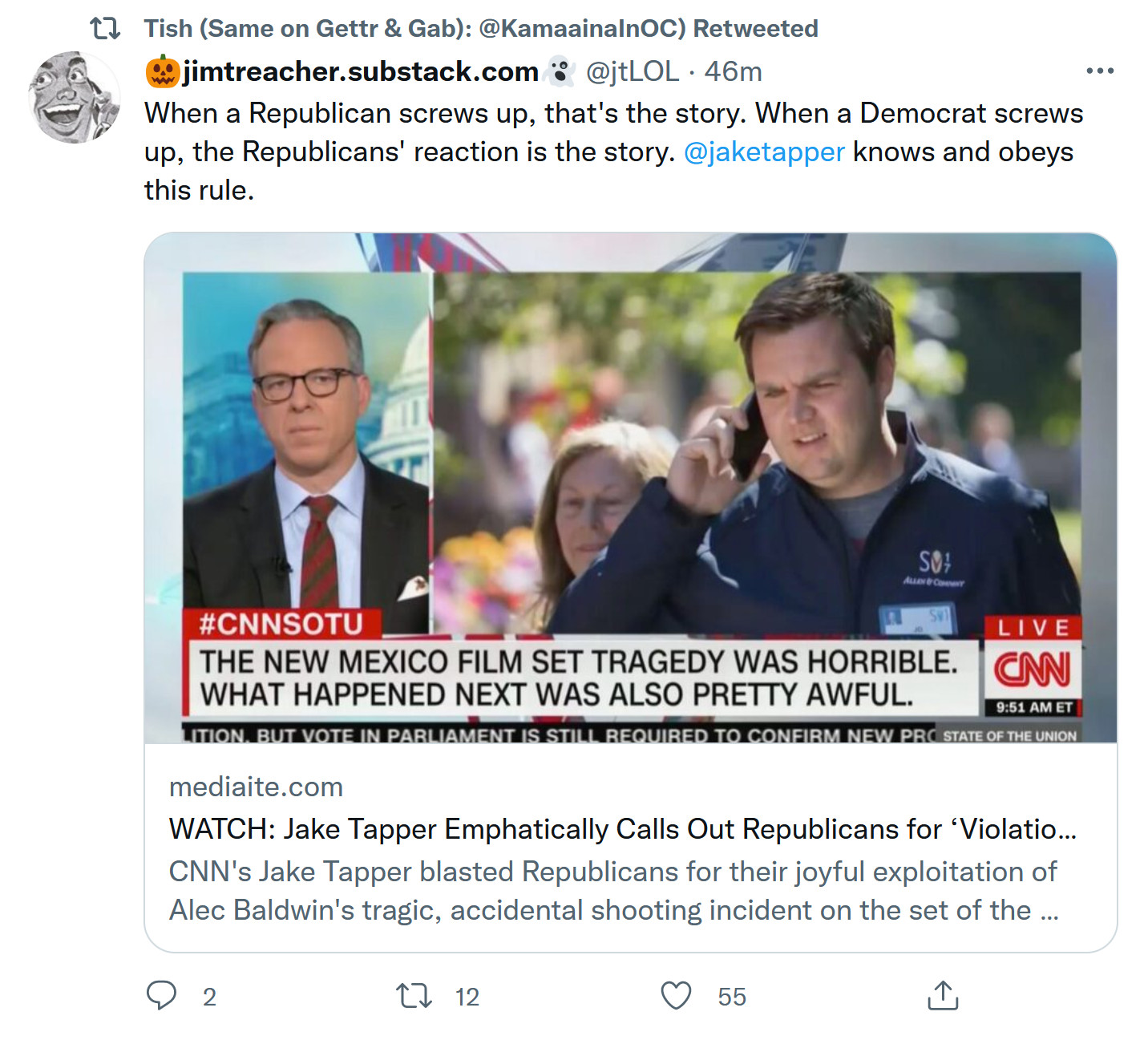
And of course, even Stelter doesn’t believe what CNN tells him, particularly involving global warming:
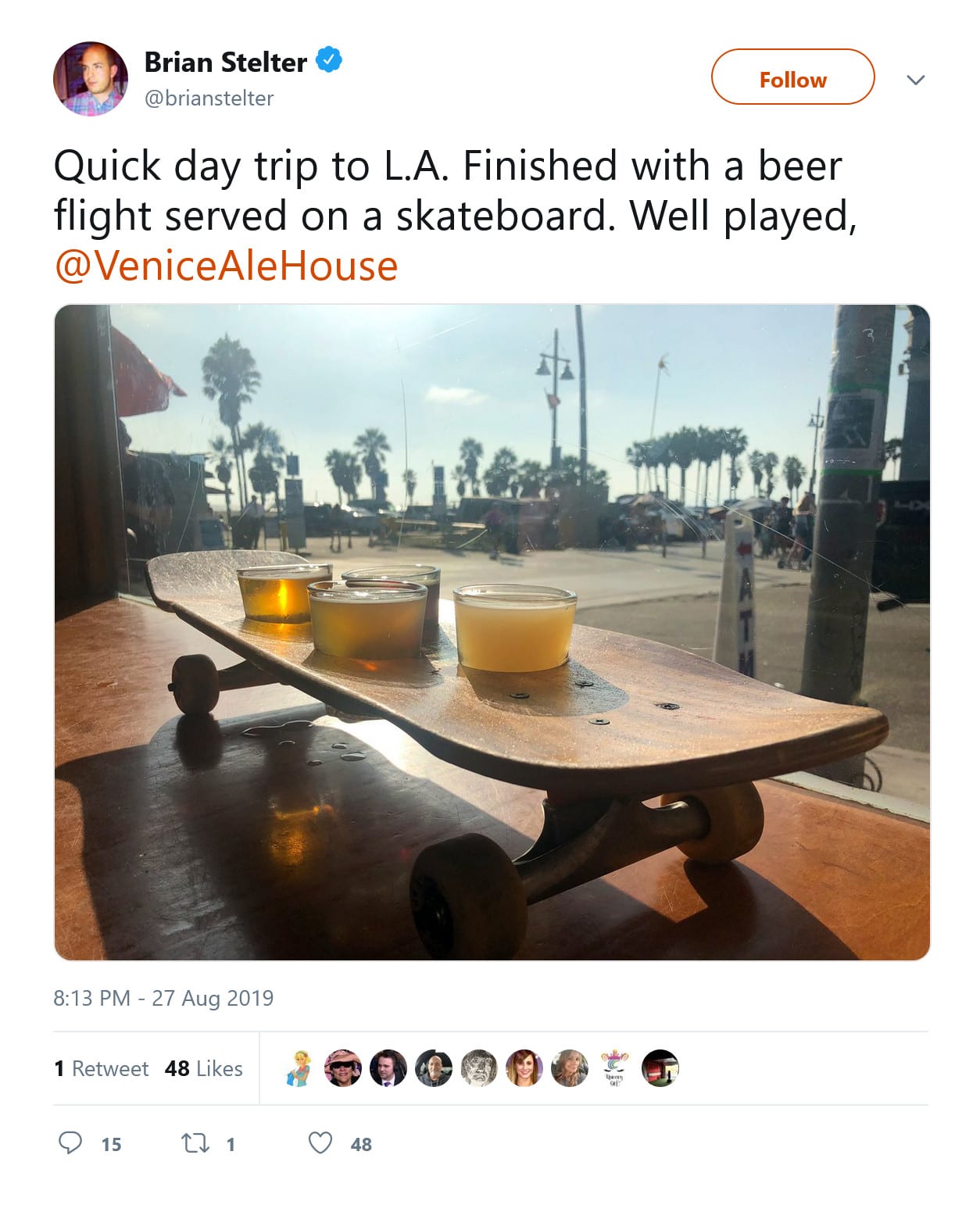
And then there’s one of Stelter’s favorite guests on a show called “Reliable Sources:” A gentleman named Dan Rather.
As Glenn wrote in the aftermath of Rather’s meltdown in 2004:
The world of Big Media used to be a high-trust environment. You read something in the paper, or heard something from Dan Rather, and you figured it was probably true. You didn’t ask to hear all the background, because it wouldn’t fit in a newspaper story, much less in the highly truncated TV-news format anyway, and because you assumed that they had done the necessary legwork. (Had they? I’m not sure. It’s not clear whether standards have fallen since, or whether the curtain has simply been pulled open on the Mighty Oz. But they had names, and familiar faces, so you usually believed them even when you had your doubts.)
The Internet, on the other hand, is a low-trust environment. Ironically, that probably makes it more trustworthy.
That’s because, while arguments from authority are hard on the Internet, substantiating arguments is easy, thanks to the miracle of hyperlinks. And, where things aren’t linkable, you can post actual images. You can spell out your thinking, and you can back it up with lots of facts, which people then (thanks to Google, et al.) find it easy to check. And the links mean that you can do that without cluttering up your narrative too much, usually, something that’s impossible on TV and nearly so in a newspaper.
(This is actually a lot like the world lawyers live in — nobody trusts us enough to take our word for, well, much of anything, so we back things up with lots of footnotes, citations, and exhibits. Legal citation systems are even like a primitive form of hypertext, really, one that’s been around for six or eight hundred years. But I digress — except that this perhaps explains why so many lawyers take naturally to blogging).
You can also refine your arguments, updating — and even abandoning them — in realtime as new facts or arguments appear. It’s part of the deal.
This also means admitting when you’re wrong. And that’s another difference. When you’re a blogger, you present ideas and arguments, and see how they do. You have a reputation, and it matters, but the reputation is for playing it straight with the facts you present, not necessarily the conclusions you reach. And a big part of the reputation’s component involves being willing to admit you’re wrong when you present wrong facts, and to make a quick and prominent correction.
When you’re a news anchor, you’re not just putting your arguments on the line — you’re putting yourself on the line. Dan Rather has a problem with that. For journalists of his generation, admitting an error means admitting that you’ve violated people’s trust. For bloggers, admitting an error means you’ve missed something, and now you’re going to set it right.
What people in the legacy media need to ask themselves is, which approach is more likely to retain credibility over time? I think I know the answer. I think Dan Rather does, too.
That seems like pretty good advice. Naturally, Stelter completely ignores it, week after week.
BIDEN HEADS TO CLIMATE SUMMIT AS CHINA EXPANDS FOSSIL FUEL IMPORTS: Don’t expect to read about it in the New York Times or Washington Post, but China is aggressively expanding its oil and natural gas exploration and production, particularly in the resource-rich South China Sea, according to a new report from the Institute for Energy Research (IER).
WHEN YOU’RE A LEFTY AND THE DAILY BEAST CALLS YOU OUT FOR YOUR LYING…: Terry McAuliffe Said More Than 1,100 Kids Were Hospitalized With COVID. There Were 35.
I’M NOT ACTUALLY SHOCKED: Shock Poll Reveals Just How Little Virginia Democrats Care About Kids’ Education.
TOP SELLER IN MEN’S JEANS: Levi’s Men’s 550 Relaxed Fit Jeans, Medium Stonewash. #CommissionEarned
WITH MALICE AFORETHOUGHT: Former Soros Activist Explains How Progressive Policies Ruined San Francisco. “Out of frustration over the problems he was seeing in San Francisco and other liberal cities, Shellenberger became determined to diagnose the problems driving the homeless crisis and find solutions. He presents the result of his research and investigation in his new book ‘San Fransicko: Why Progressives Ruin Cities.'”
It looks like what we think a Third World country looks like. I’m somebody that’s spent a fair amount of time in Brazil, in Africa, in India. I go to slums every time I go to developing and poor countries. This is different in the sense that, obviously, San Francisco is one of the richest cities in the world. The number of billionaires per capita is huge. It’s obviously the center of much of our technology boom.
The drug crisis is the result of deliberate policies that are imposed by progressives, demanded by progressives, to not treat addiction, not treat mental illness, and to basically defend the right of people to sleep anywhere, defecate anywhere, and not be arrested, not be mandated treatment.
Interesting interview, in podcast or transcript form.
MEET THE NEW BOSS, SAME AS THE OLD BOSS: New York’s New Governor Draws Backlash For Maskless Broadway Outing.
As Stephen Kruiser suggested: Let’s Start Jailing Lawmakers Who Violate Their Own COVID Restrictions. “Imagine the pure, poetic justice of seeing Newsom, Cuomo, and some of the other Hitler youth (stole that from Animal House) cooling their heels in a holding cell after being caught with their masks off and their pants down.”
BECAUSE THEY KNEW THEY WERE DOING SOMETHING WRONG: “Why Didn’t Anybody Tell Us?”: Angry Loudoun County Students Stage Walk Outs Over Sexual Assaults in Their Schools. Plus: “Every student that participated in today’s walkouts should take their activism directly to the next school board meeting and demand answers and mass resignations.”
In fact, they should protest at board members’ homes, since the left has explained to us that that sort of thing is just part of the political process.
THE SLIPPERY SEMANTICS OF ANTHONY FAUCI:
[L]ike the ponytailed Chad in Good Will Hunting attempting to flex his big brain, Fauci’s arguments fall apart in front of the initiated.
Last week, Lawrence Tabak, the principal deputy director of the NIH, sent a letter to Congress saying that EcoHealth Alliance failed to report certain aspects of the experimental work it had been conducting in China on bats and bat-borne viruses. Tabak pledged that the NIH and Fauci’s NIAID would take administrative action, but not much more than that.
So Fauci’s absolutist answer from May has proven to be false. At the very least, the doctor needs to answer directly why he chose to deflect questions on gain-of-function research, something his own agency is claiming it had no idea was happening. How could have Fauci have denied back in May something so “categorically” if EcoHealth Alliance, run by Fauci ally Peter Daszak, had failed to report the full extent of their experiments?
Earlier:
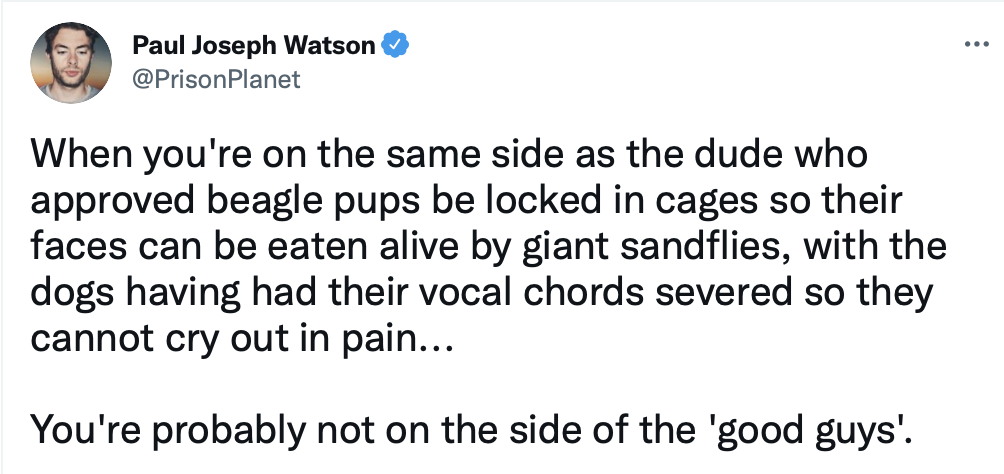
And it’s time to ask yourself:
https://youtu.be/hn1VxaMEjRU
PROPAGANDA: Jeffrey Singer: Dopesick Resurrects an Opioid Narrative That Is ‘Neat, Plausible, and Wrong.’ “The Drug Enforcement Administration just ratcheted down production quotas for all prescription opioids for the sixth consecutive year while doctors are terrorized into undertreating pain, or abruptly tapering and cutting off chronic pain patients from a medication that has allowed them to enjoy meaningful and productive lives. Sadly, pain patients are the real victims of the false narrative, with documented increases in mental anguish and suicide from untreated or under‐treated pain. Suicides among veterans are skyrocketing as opioid treatments have been curtailed in the Veterans Health Administration system.”
WELL, YOU KNOW, THEY DON’T: What if Trigger Warnings Don’t Work?
Trigger warnings started to appear frequently on feminist Web sites in the early two thousands, as a way to warn readers of fraught topics like sexual assault, child abuse, and suicide, on the theory that providing warnings would reduce the risk of readers experiencing symptoms of post-traumatic stress disorder, or P.T.S.D. Their use steadily increased online, particularly on social media. College students who were accustomed to seeing trigger warnings on the Internet began asking their instructors to provide them in class. In 2014, Oberlin College produced a trigger-warning policy as part of its Sexual Offense Resource Guide, advising faculty members to “understand triggers, avoid unnecessary triggers, and provide trigger warnings.” It claimed that a trigger, defined as something that “recalls a traumatic event to an individual,” would “almost always disrupt a student’s learning and may make some students feel unsafe in your classroom.” For example, “Chinua Achebe’s Things Fall Apart is a triumph of literature that everyone in the world should read. However, it may trigger readers who have experienced racism, colonialism, religious persecution, violence, suicide, and more.” Oberlin dropped the policy after receiving pushback from faculty, some of whom argued that the list of triggers was potentially endless.
Yet many academics embraced the use of trigger warnings. The philosopher Kate Manne explained, in a 2015 Times Op-Ed, that “the point is not to enable—let alone encourage—students to skip these readings or our subsequent class discussion (both of which are mandatory in my courses, absent a formal exemption). Rather, it is to allow those who are sensitive to these subjects to prepare themselves for reading about them, and better manage their reactions.” She wrote that exposing students to triggering material without trigger warnings seemed “akin to occasionally throwing a spider at an arachnophobe,” which would impede rather than enable the rational state of mind needed for learning. By 2016, an NPR poll of eight hundred college and university teachers showed that half of those surveyed had used trigger warnings in their teaching. Since then, trigger warnings have become culturally mainstream well beyond classrooms: last month, the Globe Theatre, in London, forewarned its audiences of “upsetting” themes in “Romeo and Juliet,” including suicide and drug use.
Whatever individual instructors might do in their courses, universities have not typically adopted official policies on trigger warnings. But the University of Michigan does provide its teachers a guide to trigger warnings within its resources on “planning for inclusive classrooms.” The guide urges instructors to design course content “with common triggers in mind” and offers examples of “tags” that teachers might provide on syllabi, including “death or dying,” “pregnancy/childbirth,” “miscarriages/abortion,” “blood,” “animal cruelty or animal death,” and “eating disorders, body hatred, and fat phobia.” The university tells teachers that “it is appropriate” to say to students: “If you have concerns about encountering anything specific in the course material that I have not already tagged and would like me to provide warnings, please come see me or send me an email. I will do my best to flag any requested triggers for you in advance.” When I read this, I pictured instructors attempting to comply with this advice by keeping color-coded tabs on individual students’ triggers in their teaching notes. In the event that teachers “miss flagging content that a student may identify as triggering,” they are told to “apologize sincerely to the student, assure them that you will try to do better, and ask for any clarification.”
As a law professor teaching criminal, constitutional, and family law—subjects that involve topics such as homicide, sexual assault, racial discrimination, guns, domestic violence, abortion, divorce, and child abuse—I know from experience that many students have endured very challenging life and family experiences that may not be apparent to others. As a result, my introduction to any course includes a statement that it will delve into many of the most controversial and difficult issues in our society, ones that may personally affect the lives of people in the class, and that all discussions must be conducted with respect for one another. I don’t frame my statements as addressing triggers, and I don’t flag particular readings or discussions, apart from the fact that a course unit may already have a heading: “Homicide,” “Sexual Assault,” “Segregation,” or “Divorce,” for example. (Of course, any student with a disability—including mental illnesses such as P.T.S.D.—may seek appropriate accommodations through the school’s disability office.) Since trigger warnings began to appear on syllabi, I’ve been troubled by uncertainty about whether students benefit from them. Like the Brandeis students, I’ve wondered, Is warning students that they are about to be traumatized or re-traumatized likely to decrease or increase the stress they feel?
Because trigger warnings involve assumptions about emotional reactions, particularly with respect to P.T.S.D., psychology researchers have begun to study whether trigger warnings are in fact beneficial. The results of around a dozen psychological studies, published between 2018 and 2021, are remarkably consistent, and they differ from conventional wisdom: they find that trigger warnings do not seem to lessen negative reactions to disturbing material in students, trauma survivors, or those diagnosed with P.T.S.D. Indeed, some studies suggest that the opposite may be true. The first one, conducted at Harvard by Benjamin Bellet, a Ph.D. candidate, Payton Jones, who completed his Ph.D. in 2021, and Richard McNally, a psychology professor and the author of “Remembering Trauma,” found that, among people who said they believe that words can cause harm, those who received trigger warnings reported greater anxiety in response to disturbing literary passages than those who did not. (The study found that, among those who do not strongly believe words can cause harm, trigger warnings did not significantly increase anxiety.) Most of the flurry of studies that followed found that trigger warnings had no meaningful effect, but two of them found that individuals who received trigger warnings experienced more distress than those who did not. Yet another study suggested that trigger warnings may prolong the distress of negative memories. A large study by Jones, Bellet, and McNally found that trigger warnings reinforced the belief on the part of trauma survivors that trauma was central (rather than incidental or peripheral) to their identity. The reason that effect may be concerning is that trauma researchers have previously established that a belief that trauma is central to one’s identity predicts more severe P.T.S.D.; Bellet called this “one of the most well documented relationships in traumatology.” The perverse consequence of trigger warnings, then, may be to harm the people they are intended to protect.
My grandmother could have predicted this.
CHANGE (IT BACK): Buyer’s Remorse — Re-fund the Police on Ballot in Austin.
INTERESTING: Stalin’s War: A New History of World War II. #CommissionEarned