Archive for 2020

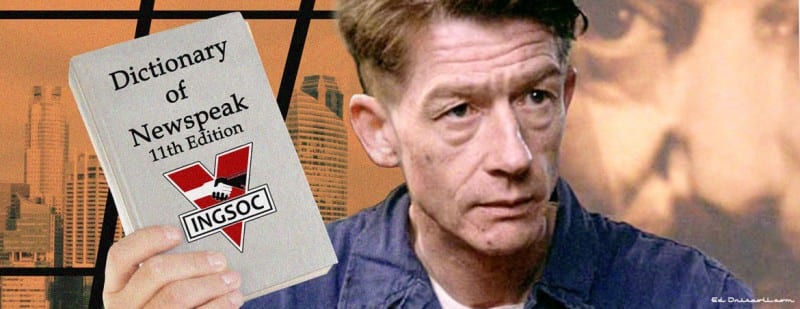
THE NEW YORKER IS THE LATEST LEFTIST OLD MEDIA REDOUBT UNCOMFORTABLE WITH FREE SPEECH AND A DIVERSE INTERNET: Is Substack the Media Future We Want?

Readers of magazines, newspapers, and many Web sites, which publish established writers alongside emerging ones, automatically encounter new voices; on Substack, the most successful newsletters are almost always written by people who have already cultivated an audience at traditional publications or built up a following elsewhere. (I learned about “Maybe Baby” via the Instagram Explore algorithm.) Many of these writers, like Yglesias, consolidated their reputations in the previous two decades, as bloggers, before leveraging that work into book deals or columns at traditional outlets; now, having built large followings, they are working as free agents. Substack is a natural fit for the influencer, the pundit, the personality, and the political contrarian. It’s debatable whether this represents “a better future for news.” But it’s great business for Substack.

The durability and sustainability of the digital-newsletter model remain to be seen. Carving out new ways for writers to make money from their work is surely a good thing: the United States lost sixteen thousand newsroom jobs this year, and many mainstream publications have struggled to overcome issues like discrimination, clubbiness, and prohibitively low compensation. But whether Substack is good for writers is one question; another is whether a world in which subscription newsletters rival magazines and newspapers is a world that people want. A robust press is essential to a functioning democracy, and a cultural turn toward journalistic individualism might not be in the collective interest.

Related: “The New Yorker, American weekly magazine, famous for its varied literary fare and humour. The founder, Harold W. Ross, published the first issue on February 21, 1925, and was the magazine’s editor until his death in December 1951.” No word yet if Ross checked to see if his magazine would or wouldn’t be “in the collective interest” before launching it.
ROGER SIMON: In Praise of Josh Hawley.

President Donald Trump is obviously the leader of the Republican Party (see the latest Gallup poll on the most admired American) but should the 2020 election remain in its current dubious state and should Trump decide not to run in the future, Josh Hawley, the senator from Missouri, has moved to the head of the class for the 2024 GOP presidential nomination.

He has done this by being the first Republican senator to commit to objecting to electoral college certification for presidential election 2020.

This courageous act, in conjunction with similar pledges already made by members of the House, opens the door to serious discussion of the election on the floor of Congress

In so doing Hawley has cited problems that several states had, particularly Pennsylvania, in not following their own election laws. (Georgia’s problems were demonstrated today by the testimony of IT expert Garland Favorito and others in front of their Judiciary Committee.)

But equally, if not more, importantly to the future of our country, and the democratic world in general, Hawley has called out the undue influence of Big Tech in our presidential election, in this case Facebook and Twitter. (He could easily have added the giant of giants, Google, as well.)

Many have asserted these entities, as private companies, have the right to do as they wish. In a perfect world, that is correct. But this world is far from perfect and getting less so.

Big Tech controls the flow of information globally to a degree no one has ever conceived, not even Orwell or Huxley. Traditional anti-trust legislation is virtually Paleolithic when it comes to adjudicating the capabilities of these companies.

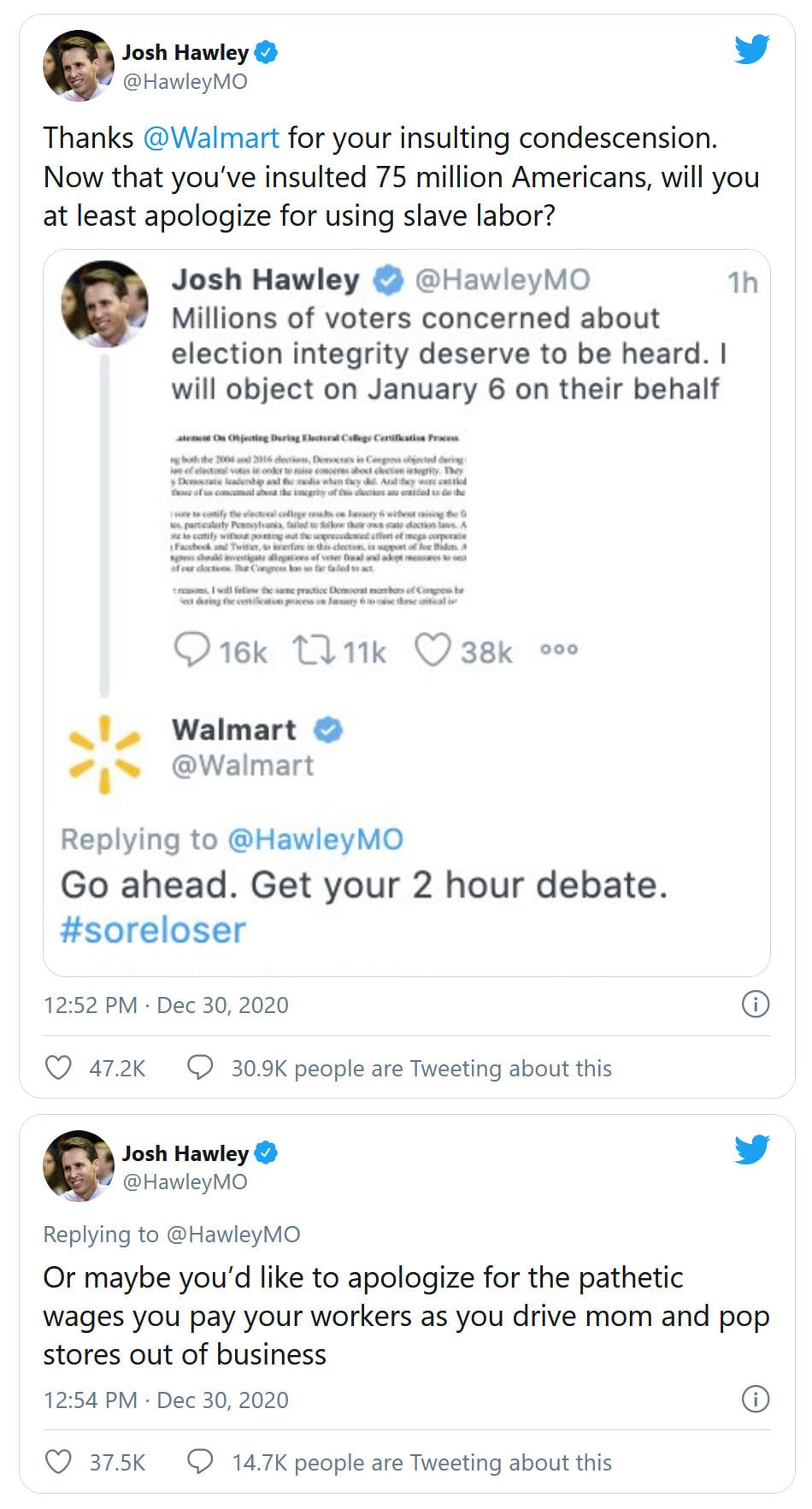
Curiously, Hawley seems to have run afoul of Walmart as well: Walmart blames deleted ‘#SoreLoser’ reply to Sen. Josh Hawley on social media team ‘mistake’ (but not before Hawley fired back hard).


2020 WASHINGTON FREE BEACON MAN OF THE YEAR: MAGA Matt Yglesias.

You know how it goes: You oppose defunding the cops, and a million rose emojis scream at you for hours. You sign a letter tepidly endorsing free speech, and your colleagues denounce you to your bosses and Twitter. The company you founded gets overrun by campus communists, so you quit to blog from your basement.

We’ve all been there.

Many of us would have called it quits after a year of such beatings. One tenacious egghead, though, never gave up, but kept coming back for more: Washington Free Beacon Man of the Year Matt Yglesias.

Heh. Read the whole thing.

THE GRAY LADY IS LARGE, SHE CONTAINS MULTITUDES: New York Times: Tiki Bars Need ‘Reclaiming’ Because Racism.

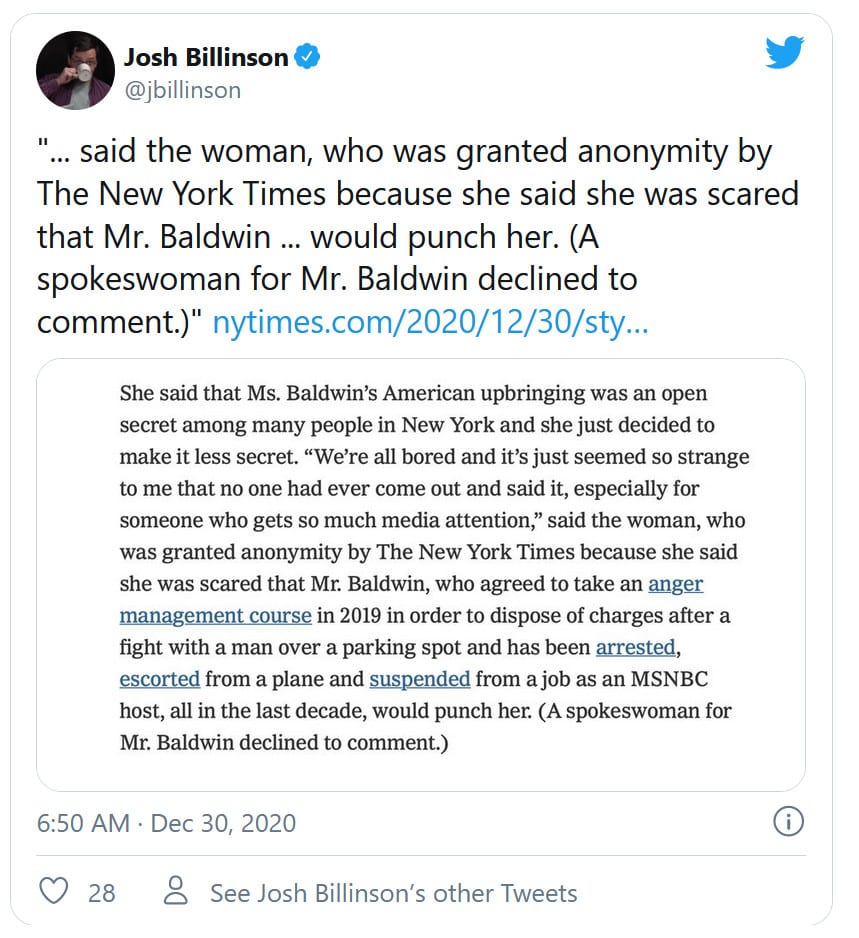
Also in the New York Times: Hilaria Baldwin Doubles Down on the Crazy, Defends Her Bizarre Insistence That She’s Spanish to the New York Times. Serving as a stenographer to a celebrity’s wife who needs some serious PR damage control, the Times is prepared to junk two lefty tropes in a single article: Goodbye, temporarily at least, to both “cultural appropriation,” and #MeToo:

Meanwhile, in order to defect from “Hilaria’s” woes, Alec Baldwin switches into performance art mode: Alec Baldwin Tweets President Trump Deserves, “A Knee On His Neck, Cutting Off His Oxygen.”

VIA BRYAN CAPLAN: The “Democratic Centralism” of COVID.

Since very early in the pandemic, there has been a somewhat novel approach to information flow in the media and particularly on social media sites, at least compared to the baseline in the western world. Very quickly, there seems to have been a consensus that information gatekeepers should determine which opinions about the nature of the coronavirus and the appropriate policy response should be allowed to be widely disseminated. One of the notable early examples was when Medium, which is basically a website host, took down a piece written by Aaron Ginn arguing that the costs of lockdowns should be considered. There was no basis to argue that he was providing disinformation; his post was removed because it argued for a different position than what was being promoted.

While biased journalism is hardly new in the US or anywhere, the movement to close down the ability to distribute alternative opinions seems to have been novel at least within the United States. This was not like the New York Times refusing to publish opinion pieces that disagreed with its editorial stand; this was more like if the people in the olden days who sold bulk newsprint paper refused to allow anyone who dissented from the views of the newsprint providers to even obtain raw materials for printing.

This new attitude is puzzling given the novelty of the virus and the nearly intractable nature of the optimal policy decision, which must take into account the likely spread of the virus under various policies and the overall effect of the policies on the enormously complex and interconnected global economy. It is frankly absurd to think that by March or April all reasonable people had converged to the consensus view that the world economy should be locked down, but major press outlets and information platforms proceeded as if this was established fact. Given the extraordinarily poor performance of even the relatively simple virus models that were applied to the consensus view and the total inability to even begin to estimate the economic and human costs of the lockdowns, in retrospect this rapid convergence on consensus appears to be one of the single greatest acts of hubris in the history of mankind.

But, crucially, even at the time and without the benefit of hindsight this rapid collapse onto a single acceptable viewpoint by those who control the flow of information should have been seen as a colossal error. Modern information economics makes it abundantly clear that in the presence of biased experts whose objectives do not perfectly align with the people receiving advice, having multiple experts, each with their own different biases and preferences, is much better than having a single biased expert. This is true even if you could chose the least biased expert as your one expert.

This was never about providing the best advice, or enacting the best policies.

HUNTER BIDEN: THE DEFINITIVE “TIK-TOK.” In journalism we use the word “tik-tok” for a story that recaps what is known for certain, what’s been alleged and what’s been proven. (It long predates the social media app). It’s not clear to me whether Joe Biden will get the four year tongue bath from media that President Obama was treated to. I’m not betting against it.

That said, if journalism is indeed history’s rough first draft, John Solomon’s justthenews.com has provided a treasure trove of verified information today about Hunter Biden and the ‘big guy’. Key events and emails obtained directly from the infamous laptop (not via Rudy Guiliani or another third party) are included and linked.

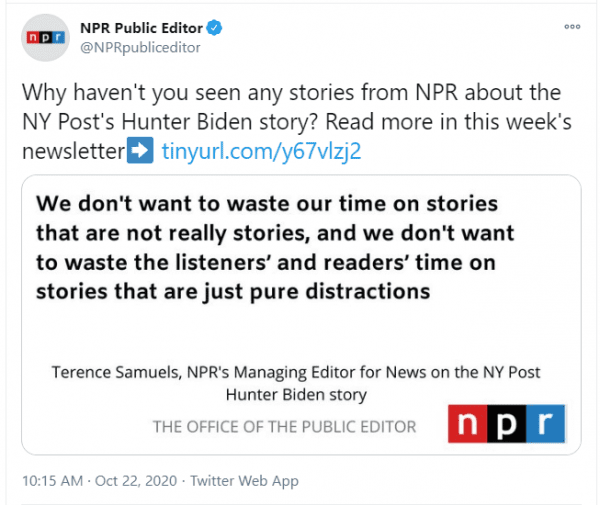
Current and future political scientists, journalists and observers will have this work to draw upon, and it’s a pity that in the blind zeal to drag Joe Biden across the finish line, outfits like NPR pretended the story was not newsworthy:

History will judge them harshly.

TAMARA KEEL: “While writing to Slate’s parenting advice column on the topic of practical firearms safety would seem to make about as much sense as writing to Soldier of Fortune for advice on potty-training or getting your toddler to eat broccoli, someone apparently has done just that. Actually, they don’t want gun safety advice, they just want some validation and asspats for ruining family gatherings with their anti-gun outbursts, and I guess Slate seemed like a good place to go for some of that.”