Archive for 2020

JIM TREACHER: Shellshocked.

Hello, Dear Reader. You haven’t heard much from me lately, because I’m feeling what you’re probably feeling right now: shellshock.

Not “battle fatigue.” Not “operational exhaustion.” Not “post-traumatic stress disorder.” Shellshock. Like George Carlin said 30 years ago, it’s a perfectly accurate and descriptive word for a horrible experience, and over the past century we’ve used euphemisms and distancing language to soften the impact and strip the meaning from it. You might not be shocked by a literal WWI artillery shell right now, but the fear response is the same. The pain and confusion are still real.

Read the whole thing.

#JOURNALISM:

And the press wonders why people don’t trust or respect it.

A POINT THAT SHOULDN’T HAVE TO BE MADE, BUT YES:

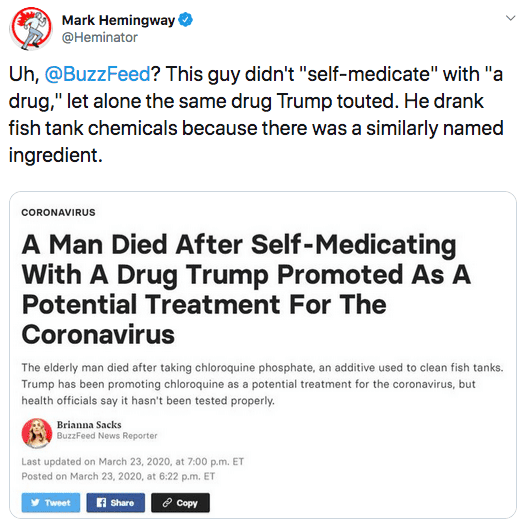
TREATMENTS: These Drugs Are Helping Our Coronavirus Patients:

A flash of potential good news from the front lines of the coronavirus pandemic: A treatment is showing promise. Doctors in France, South Korea and the U.S. are using an antimalarial drug known as hydroxychloroquine with success. We are physicians treating patients with Covid-19, and the therapy appears to be making a difference. It isn’t a silver bullet, but if deployed quickly and strategically the drug could potentially help bend the pandemic’s “hockey stick” curve.

Hydroxychloroquine is a common generic drug used to treat lupus, arthritis and malaria. The medication, whose brand name is Plaquenil, is relatively safe, with the main side effect being stomach irritation, though it can cause echocardiogram and vision changes. In 2005, a Centers for Disease Control and Prevention study showed that chloroquine, an analogue, could block a virus from penetrating a cell if administered before exposure. If tissue had already been infected, the drug inhibited the virus.

On March 9 a team of researchers in China published results showing hydroxychloroquine was effective against the 2019 coronavirus in a test tube. The authors suggested a five-day, 12-pill treatment for Covid-19: two 200-milligram tablets twice a day on the first day followed by one tablet twice a day for four more days.

A more recent French study used the drug in combination with azithromycin. Most Americans know azithromycin as the brand name Zithromax Z-Pak, prescribed for upper respiratory infections. The Z-Pak alone doesn’t appear to help fight Covid-19, and the findings of combination treatment are preliminary.

But researchers in France treated a small number of patients with both hydroxychloroquine and a Z-Pak, and 100% of them were cured by day six of treatment. Compare that with 57.1% of patients treated with hydroxychloroquine alone, and 12.5% of patients who received neither.

What’s more, most patients cleared the virus in three to six days rather than the 20 days observed in China. That reduces the time a patient can spread the virus to others. One lesson that should inform the U.S. approach: Use this treatment cocktail early, and don’t wait until a patient is on a ventilator in the intensive-care unit.

A couple of careful studies of hydroxychloroquine are in progress, but the results may take weeks or longer. Infectious-disease experts are already using hydroxychloroquine clinically with some success. With our colleague Dr. Joe Brewer in Kansas City, Mo., we are using hydroxychloroquine in two ways: to treat patients and as prophylaxis to protect health-care workers from infection. . . . As a matter of clinical practice, hydroxychloroquine should be given early to patients who test positive, and perhaps if Covid-19 is presumed—in the case of ill household contacts, for instance.

Good. Sounds promising.

WELL, THIS IS THE 21ST CENTURY, YOU KNOW: US Army eyes robot tanks with AI.

“For the first time the Army will deploy manned tanks that are capable of controlling robotic vehicles able to adapt to the environment and act semi-independently,” said Dr. Brandon Perelman, scientist and engineer at the Army Research Laboratory, in an interview with WarriorMaven and reported by Kris Osborn in National Interest.

The concept is aligned with ongoing research into new generations of AI being engineered to not only gather and organize information for human decision-makers but also advance networking between humans and machines, wrote Osborn, who previously served at the Pentagon as a Highly Qualified Expert with the Office of the Assistant Secretary of the Army — Acquisition, Logistics & Technology.

“In the future we are going to be incorporating robotic systems that are larger, more like the size of a tanks,” he said.

See also: Loyal wingman.

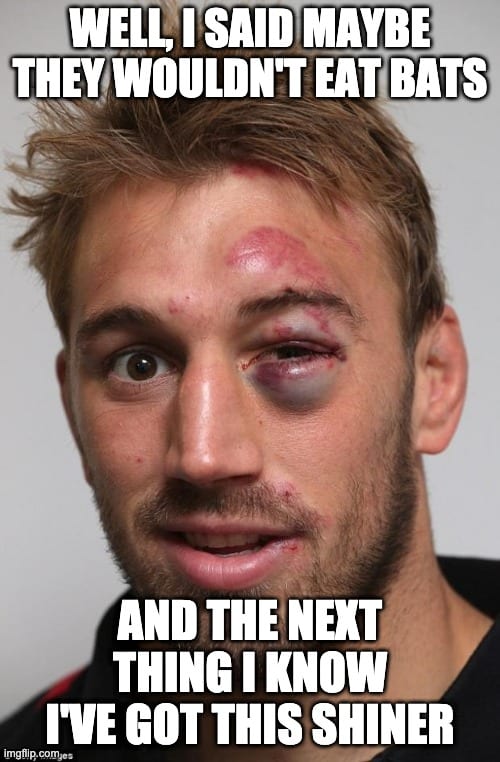
CORONAVIRUS MIGHT NOT HAVE JUMPED FROM BATS TO HUMANS IF CHINA WEREN’T PERSECUTING CHRISTIANS: That may sound far-fetched, but it’s anything but because the Old Testament warned more than three millennia ago that bats are “unclean.” More people in China would know that if the Chinese Communist Party (CCP) regime in China would stop jailing Christians, tearing down churches and suppressing Christianity.

UPDATE: Geez, folks, did nobody see the “might not have” in the title? Man, this is a tough room!

UNEXPECTED, BUT WELCOME: Polis just bet on individuals over harsher crackdown.

Everyone I heard from fully expected Colorado Governor Jared Polis to issue a severe state-wide “shelter in place” order at his Sunday press conference.

George Brauchler seemed to think he would. Brauchler, recall, is a district attorney in the state and a prominent Republican who, in an alternate universe, might have been in the governor’s seat during all this. Shortly before Polis’s media conference, Brauchler pleaded, “Please do not issue any sweeping shelter-in-place order without first consulting with the agencies across the state who will be called upon to enforce such an order.”

On Friday, Colorado Public Radio’s Ben Markus asked, “Why Isn’t Colorado Sheltering In Place Like Other States?” During Sunday’s conference, several journalists seemed shocked that Polis did not issue such an order. Meanwhile, Colorado’s journalists have worried how to keep themselves in the “essential services” category and therefore exempt from any statewide crackdown. (Obviously I agree journalists need the freedom to keep working during this critical time.)

Rather than impose an extreme statewide crackdown, Polis instead did something remarkable, something that politicians often have trouble doing. He chose, at least to a substantial degree, to trust individuals to rise to the challenge, do the right thing, and do their part to keep Coloradans safe. Polis chose to lead with moral authority rather than the point of a government gun.

That’s the way to treat a free people.

JOEL KOTKIN: It’s Not Going To Be A Blue Future: Coronavirus and the future of living and working in America. “Ever since classical times, pandemics have tended to be especially tough on large, dense urban areas. A look at a map of COVID-19 infections, reveals that the vast majority of cases have occurred in dense cities, like Wuhan, and later on around Milan, and, to a lesser extent, Seattle, Los Angeles, San Francisco, New York and Boston. In contrast there has been very little incidence in vast middle of country and particularly more rural areas, which benefit from less crowding and unwanted human contact, which now may be even more attractive to urban workers.”

I’ve always thought that one driver for suburbanization after World War Two was the display of photos showing how much of various urban areas would be destroyed by an atomic bomb. Suddenly, it seemed safer to live a ways from town. This may have a similar effect.

I AGREE, BUT… Ex-Clinton adviser: Coronavirus pandemic ‘changes the presidential race overwhelmingly in Trump’s favor.’

“This crisis completely changes the presidential race overwhelmingly in Trump’s favor,” Dick Morris, who was Clinton’s political adviser and later campaign manager, told radio show host John Catsimatidis on Sunday.

“There is no more oxygen left in the room for Joe Biden. … He can’t say anything. He can’t campaign. He can’t attack Trump. He can’t talk about [the coronavirus]. There is nothing left for him to say,” he added. “Biden is kind of an afterthought. He’s almost in the history books.”

Biden, who is likely to win the Democratic presidential nomination, and his rival Vermont Sen. Bernie Sanders have been sidelined from campaigning across the country because of the pandemic. Trump has also canceled campaign events, but the White House has held daily news briefings on the crisis.

Morris argued Hurricane Sandy had a similar effect on President Barack Obama’s reelection and other policy issues that could derail Trump’s chances of keeping the White House have been brushed under the rug as the coronavirus pandemic takes precedence.

“There are no other issues anymore in America. Nobody’s thinking about immigration, or income inequality, or climate change,” he said. “All Trump has to do now is be a good president. … Ride out this epidemic. Succeed in containing it, and he’s home free.”

…don’t get cocky.

ROGER KIMBALL: Cancel culture comstockery.

Fast forward to early March 2020. The Hachette Book Group suddenly announced that its Grand Central Publishing imprint would be bringing out Apropos of Nothing, a memoir by Allen, in early April. In an interview, Michael Pietsch, Hachette’s ceo, noted the controversy surrounding Allen but said that “Grand Central Publishing believes strongly that there’s a large audience that wants to hear the story of Woody Allen’s life as told by Woody Allen himself. That’s what they’ve chosen to publish.”

A few days later, a group of Hachette employees staged a walkout to protest the book’s publication. The next day, Hachette announced that it was hopping onto the cancel culture bandwagon and dropping the book.

“The decision to cancel Mr. Allen’s book was a difficult one,” said a spokesman for the publisher (so difficult it took twenty-four hours to achieve). “At hbg we take our relationships with authors very seriously, and do not cancel books lightly. We have published and will continue to publish many challenging books.”

Translation: Hachette, as Oscar Wilde said in another context, can resist anything except temptation. Just so long as a book does not attract the ire of the politically correct establishment, the firm is all for publishing “challenging” books. (Item: Commandant of Auschwitz, a memoir by Rudolf Hoess, is published by Hachette.) But trespass on that PC orthodoxy and watch the capitulation, leavened by moralistic hand-wringing, begin. As Groucho Marx is supposed to have said, “These are my principles. If you don’t like them, I have others.”

Our interest in Woody Allen is minimal. Yes, his early movies and writings are funny. Then he discovered Ingmar Bergman. The quantum of pretension and narcissistic self-seriousness proceeded to swamp the comedy. For us, the prospect of wading through “a comprehensive account of [Woody Allen’s] life, both personal and professional” (as Hachette put it when the publishing skies were sunny) is queasy-making.

But Hachette had determined that many readers would be interested in Allen’s life story. They simply forgot to check with the feminist commissars to see if Woody Allen passes muster in the age of #MeToo. He doesn’t.

These weren’t even commissars, but Red Guards in the form of their own 20-something editorial staff, who should have been told that there are lots of people who would like to work in publishing, and that some of those people would be taking over their jobs shortly.

THOUGH YOU’RE NOT MY ENEMY, I LIKE THINGS LIKE THEY USED TO BE.

AN OLD FRIEND’S SON APPEARS IN THIS PHOTO:

SEEN ON FACEBOOK:

Yes, the Coronavirus is a killer. No, it’s not “just a flu”.
But:
They did not stop the economy for cancer, which is a bigger killer.
They did not stop the economy for diabetes, which is a bigger killer.
They did not stop the economy for heart disease, which is a bigger killer.
Why stop it for the coronavirus?

Um, maybe because those aren’t contagious diseases that can be stopped or slowed by quarantine? Just spitballing here. . . .