
Archive for 2020
May 6, 2020
ONE OF THE THINGS I LIKE ABOUT THE TRUMP ADMINISTRATION IS AN UNWILLINGNESS TO TAKE CRAP FROM WASHED UP ATTENTION-SEEKING CELEBRITIES.

And reading Axl’s Twitter feed is just sad. From fearless rocker to . . . male Karen.
FINES ISSUED AFTER VIDEO SHOWS GROUP SKATEBOARDING ON ONTARIO’S GARDINER EXPRESSWAY.
Best to take the California approach and fill the expressway with gravel to put a stop to this unauthorized display of enthusiastic fun.
ROGER SIMON: Pelosi Redefines Hypocrisy and Destroys #MeToo for… Biden?
But the other unintended victim is something more significant — feminism. We have gone from “Sisterhood is powerful!” to “Screw you, sister!” in a heartbeat, thanks to the first female Speaker of the House.
The irony of all this is that it is happening because of Joe Biden. He is what we used to call in show biz Fifth Business, that is, extraneous. (cf. the Robertson Davies’ wonderful novel with that title). As I wrote earlier, he is the Chauncey Gardner presidential candidate, straight out of Jerzy Kosinksi’s accurately titled novel (and then film) “Being There.”
Or is he the human embodiment of Gertrude Stein’s oft-quoted description of Oakland, Calif.—“There’s no there there”?
If #MeToo and feminism itself can be thrown over to make Joe Biden president, then anything’s possible.
I wonder if any of the 75 staffers at Hachette Book Group’s Manhattan office, who in early March walked out in protest (and apparently kept their jobs) to blacklist Woody Allen’s autobiography (temporarily, as it turned out), thought that #metoo would be dead two months later?
Related: Biden Voted to Block Creation of Senate Office That Handles Sexual Harassment Complaints.
More: Sexual assault accuser shocked Joe Biden put Chris Dodd on VP committee.
UPDATE (FROM GLENN): Seen on Facebook:

DISPATCHES FROM THE EDUCATION APOCALYPSE: Education Secretary Betsy DeVos Issues New Title IX Rules To Protect Free Speech, Due Process for Accused Students.
Flashback: “Well, one sexual assault is one too many, and one falsely accused individual is one too many,” DeVos told 60 Minutes in 2018.
.
WHY IS THE LEFT SUCH A CESSPIT OF HOMOPHOBIA? New Jersey Democrat In Hot Water After Calling Gay Mayor A ‘Pedophile.’
In a 2016 article for the Conversation, an online academic journal, historian John Broich best summed up how fascism and il Duce were viewed in the U.S.: “Mussolini was a darling of the American press, appearing in at least 150 articles from 1925–1932, most neutral, bemused or positive in tone.” The Saturday Evening Post even serialized the fascist leader’s autobiography in 1928. Acknowledging that the new “Fascisti movement” was a bit “rough in its methods,” as the New York Tribune put it, papers ranging from the Cleveland Plain Dealer to the Chicago Tribune credited it with saving Italy from the far Left and revitalizing its economy. From their perspective, the post-war surge of anti-capitalism in Europe was a vastly worse threat than fascism. Ironically, while the media acknowledged that fascism was a new “experiment,” papers like the New York Times commonly credited it with returning turbulent Italy to what it called “normalcy.”
Some things never change. Though no word yet if the Gray Lady of the 1930s believed that Mussolini’s form of socialism would improve his nation’s collective sex life.
DECADENCE AND DEPRAVITY IN LOUISVILLE, KENTUCKY: At Quillette, David S. Wills looks at the rapid rise and slow drug-fueled decay of Dr. Gonzo, Hunter S. Thompson.
Despite his reputation as a sybarite, Thompson mostly smoked cigarettes and slugged beers while writing. Recreational drug use was generally reserved for when he was not at his typewriter. However, when David Felton at Rolling Stone asked Thompson to review Sigmund Freud’s Cocaine Papers for the magazine in 1973, he thought it would be dishonest not to try the substance in question and had Felton send him some. Most of the people close to Thompson identify this as the turning point after which drug abuse overwhelmed his ability to write. The Freud review was never published, and Thompson subsequently developed a habit of taking assignments and simply not completing them.
There were also the pitfalls of fame to navigate. After Fear and Loathing in Las Vegas, Thompson was practically a household name, and his notoriety only grew throughout the rest of the decade. He became trapped in the character of Raoul Duke, particularly after he was satirized in Gary Trudeau’s comic, Doonesbury. Even when he tried to do his job, he found himself hounded by autograph hunters. Fans, journalists, politicians… everyone wanted to meet America’s glamorous outlaw journalist. On one occasion when he was attempting to report on a court case, the judge blurted out, “I’m so honored to meet you, Mr. Thompson.”
He retreated to his “fortified compound” in Woody Creek, Colorado, where he surrounded himself with friends, drugs, guns, and other distractions. Soon he was partying with John Belushi, Bill Murray, Jack Nicholson, Sean Penn, and Johnny Depp. This hedonistic existence was not exactly compatible with a journalist’s deadlines or a novelist’s long meditations. As the years went by, it became harder to recall the days when he had sweated over every word and sentence and paragraph as he redrafted Fear and Loathing. Gonzo had been the breakthrough that allowed Thompson to command vast fees for his increasingly erratic writing and disastrous speaking engagements. He had planned to apply his unique approach to a wide variety of stories, but instead he became trapped in the cartoonish world he had created—what had once seemed so fresh and original soon became stale and repetitive.
He had arrived on the scene with a bang in the first years of the Seventies, but most of what remained of the decade disappeared in a blur of disappointment and failure. He flew to Zaire to cover one of the biggest sporting events of the century, “The Rumble in the Jungle,” and spent several weeks taking drugs instead of trying to get face time with Muhammad Ali or George Foreman. Hours before the fight, Ralph Steadman found Thompson in a swimming pool, clutching a bottle of scotch and surrounded by chunks of floating marijuana. The pair of them had been paid by Rolling Stone to report on the fight, but Thompson had sold their tickets.
A year later, he flew to Vietnam to cover Saigon’s fall to the North Vietnamese, but days before the city fell, he fled to Hong Kong. He refused to hand over what little writing he had managed to produce to the Rolling Stone editors, and it was 10 years before his report was eventually published. In the Eighties, Jann Wenner managed to entice Thompson to cover the US invasion of Grenada, and was rewarded with the same fiasco. A trip to New Orleans similarly turned into a week’s abuse of his publisher’s credit cards, with not even a half-baked article to show for it at the end.
This kind of behavior became normal for Thompson. Long-suffering friends like Wenner who had tolerated his tantrums and abuse and chronic unreliability finally ran out of patience. Few editors would dare hire him, and those that did found that he would take vast sums of money and then simply not turn in any work. Sometimes he tried hard and failed, and other times he just did not try at all. When he did manage to file copy, it was frequently so unintelligible that his editors would have to work for days patching fragments of disordered prose into something comprehensible. From a bottom-line point of view, it was usually worth the effort because his name still sold copies and his fans did not much care what he turned in. But the decline in quality was steep.
By the end, the man whom Tom Wolfe credited in the mid-1970s as being the star of “New Journalism” was reduced to a painful-to-read ESPN.com column, culminating in Thompson red-lining the Godwin meter in 2004:
The long-dreaded 2004 Olympics in Greece will be the ultimate crossroads for sports and politics in this new and vicious century. The recent photos of cruelty at the Abu Grahaib all-american prison in Baghdad have taken care of that.
Yes, sir. We have taken the bull by the horns on this one, sports fans. These horrifying digital snapshots of the American dream in action on foreign soil are worse than anything even I could have expected. I have been in this business a long time and I have seen many staggering things, but this one is over the line. Now I am really ashamed to carry an American passport. Not even the foulest atrocities of Adolf Hitler ever shocked me so badly as these photographs did.
Around that time, James Lileks wrote:
Thompson has less hope than the Islamists; at least they have an afterlife to look forward to. All we have is a country so rotten and exhausted it’s not worth defending. It never was, of course, but it’s even less defensible now than before.
He can say what he wants. Drink what he wants. Drive where he wants. Do what he wants. He’s done okay in America. And he hates this country. Hates it. This appeals to high school kids and collegiate-aged students getting that first hot eye-crossing hit from the Screw Dad pipe, but it’s rather pathetic in aged moneyed authors. And it would be irrelevant if this same spirit didn’t infect on whom Hunter S. had an immense influence. He’s the guy who made nihilism hip. He’s the guy who taught a generation that the only thing you should believe is this: don’t trust anyone who believes anything. He’s the patron saint of journalism, whether journalists know it or not.
Thompson would be dead less than a year later.
Rolling Stone published what Doug Brinkley described as a suicide note written by Thompson to his wife, titled “Football Season Is Over”. It read:
No More Games. No More Bombs. No More Walking. No More Fun. No More Swimming. 67. That is 17 years past 50. 17 more than I needed or wanted. Boring. I am always bitchy. No Fun — for anybody. 67. You are getting Greedy. Act your age. Relax — This won’t hurt.
In his Quillette article, David S. Wills concludes:
As a young man, Hunter S. Thompson had visited Ernest Hemingway’s home in Ketchum, Idaho, to discover what had driven a great American writer to take his own life. He concluded that Hemingway had lost confidence in his voice and was unable to describe a world moving at a frantic pace. Forty-two years later, Thompson found his own reasons. The publication of his electrifying dispatch from the Kentucky Derby on May 2nd, 1970, had announced him as among the most innovative and powerful voices in American letters. But when a great writer can no longer write, and when even the possibility of turning out another great book no longer exists, there is little else to do. It was a tragic end to a life of unfulfilled promise.
Read the whole thing.
REMINDER: WHY REQUIRING MASKS OUTDOORS IS GENERALLY DUMB: Sunlight destroys coronavirus quickly, say US scientists.
AT AMAZON, spring savings in Car Care.

PROJECT VERITAS EXPOSES CBS THIS MORNING CREW FAKING A SCENE AT A MICHIGAN COVID TESTING SITE.
To be fair, that’s awfully on-brand from the network that brought you Walter Cronkite, Dan Rather, Katie Couric, and Scott Pelley.
BRENDAN O’NEILL: What Neil Ferguson’s booty call tells us about modern politics. “It is actually incredibly important news that Ferguson, the Imperial College modeller who said it was possible 500,000 Brits would die if we didn’t lock down, defied the lockdown. It deserves the frontpage treatment it is getting today. For Ferguson’s booty call with his married lover actually reveals a great deal about the 21st-century elites and how they view their relationship with the masses. It’s one rule for them and another for us.”
DRIVE-BY MEDIA GETS MURDERED:
UPDATE: Kayleigh McEnany rips media for downplaying coronavirus when pressed on her past rhetoric.
I SUSPECT THAT THE SWEDES SEE HIGHER DEATH TOLLS AMONG OLD PEOPLE — AND, I THINK, IMMIGRANT POPULATIONS — AS A FEATURE, NOT A BUG: Sweden Health Agency Investigates High Coronavirus Death Toll In Elderly Care Homes.
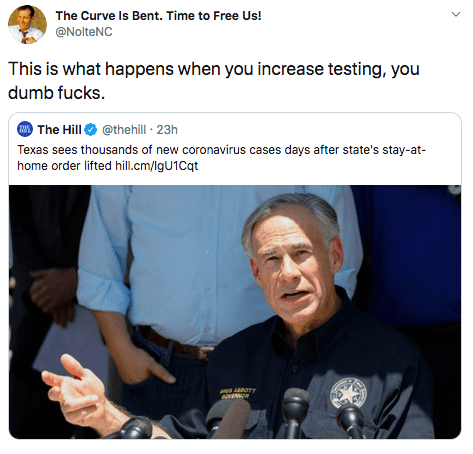
MATH IS HARD:
IRISH DEMOCRACY: Something that can’t go on forever, won’t. The lockdown can’t go on forever, and it isn’t. In Tennessee, we’re following a reasonably well-thought-out plan for reopening things. But a friend from Manhattan writes that she’s seeing stores, coffee shops, etc., just spontaneously reopening in spite of the orders. Not with loud defiance, just ignoring the government. It’s “Irish democracy,” and we’re going to see a lot more of it.
The shutdowns were sold as “two weeks to slow the spread,” and “flattening the curve,” and so on, and lots of people thought that was sensible, and it was. A two-month (or longer) shutdown is a different animal, and nobody consented to that. So now people are, mostly silently, withdrawing their consent from the state.
MY USA TODAY COLUMN: Coronavirus lessons on density, mass transit, bureaucracy and censorship: They kill.
PARTY OF SCIENCE: Cuomo says it’s ‘shocking’ most new coronavirus hospitalizations are people who had been staying home. It’s almost as if most people are staying home, and people who are staying home are most people, and hospitalizations come from people.
NEIL FERGUSON’S REMARKABLE FALL FROM GRACE:
I originally had Neil Ferguson down as a kind of Henry Kissinger figure. The professor of mathematical biology at Imperial College London seemed to have bewitched successive prime ministers, blinding them with his brilliance. Whenever a health emergency broke out, whether it was mad cow disease or avian flu, there he was, PowerPoint in hand, telling the leaders of the United Kingdom what to do. And they invariably fell into line. In 2001, after the outbreak of foot and mouth, his team at Imperial advised Tony Blair’s government to adopt a strategy of pre-emptive culling, leading to the slaughter of more than six million animals. Gordon Brown consulted him about swine flu in 2009 and two months ago Boris Johnson was persuaded to put the country under lockdown after the 51-year-old boffin bamboozled him with one of his computer models.
But it turns out to be less a case of Dr Strangelove than Carry On Doctor. On Tuesday night, we discovered that the furrowed-browed scientist, who has been at the Prime Minister’s side throughout this crisis, is in fact Austin Powers in a lab coat. He’s been having an affair with a 38-year-old married woman who travels regularly across the capital from her home in south London to spend time with him. This revelation, which has to be the scoop of the year, was brought to us by the Telegraph and is the epitome of what newspapers call a ‘marmalade dropper’ — a story so astonishing it causes the typical reader to drop his toast mid-mouthful.
A good deal of the coverage has focused on Ferguson’s hypocrisy. After all, this is the man who has told 66 million Britons they must remain in their homes to protect the NHS and save lives. Under the draconian new rules imposed by the Coronavirus Act, we’re allowed to venture out only if we have a ‘reasonable excuse’ such as a medical emergency, daily exercise, essential food shopping or certain types of work. Hard to imagine an extra-marital affair falling under one of those headings. How can Professor Lockdown encourage the authorities to enforce these rules when he’s flagrantly breaking them himself?
“On at least two occasions, Antonia Staats, 38, traveled across London from her home in the south of the capital to spend time with the government scientist, nicknamed Professor Lockdown,” reported the Telegraph.
Staats, we later learn, lives with her husband and two children in a £1.9 million home in south London. She’s a “left-wing campaigner” who is reportedly in an open marriage. According to the Telegraph, “She has told friends about her relationship with Prof Ferguson, but does not believe their actions to be hypocritical because she considers the households to be one.”
Ah yes, the old our-households-are-one-because-I’m-in-an-open-marriage argument. Never mind that a week before Ferguson and Staats’ first meeting, Britain’s Health Secretary had said even couples not living together must stay apart during the lockdown.
* * * * * * * * *
One rule for the poor people, another rule for us elites. And they wonder how they got Brexit.
A month ago, Glenn linked to this story in Science Alert, “Stunning Satellite Images Reveal Pollution Plummeting Across Europe in Lockdown,” with the Insta-headline, “My Grandpa Was Right: Smog Means Jobs. And Conversely.”
There have been loads of enviro-lefty articles along similar lines shortly after the Big Lockdown began. Will Ferguson or Staats be asked about their role in setting that scenario in motion?
IRRATIONAL EXUBERANCE: What Do We Clap for When We Clap for Government? I like joining my Bronx neighbors in the nightly tribute to health-care workers, but I worry about our fondness for “encompassment,” as the economist Daniel Klein terms our yearning for emotional communion with everyone around us. As Hayek warned, it’s this emotional inheritance from our hunter-gatherer ancestors that leads to blather about “social justice” and enthusiam for political collectivism. This primal impulse for solidarity explains why socialism’s appeal endures despite its colossal failures — and why Americans have cheered the unprecedented expansion of government power during the pandemic.
THIS IS FOR YOUR HEALTH, SIR!!!! Video: NYPD Officer Beats Bystander, Kneels On His Head During Social Distancing Enforcement.
SOMEONE FORGOT TO MUTE: Supreme embarrassment: The flush heard around the country.
RELEASING VIOLENT SEX OFFENDERS WHILE LOCKING UP SALON OWNERS IS A BAD LOOK FOR THE DEMOCRATS: Texas Attorney General Ken Paxton Calls For ‘Immediate Release’ Of Jailed Dallas Salon Owner Shelley Luther.