LIZ SHELD’S MORNING BRIEF: Nunes Targets Sessions, Mueller Gets Some Throat Punches and Much, Much More. “Why does the DOJ think it’s above the oversight process? It’s almost as if they are hiding something.”
Almost!

LIZ SHELD’S MORNING BRIEF: Nunes Targets Sessions, Mueller Gets Some Throat Punches and Much, Much More. “Why does the DOJ think it’s above the oversight process? It’s almost as if they are hiding something.”
Almost!
I AGREE, BUT I’M NOT OPTIMISTIC:
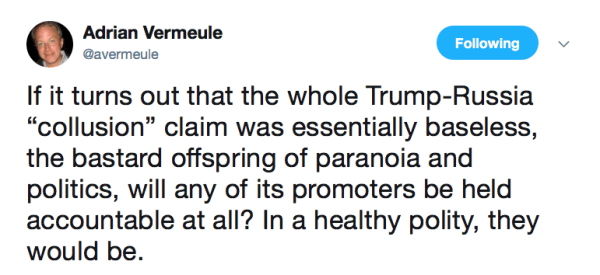
Because we don’t live in a healthy polity.
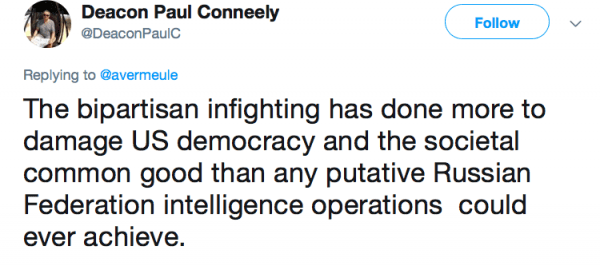
And the people claiming the most concern with Russian machinations have contributed the most to the damage.
Related: How the Russian collusion myth was hatched by Team Hillary immediately after her loss.
It’s all in Shattered, a book everyone supposedly read.
PRIVACY: Mark Zuckerberg apologized. Now he has to fix Facebook for real.
After two months of public beating, punctuated with a combined 10 hours of testimony before three congressional committees in Washington, Zuckerberg spent his time on the F8 stage signaling that things were going to change.
It started with his uniform. Gone was his years-old dress code of hoodies, grey T-shirts and blue jeans, swapped out for a more mature sweater and dark pants.
Zuckerberg’s announcements were peppered with a newfound restraint too. For 14 minutes, nearly half his speech, Zuckerberg talked about data privacy, election integrity and fact-checking articles posted to the site. When Zuckerberg finally got to announcing new features for Facebook, like a dating service to take on Match.com and Tinder, he immediately noted it was designed with “privacy and safety in mind from the beginning.”
He even scooped his own presentation, announcing 85 minutes before the F8 festivities began a new feature to clear people’s web and app histories from Facebook. “One thing I learned from my experience testifying in Congress is that I didn’t have clear-enough answers to some of the questions about data,” he said. “We’re working to make sure these controls are clear, and we will have more to come soon.”
Fixing Facebook “for real” would involve adopting a new business model which, given the company’s profitability, seems unlikely in the extreme.
A NEW HOPE: Joel Kotkin: Looking Beyond One-Party Rule In California.
It’s been a half century since Ronald Reagan shocked California, and the nation, by beating the late Pat Brown for governor by a million votes. Yet although the Republican Party is a shadow of its mid-20th century form, there are some clear signs that growing discontent — including among independents and many Democrats today — with the regime forged by Brown’s son Jerry, with which so many progressives are deeply enamored.
In 1966 Reagan used the term “Ya basta” (“Had enough?”) to tap on voter displeasure on issues from the Watts Riots, disturbances at Berkeley, resistance to growing state bureaucracy and elevated levels of taxation. As historian Gene Kopelson has suggested, Reagan even penetrated Mexican-American communities, winning a larger share of their traditionally solid Democratic vote than previous GOP candidates.
As in the 1960s, California’s economy appears relatively buoyant. Yet the state’s post-recession resurgence has been greatly skewed to one region — the Bay Area — and benefited a relatively small group of people. The rest of the state largely has stagnated economically, with no appreciable income growth adjusted for costs. With weakness in higher-paying blue- and white-collar sectors, three out of five Californians express dissatisfaction with the current economic “boom,” as well as the rampant growth of inequality in the state.
Even in the Bay Area, there has been a surge in homelessness, and reduced incomes for Latinos and African Americans. Rather than an engine of upward mobility for locals, the tech economy workforce is made up of over 40 percent non-citizens, many not much better than indentured servants. Housing prices are now out of reach even for Google engineers; roughly three-quarters of millennials in the Bay Area are considering an exit, largely due to unaffordable housing.
Similarly, young people in Los Angeles, notes a recent UCLA survey, are the most dissatisfied with life in the Basin. Poverty in South L.A. remains as intractable today as it was at the time of the 1992 riots. The Central Valley and the Inland Empire remain economically distressed, with elevated levels of poverty and a lack of good paying jobs.
As another famous man once said, what have they got to lose?
BACK TO THE FUTURE: U.S. Navy Reviving Atlantic Fleet. “Seven years after deactivation, the U.S. Second Fleet will be patrolling the North Atlantic again.”
The oceans haven’t gotten any smaller, our seaborne trade increases every year, but our Navy is still less than half the size it was in 1989.
NOBODY WANTS TO TALK PUBLICLY ABOUT MALAYSIA’S AFFIRMATIVE ACTION POLICY, BUT VOTERS SURE DO THINK ABOUT IT: From the Nikkei Asian Review:
For decades Malaysia has granted privileges to ethnic Malays … or Bumiputera [translation: “Sons of the Soil”], under a policy of affirmative action for the majority group that is less wealthy than the country’s ethnic Chinese minority. While this policy has created discontent …, it has largely dropped out of the political debate ahead of general elections on May 9 ….
“There is always unfairness we feel,” a 58-year-old retired ethnic Chinese man told the Nikkei Asian Review on Thursday, speaking of … affirmative action … officially known as The New Economic Policy, launched in 1970. He was attending an evening rally by the opposition coalition Pakatan Harapan, or Alliance of Hope, … which drew about 1,000 people from diverse races. Together, they called for the defeat of Prime Minister Najib Razak’s ruling coalition.
The retired man said he felt that the Chinese were treated as “second-class or third-class citizens.” … [H]e added: “We are all hoping that there will be some changes [in the Bumiputera policy].”
Malaysian politics is not as different from American politics as one might hope. Polls indicate that Americans oppose race-preferential college admissions and employment practices, and the clearer the poll questions, the more strongly they oppose such preferences. It’s very likely this issue has contributed to the pattern of racially-polarized voting that we see today.
The kicker—as I discuss in A “Dubious Expediency”: How Race-Preferential Admissions Policies on Campus Hurt Minority Students—is that affirmative action admissions policies aren’t even good for their supposed beneficiaries. Nobody ever said public policy is rational.
ELIZABETH PRICE FOLEY IN THE HILL: Mueller’s jurisdiction must be limited.
Special Counsel Robert Mueller’s investigation has begun to reek of both desperation and megalomania. On Friday, a federal judge overseeing the Paul Manafort prosecution, T.S. Ellis III, questioned whether the special counsel has strayed beyond its original jurisdiction over possible Trump-Russia collusion, demanding to see an unredacted version of a memo penned by Deputy Attorney General Rod Rosenstein that allegedly authorizes the special counsel to pursue Manafort for unrelated matters dating to 2005.
Judge Ellis expressed concern that the special counsel was claiming “unfettered power” to investigate anyone, for anything, in an effort to inflict political harm on the president. “You don’t really care about Mr. Manafort,” Judge Ellis told Mueller’s team. “You really care about what information Mr. Manafort can give you to lead you to Mr. Trump and an impeachment, or whatever.”
Judge Ellis’s legal instincts are right. The special counsel, like the independent counsel that preceded it, is a dangerous constitutional hydra. In 1999, Congress allowed the old independent counsel statute to lapse because independent counsels routinely had strayed beyond their original jurisdiction, morphing into political witch-hunts aimed at embarrassing, hindering and impeaching presidents.
Independent counsel investigations had infuriated both sides of the political aisle: Republicans were furious with the Iran-Contra investigation led by Independent Counsel Lawrence Walsh. Democrats were furious with the Whitewater investigation led by Independent Counsel Ken Starr (which ultimately led to House impeachment of President Clinton).
In place of the independent counsel statute, we now have special counsel regulations, issued by the Department of Justice. In theory, the special counsel regulations are supposed to be “better” than the old independent counsel law, because the lines of political accountability to the president are stronger, with the special counsel being an employee of the Department of Justice who can be fired by the attorney general for “good cause.” The attorney general, in turn, serves at the pleasure of the president, and can be fired for any reason.
But when Attorney General Jeff Sessions recused himself, President Trump’s opponents immediately began a campaign asserting that any effort to fire Rosenstein or Mueller would constitute an obstruction of justice. Nothing could be further from the truth: The president has plenary constitutional authority to fire his executive branch officers. This is so because the executive branch is not a “fourth branch of government” — it is the second branch, a manifestation of power granted to the president by Article II of the Constitution.
She’s right.
HMM: U.S. Troops in South Korea Emerge as Potential Bargaining Chip.
If a peace deal can be struck with Pyongyang, would there be any need for U.S. forces on the Korean Peninsula?
The suggestion, once taboo in Washington and Seoul, comes ahead of a planned summit between North Korean leader Kim Jong Un and President Donald Trump, where some North Korea watchers expect Mr. Kim to raise the idea with the U.S. president.
A fringe minority of peace activists in South Korea has for decades called for the removal of the 28,500 U.S. troops in South Korea, calling them an affront to the country’s sovereignty and an obstacle to peace. That is largely in line with North Korea’s consistent position in calling for their removal.
Generally in South Korea and the U.S., however, the idea of withdrawal or troop reduction has been regarded as a nonstarter. Both the White House and South Korea’s left-leaning Moon Jae-in administration have been careful to underscore the importance of the U.S.-South Korea military alliance for maintaining stability in the region.
On Friday, national security adviser John Bolton joined the Pentagon and South Korea’s presidential office in denying a New York Times report that Mr. Trump had ordered the Pentagon to look into drawing down troops in South Korea.
Even so, the debate has picked up steam in the past week as top advisers and officials in the U.S. and South Korean governments express an openness to the idea.
Disbanding US VII Corps in the wake of our twin victories in the Cold War and the Iraq War, then eventually denuding NATO of heavy American forces, accomplished little but encourage Russian adventurism.
IT’S BEEN A LONG TIME SINCE THE BATTLES OF LEXINGTON AND CONCORD: This Is The Toughest Gun Law In America. “Reformers love what Massachusetts is doing. The NRA? Not so much.”
A thirtysomething man sought to buy a rifle here last September, and if he had been living in almost any other part of the country, he could have done so easily.
His record was free of arrests, involuntary psychiatric commitments or anything else that might automatically disqualify him from owning firearms under federal law. He could have walked into a gun store, filled out a form and walked out with a weapon in less than an hour.
But he couldn’t do that in Massachusetts because the state requires would-be buyers to get a permit first. That means going through a much longer process and undergoing a lot more scrutiny.
Each applicant must complete a four-hour gun safety course, get character references from two people, and show up at the local police department for fingerprinting and a one-on-one interview with a specially designated officer. Police must also do some work on their own, searching department records for information that wouldn’t show up on the official background check.
I’ll leave it to Glenn to opine on the constitutionality of Massachusetts’ gun restrictions. But I will wonder out loud if HuffPo writer Jonathan Cohn would sound so jubilant if he had to jump through the same hoops before being allowed to exercise his First Amendment right to publish an opinion piece.
NO, THE CLINTONS ARE NOT TOO BIG TO JAIL: Remember the megabuck Wall Streeters who were “too big to fail” without putting the entire economy at risk. Well, Charles Ortel makes the case in today’s LifeZette that Bill and Hillary are not too big to jail without fears the civilized world will come crashing down.
A TALE OF TWO CITIES: How Russia Lost WWII.
This week, Russia will spend millions of dollars to put up yet another WWII victory parade in the Red Square. Tanks will rumble and jets will fly overhead. Nuclear-capable ballistic missiles will slowly crawl past the same old mausoleum with the same old corpse inside. But what about the people watching? Some are clinging to old glory. Many are beginning to see the absurdity of celebrating in superpower style victory over countries that are now vastly more prosperous than their own. Russia is a poor country that does not even have the technological and business expertise to exploit its own natural resources, letting foreign powers do it instead, akin to the literal banana republics of early 20th century Central America. Russia has roughly half the population it had a hundred years ago and in many metrics such as consumer goods production has yet to reach pre-revolutionary levels or levels that were achieved by Stalin’s GULAG slave labor in the 1930’s. In all ways that count, Russia is the sole loser of the Second World War.
Nazi Germany inflicted unimaginable losses on the Soviet Union. But since 1945 all of Russia’s many, lingering wounds have been self-inflicted.
MICHAEL WALSH: In the Trump Era, Politics and Pews Don’t Mix. “This is how the Left works: by covering its attack on the past by using the values of the present in order to command the dialogue of the future.”
Needless to say, read the whole thing.
JULIE KELLY: The Rape Culture of Politics by Investigation. “This is a punishment strategy. I think they want to destroy the president, they want to destroy his family, they want to destroy his businesses, they want to destroy his friends.”
BECAUSE IT IS: Activist Art Exposed as an Elitist Bait and Switch.
‘BOUT TIME SOMEONE DID: Judge Ellis Wants to See Mueller’s Hunting License.
THIS IS MY SHOCKED FACE: Lock Him Up: If Anyone Is Violating the Logan Act, It’s John Kerry!
MUSCLE MEMORY STILL HAS ME TYPING TWO SPACES BETWEEN SENTENCES, BUT I MIGHT AS WELL TYPE “I’M OLD” ALL OVER MY MANUSCRIPTS: One space between each sentence, they said. Science just proved them wrong.
A CONFLAGRATION OF REPULSIVE: Michael Moore Wishes Karl Marx Happy Birthday. Because of Course.
DEFUSING THE POPULATION BOMB ONE STREAMED VIDEO AT A TIME: Netflix is killing couples’ sex lives: study.
GERALDO RIVERA MOST AFFECTED: Egypt says no hidden rooms in King Tut’s tomb after all.
InstaPundit is a participant in the Amazon Services LLC Associates Program, an affiliate advertising program designed to provide a means for sites to earn advertising fees by advertising and linking to Amazon.com.

