Archive for 2018

OF COURSE: Facebook created a tool to hide your data from apps but it never launched.

Facebook’s policies prior to 2014 were much more lax than they are today. At the time, apps could scrape data from both their users and the friends of those users, unless you had your privacy setting sufficiently locked down.

The company actually built an “Anonymous Login” tool that was specifically created so that Facebook users could log into third-party services without making all of their data available to developers.

But the once-hyped feature never launched. Facebook quietly killed the project, allegedly due to lack of interest.

Whose lack?

YOUR CHEAP SHOT OF THE WEEK: Huffington Post encourages mocking the encouragement of women in science. Oh, it’s Ivanka. SUSPEND YOUR PRINCIPLES! The column is slugged “Humor” but I think *this* is actually funnier.

VIDEO: Dem Rep Thanks Andrea Mitchell For Advice To Hire McCabe.

More:

Despite the allegations of severe misconduct, Democrats and members of the media have fretted over McCabe’s lost pension. Mitchell, who hosts a show on MSNBC, offered “friendly member[s] of Congress” a strategy for McCabe to collect his check anyway.

“One suggestion from a McCabe supporter: if a friendly member of Congress hired him for a week he could possibly qualify for pension benefits by extending his service the extra days,” Mitchell helpfully tweeted.

Democratic lawmakers took the hint and started offering McCabe jobs en masse.

If it weren’t obvious that they all got the idea from Mitchell, Democratic Rep. Mark Pocan specifically thanked Mitchell on Monday’s edition of “Andrea Mitchell Reports.”

“Well, it’s your tweet, Andrea. It was your tweet that started all this,” Pocan said. “I just want you to know. We saw your tweet over the weekend and that’s what gave us the idea. So, thank you.”

“Well, that’s interesting to note,” Mitchell said modestly. “Thank you very much, congressman.”

Joe Simonson adds, “We tried finding out if an anchor or reporter offering advice to politicians is a violation of NBC’s policies, but they wouldn’t respond.”

That’s none of your business, prole.

ROBOTS: The Beginning Of The End Of Work.

From the cute little vacuum Roomba to Siri or Alexa and cars that drive themselves, we are at the beginning of the end of work. In 2013, a now-famous Oxford University analysis forecasted that 47 percent of all jobs are threatened in the United States. There are already signs from shuttered shopping malls to the fact that robots and artificial intelligence are taking over factories, offices, and cash registers. Clearly, they will win the job stakes because they don’t ask for raises or take sick days.

All of which is to say that winter is coming to America’s middle class.

The late physicist Stephen Hawking warned that this would result in income disparity and chaos. “Everyone can enjoy a life of luxurious leisure if the machine-produced wealth is shared, or most people can end up miserably poor if the machine-owners successfully lobby against wealth redistribution. So far, the trend seems to be toward the second option, with technology driving ever-increasing inequality,” he wrote.

Hawking’s warning may be regarded by some as hysterical, but it should be heeded. Deniers maintain that automation triggers “creative disruption” or a transition from lousy jobs to better ones. For instance, Silicon Valley types trot out the fact that in 1900, 40 percent of people slogged daily on farms, and now only 2 percent do. However, their example disproves their point: The transition in the United States from farm to city took generations and was grueling, scarred by social disruption, mass underemployment, unrest, sweatshops, urban slums, forced urbanization, poverty, crime, worker struggles, and enormous socioeconomic upheaval and strife. This time will be different, and possibly worse, unless brakes or policies are put in place as automation increases.

The automation trend clearly makes workers uneasy, but hard facts are unavailable because technological unemployment is not identified and highlighted in economic reports as it should be. This lapse lulls some into disbelief about dire predictions because, after all, unemployment levels are relatively low, (though so is labor force participation), and job creation growth appears respectable. But a glimpse into what’s underway was contained in a 2014 study by the U.S. Bureau of Labor Statistics which measured hours of work (whether by self-employed, part-time or full-time workers) and not jobs over a 15-year period from 1998 to 2013.

During that time, economic output in the United States increased by 42 percent (or $3.5 trillion after inflation adjustments). But the number of hours worked remained exactly the same, at 194 billion hours in total. This is technological unemployment: Zero growth in the number of hours needed to create wealth despite a population increase of 40 million people. . . .

Robots and AI are going to cut an even deeper swath through the middle class, blue and white collar, and there are no replacement jobs.

And unemployment, Nancy Pelosi’s reassurances notwithstanding, isn’t good for people.

PROCUREMENT: Navy, Newport News Taking Steps Towards Two-Carrier Buy.

The Navy today moved towards signing the first two-carrier contract since the Reagan Administration, asking builder Newport News Shipbuilding for additional data on the cost-savings potential for buying CVNs 80 and 81 together.

The service released a request for proposal to the company this afternoon, with the hopes of receiving the necessary cost and schedule predictions by late summer or early fall and potentially reaching a two-carrier agreement with Newport News Shipbuilding by the end of the calendar year.

Assistant Secretary of the Navy for Research, Development and Acquisition James Geurts told reporters today that it is still unclear what the final product would be after today’s RFP – whether it would be a construction contract for two aircraft carriers, or some other means of allowing for the Navy and its prime contractor to buy two ship-sets of materials at a time.

“If you’re building two of these, your return on investment and the sharing between the government and industry to drive towards affordability, I think, there’s a much better return on investment,” he said.

For example, “instead of buying one set of parts we buy two sets of parts.”

Here’s to hoping, but government spending rarely seems to work out that way.

WAIT, WHAT? Ex-French president Sarkozy held on Gadhafi claims. “In the latest judicial setback for the former French president, Nicolas Sarkozy was placed in custody on Tuesday as part of an investigation that he received millions of euros in illegal campaign financing from the regime of the late Libyan leader Moammar Gadhafi. . . . Sarkozy has vehemently and repeatedly denied wrongdoing in the case, which involves funding for his winning 2007 presidential campaign.”

NEWS YOU CAN USE: How to Make a Clean Break with the Clingiest Social Networks.

If you’ve ever deactivated your account, you may have noticed that everything goes back to normal the next time you log in, as if nothing has happened. That’s because deactivating your Facebook account is not the same as deleting it. When you deactivate your account, you are just hiding your information from searches and your Facebook friends. Although nothing is visible on the site, your account information remains intact on Facebook’s servers, eagerly awaiting your return.

Even so, deactivating your account is still a complex process. Go into your settings and click General. At the bottom, you’ll find Manage your Account. From there, click on “Deactivate your account” and type in your password. Before you’re completely off the hook, Facebook shows you photos of all the “friends” you’ll miss (“Callie will miss you”, “Phoebe will miss you”, “Ben will miss you”) followed by a survey asking you to detail your reasons for leaving. Get through that, click Deactivate, and you’re good to go.

Now, to permanently delete your account, you’ll need to learn where the delete option resides. The easiest way to find it is by clicking the “Quick Help” icon in the top-right corner, then the “Search” icon. When you see the search field, type “delete account.” You’ll see a list of search results. Click on “How do I permanently delete my account?” and Facebook will give you the obscure instructions to “log into your account and let us know.” In this case, “let us know” is code for “delete my account,” so click on that link. From here, the final steps are clear: Enter your password and solve the security captcha, and your request to permanently delete your account is underway.

Yes, you read that right—it’s just a request. Facebook delays the deletion process for a few days after you submit your request, and will cancel your request if you log into your account during that time period.

It’s like trying to find the exit from the casino floor.

HOW U.S. NEWS SHAFTED PEPPERDINE LAW SCHOOL.

My sense, actually, is that Pepperdine is doing very well these days, and if the ranking system worked it would be moving up.

UPDATE: More here:

U.S. News removed Pepperdine University School of Law from the ranking after the school reported a mistake in the median LSAT score it provided to the publication. According to Pepperdine law dean Paul Caron, the school last week realized that it had incorrectly reported its median LSAT score as 162 instead of the correct 160 when it saw the early embargoed version of the rankings that U.S. News provides each school for review. (The initial ranking had Pepperdine moving up from No. 72 to No. 59.)

Rather than recalculate the school’s rank and issue a new list prior to the official release, as the Caron requested, U.S. News removed Pepperdine’s ranking altogether.

“It is, of course, deeply disappointing to be unranked for a year,” Caron wrote in a post on his Tax Prof Blog. “But the reality is that we made great progress in the rankings this year, and should continue our ascent next year.”

Caron said several experts concluded that Pepperdine would have ranked 62nd or 64th using the correct median LSAT.

University of Chicago law professor Brian Leiter, a frequent critic of law school rankings, said on his blog that U.S. News’ handling of the situation will dissuade law schools from disclosing any inadvertent mistakes in their data.

I think U.S. News blew this call. And credit to Dean Paul Caron for reporting the error; I feel certain that some schools wouldn’t have been so honest.

WE SHOULD PROBABLY SHUT DOWN FACEBOOK, IN THE INTERESTS OF NATIONAL SECURITY AND OF PROTECTING THE CHILDREN: Facebook faces new crisis over Cambridge Analytica data.

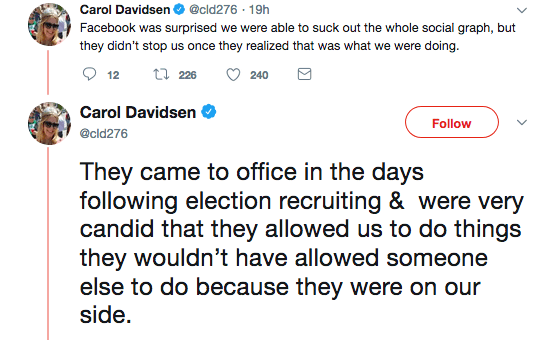
Meanwhile, here’s a whole Twitter thread on how Obama’s 2012 team scraped social media data, for which they were hailed as geniuses.

And Facebook let them do it, because they were on their side:

LATE-STAGE SOCIALISM: Venezuela town issues own currency amid cash shortages.

Amid an acute national shortage of banknotes, the town of Elorza in western Venezuela has started issuing its own paper currency.

Local officials said that the currency would make it easier for residents and visitors to trade during the town’s festivities, which start on Monday.

They said rampant hyperinflation and a scarcity of bolivares, the national currency, had affected trade in Elorza.

The new currency can be bought at the mayor’s office via bank transfer.

The paper bills feature the face of independence hero José Andrés Elorza and, like the town, are named after him.

“People don’t have bolivares to spend, that’s why we have created bills of two denominations… and we’ve already sold 2bn bolivares worth,” mayor Solfreddy Solórzano, from the governing PSUV party, said.

That’s nice — but what is there to buy?

BREXIT: EU Agrees on Brexit Transition Terms but Ireland Issue Remains.

European Union and British negotiators on Monday agreed on the terms of the U.K.’s 21-month transition after it leaves the bloc next March, but left unresolved a thorny issue—the future of Ireland—that could derail the entire Brexit deal.

The new agreement opens the way for talks on the U.K.’s future economic and security relationship with the bloc, something the U.K. has long asked for. But while the transition was relatively easy to agree on, the most difficult phase of negotiations still lies ahead.

With just one year to go, the two sides must finalize the negotiations and get the deal approved by EU governments, the U.K. and the EU parliament.

The U.K. wants a much closer trade and economic relationship after Brexit than the EU says is possible for a country that won’t allow free movement of EU citizens and won’t follow the rulings of the EU top court.

Getting out from under Brussels’ thumb while maintaining a free trade relationship with Europe would be ideal for the UK, but it seems more likely that Britain will lose at least some access to the common market, while remaining mired in an EU-like regulatory state.