Pauline Kael after the ’72 election: “I live in a rather special world. I only know one person who voted for Nixon. Where they are I don’t know. They’re outside my ken. But sometimes when I’m in a theater I can feel them.”
“Let’s start with the obvious point. The vast majority of journalists didn’t sign up to protect our nation and values,” Brooks said.
The op-ed, written by Notre Dame professor Joseph Holt and titled ‘The Press Isn’t The Enemy, It’s The Protector,” tried to compare members of the media with soldiers in the military.
“This professor wasn’t even talking about journalists who do put themselves in harm’s way. He was talking about White House reporters who go to the press briefings and instead of asking questions, they pull out a soapbox and deliver sermons until Sarah Sanders shuts them down,” Brooks said.
It’s absurd, of course, for journalists to compare themselves to soldiers (or firefighters), but perhaps this is progress of a sort. I’m so old, I remember when elite journalists thought themselves so far above American soldiers, they’d sell them out simply to get a good story on the air.
DEREGULATION AND RE-REGULATION: One of the Obama era’s most costly rules was the over-regulation of financial/retirement advisers known as the “Fiduciary Rule.” It was rightly struck down by a court and the Trump Labor Department decided to let the issue go. Now the independent Securities and Exchange Commission has come up with its own version of the regulation. My colleague John Berlau says that it’s better than the Obama version, but still has problems.
MORE SWAMP-DRAINING NEEDED: At Master Resource, a twopart investigation by Paul Driessen and David Wojick into how Obama-era climate policies are still being carried out at USAID.
Imagine reading a book or article that you find thought-provoking, insightful and inspiring. It makes you think more deeply about a social, political or philosophical issue, and of ways in which you could use such intellectual insights in your own life and work. If you’re a writer or an academic, you may think of sharing it, or writing about the ideas raised. Imagine, then, not going ahead with any of that once you realise the gender and/or colour of the writer.
In her new book, Living a Feminist Life, Sara Ahmed, formerly a professor of race and cultural studies at Goldsmiths, University of London, takes the ‘political’ decision not to cite any white male authors. Ahmed decided it was time to take a stand against what she sees as the reproduction of racism and sexism due to citational politics that reproduce both whiteness and patriarchy: ‘White men cite other white men: it is what they have always done; it is what they will do; what they teach each other to do when they teach each other.’ When she reads academic texts, even ones on such subjects as critical-race theory, she sees ‘whiteness spilled all over the pages’, something that she says is invisible ‘to those who inhabit it’.
Somebody’s going to land a sweet gig with the New York Times.
[Joseph] Schumpeter predicted, before the massive expansion of higher education, that capitalism would breed a new class of intellectuals (writers, journalists, artists, lawyers, etc.) who would be motivated by both ideology and self-interest to undermine liberal democratic capitalism. “Unlike any other type of society, capitalism inevitably and by virtue of the very logic of its civilization creates, educates and subsidizes a vested interest in social unrest,” Schumpeter wrote in Capitalism, Socialism, and Democracy. He adds a bit further on: “For such an atmosphere [of social hostility to capitalism] to develop it is necessary that there be groups whose interest it is to work up and organize resentment, to nurse it, to voice it and to lead it.”
Sarah Jeong is not the ideal example of what Schumpeter was talking about, viz. capitalism (Alexandria Ocasio-Cortez fits that bill better). But she is a good example of the larger adversary culture that universities not only “nudge” students toward, but actively indoctrinate them into. Simply put, there is an entire industry dedicated to the proposition that not just the American past, but the American present, is disordered, bigoted, and oppressive. And Jeong’s meteoric and meritocratic rise demonstrates how so many of our best and brightest have gotten that message. How many have internalized it as ideology or have just cynically decided that’s how you get ahead is an open question.
The one child policy ran until 2015 when it was partially relaxed to allow some couples to have two children, but families have been slow to embrace official approval to expand.
An op-ed in a state-run newspaper titled “Giving birth is a family matter and a national issue too” is the latest to encourage couples to have more children, and call for official action to enable young people to start families.
The full-page column was published in the overseas edition of the People’s Daily, mouthpiece of the Chinese Communist Party. It warned that “the impact of low birth rates on the economy and society has begun to show.”
The piece has attracted millions of comments online, and comes as the government revealed a new official postage stamp, which seems to hint that it may drop the remaining restrictions on the number of children people can have.
Can the State cajole a country out of a State-induced demographic tailspin? We’ll see…
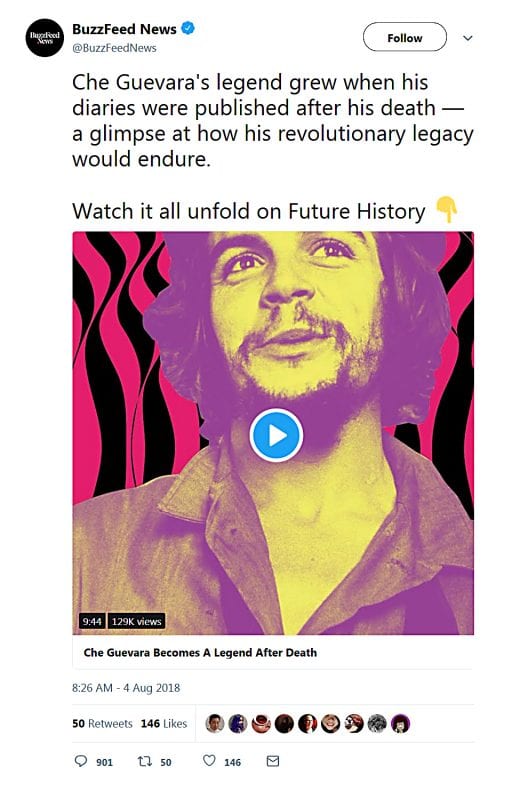
Link safe, goes to Twitchy. The groovy psychedelic artwork and video opening featuring dancing 1968-era hippies is particularly rich considering:
“Che hated artists, so how is it possible that artists still today support the image of Che Guevara?”, [asks Cuban jazz musician Paquito D’Rivera.] Turns out the rebellious icon that emblazons countless T-shirts actually enforced aesthetic and political conformity. D’Rivera explains that Che and other Cuban authorities sought to ban rock and roll and jazz.
“Che was an inspiration for me,” D’Rivera tells reason.tv. “I thought I have to get out of this island as soon as I can, because I am in the wrong place at the wrong time!” D’Rivera did escape Cuba, and so far he’s won nine Grammy awards playing the kind of music Che tried to silence. But D’Rivera says Che’s crimes didn’t end with censorship. “He ordered the execution of many people with no trial.” Che served as Castro’s chief executioner, presiding over the infamous La Cabana prison. D’Rivera says Che’s policy of killing innocents earned him the nickname-the Butcher of La Cabana.
“We’re rightly horrified by fascist murderers like Adolph Hitler,” says reason.tv’s Nick Gillespie. “Why aren’t we also horrified by communist killers?” Certainly, Che’s body count isn’t anywhere near Hitler’s. But what about someone Che idolized, someone whom he might have liked to wear on his chest?
“Che, Castro, all the communist regimes idolized only one thing that Mao personifies—violence.” Kai Chen grew up in China under the reign of Mao Zedong. Although he won gold medals for China’s national basketball team, Chen’s was far from the celebrity life of an NBA star. Says Chen, “You have no right to talk, and you have no right to think.”
Scaled for population, the Castro-Guevara police state rivaled any tyranny in history. As Humberto Fontova points out, Cubans “qualify as the longest-suffering political prisoners in modern history, having suffered prison camps, forced labor and torture chambers for a period THREE TIMES as long in Che Guevara’s Gulag as Alexander Solzhenytzin suffered in Stalin’s Gulag.” It’s worth mentioning that it would have been far worse if tens of thousands of Cubans hadn’t fled Che’s glorious revolution.
“Che Guevara would’ve happily ordered the execution of damn near everyone who works at @BuzzfeedNews over their lifestyle choices. But hey, celebrate him, leftist morons,” Derek Hunter of the Daily Callertweeted on Monday in response.
SHINING A LIGHT ON ALARMIST POLICY: Bjorn Lomborg has a powerful new essay about how environmentalists want to force people in the developing world without access to an electricity grid to use solar panels instead:
Over the past 16 years, nearly every person who gained access to electricity did so through a grid connection, mostly powered by fossil fuels. And yet donors say that many of the 1.1 billion people who are still without electricity should instead try solar panels.
Compared with expensive grid expansion, providing an off-grid, solar cell is very cheap. But for the recipient, it is a poor substitute. It offers just enough power to keep a lightbulb going, and to recharge a mobile phone, which is better than nothing – but only barely. The IEA expects that each of the 195 million people with off-grid solar will get just 170kWh per year – or half of what one US flat-screen TV uses in a year.
Perhaps not surprisingly, the first rigorous test published on the impact of solar panels on the lives of poor people found that while they got a little more electricity, there was no measurable impact on their lives: they did not increase savings or spending, they did not work more or start more businesses, and their children did not study more.
It’s unconscionable, but it’s a main plank of the global warming alarmist movement’s policy agenda.
InstaPundit is a participant in the Amazon Services LLC Associates Program, an affiliate advertising program designed to provide a
means for sites to earn advertising fees by advertising and linking to Amazon.com.