BOYCOTTS IN THE DIGITAL AGE: My weekly column is up at The Daily Caller. From Starbucks to Breitbart to Chik-fil-A, there’s something for everybody.

BOYCOTTS IN THE DIGITAL AGE: My weekly column is up at The Daily Caller. From Starbucks to Breitbart to Chik-fil-A, there’s something for everybody.
AT AMAZON, Enro Men’s Big and Tall Classic Fit Solid Point Collar Dress Shirt.
Plus, Lightning Deal, Marino Mens Genuine Leather Ratchet Dress Belt.
THE PRESIDENT’S PARDON POWER IS PLENARY: AG Sessions defends Trump’s power to pardon without consulting Justice Dept. A valid pardon can be written on a cocktail napkin in lipstick.
WELL, THIS IS THE 21ST CENTURY, YOU KNOW: The Pentagon Is Making a Ray Gun to Stop Truck Attacks.
The Defense Department’s Joint Non-Lethal Weapons Program, or JNLWD, is pushing ahead with a new direct energy weapon that uses high-powered microwaves to stop cars in their tracks without damaging the vehicle, its driver, or anyone else.
The jammer works by targeting the car’s engine control unit causing it to reboot over and over, stalling the engine. Like an invisible hand, the microwaves hold the car in place. “Anything that has electronics on it, these high-powered microwaves will affect,” David Law, who leads JNLWD’s technology division, said in March. “As long as the [radio] is on, it holds the vehicle stopped.”
Next up: Tractor beams.
THE MISANTHROPIC MRS. CLINTON:
You might expect Clinton to at least be sensitive to sexism. Instead she was a source of it. “She told aides she knew women reporters would be harder on her. We’d be jealous and catty and more spiteful than men. We’d be impervious to her flirting.” (Side note: Chozick actually thinks flirting with Hillary Clinton is something men want to do.) A running joke had it that the unofficial motto of Clinton supporters was, “I’m With Her . . . I Guess.” This, even though Chozick and other female reporters were sympathetic to Hillary based on gender solidarity: “I still felt some kind of feminine bond with Hillary then,” she writes of her early months on the beat, and later describes her coverage as “neutral to positive, with plenty of wet kisses thrown in.”
Clinton’s poor political instincts infected the entire campaign. One aide ripped a sign saying “I [heart] Hillary” out of a little girl’s hands in Phoenix because “Brooklyn [the site of Clinton’s headquarters] thought it best that Everydays hold professionally produced signs that displayed the message du jour rather than something made with love and some finger paint.”
As for larger strategic moves, Chozick notes dryly of a March excursion, “That was Hillary’s last trip to Wisconsin.” Team Clinton in its waning days was spending money in Utah, Indiana, Missouri, Arizona, and even Texas while the Upper Midwest was begging for more resources. Bill Clinton was meanwhile going “red in the face” warning his wife’s team “that Trump had a shrewd understanding . . . of the white working class,” Chozick says. Clinton’s campaign manager, Robby Mook, responded by spoofing Bill behind his back, as one would Grandpa Simpson: “And let me tell you another thing about the white working class,” he’d say, mockingly.
Savaging the guy who actually won multiple elections as both governor and president is just a minor example of how out of touch the campaign was. Read the whole thing.
PRIVACY: Amazon’s Alexa had a flaw that let eavesdroppers listen in.
Alexa, the voice assistant used by millions of smart gadgets including Amazon’s popular Echo lineup, uses what it calls Skills to carry out commands. You ask if rain is coming, for example, and Alexa uses the “Weather” Skill to answer.
Researchers from security testing firm Checkmarx found a flaw with Alexa that allowed a Skill to continue listening long after a person activated the software, said Amit Ashbel, director of product marketing for Checkmarx.
“As far as we could tell, there was no limit,” Ashbel said. “As long as you don’t tell it to stop, it wouldn’t.”
Amazon said it’s since fixed the reported issues.
But it does make you wonder if anyone has found a similar flaw and not reported it to Amazon.
CHANGE: Kanye West takes a shot at Obama over the state of Chicago.
Wait, it gets worse: Chance The Rapper: “Black People Don’t Have To Be Democrats.”
Plus: Kim Kardashian West defends Kanye on Trump: ‘He’s a free thinker, is that not allowed?’
And the big picture:
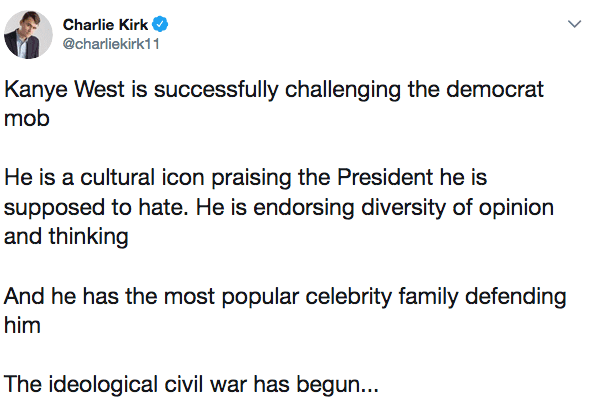
It’s not that Kanye, or Chance, or Kim is a reliable ally for Trump: They’re not. But this is a group that’s too big to get the Shania-Twain treatment, and they’re not apologizing. That’s a crack in the lefty messaging monolith. It’s breaking down those self-herding mechanisms.
SULTANS GOTTA SULTANATE: Turkey tells Council of Europe to mind its own business on elections.
Turkey has told a European rights body “to mind its own business” after it voiced concern on Tuesday over the freedom and fairness of Turkish snap elections and recommended they be postponed.
President Tayyip Erdogan announced the June 24 parliamentary and presidential elections last week, saying Turkey needed to switch quickly to a new executive presidency system that was narrowly approved in a referendum last year.
The Council of Europe Parliamentary Assembly (PACE) Monitoring Committee said the legitimacy of the elections was at stake after Turkey extended a state of emergency imposed following a failed military coup in mid-2016 and introduced a new electoral system last month.
The committee also expressed concern about what it said would be the possible presence of police forces in polling stations which “could have a deterrent effect on voters”.
The Council might also be worried that Erdogan plans to steal the election result on the first try, rather than following the European tradition of holding as many elections as necessary to produce the desired result.
THIS SEEMS LIKE AN EXCELLENT IDEA: The Trump Administration Wants to Take the Mystery Out of How Much Hospitals Charge Patients.
“We envision a system that rewards value over volume and where patients reap the benefits through more choices and better health outcomes,” wrote CMS in its release. “While hospitals are already required under guidelines developed by CMS to either make publicly available a list of their standard charges, or their policies for allowing the public to view a list of those charges upon request, CMS is updating its guidelines to specifically require that hospitals post this information.” In English: The listing of these prices vis-a-vis Medicare would become mandatory and, the hope is, eventually spill over to other parts of the health industry.
Faster, please.
BIRKENSTOCK-BOOTED THUGS: Parkland Teacher Defends Officer’s Interrogation of Pro-2nd Amendment Student Kyle Kashuv. “Mr. Pittman said it was a ‘really bad idea’ to post photos of ‘assault weapons’.”
I wonder if there are any after-school activities Mr. Pittman engages in which might warrant similar official scrutiny.
WE’VE WON, AND NOW WE’RE ASSHOLES: Jaron Lanier On The State Of The Tech Industry.
We used to be kind of rebels, like, if you go back to the origins of Silicon Valley culture, there were these big traditional companies like IBM that seemed to be impenetrable fortresses. And we had to create our own world. To us, we were the underdogs and we had to struggle. And we’ve won. I mean, we have just totally won. We run everything. We are the conduit of everything else happening in the world. We’ve disrupted absolutely everything. Politics, finance, education, media, relationships — family relationships, romantic relationships — we’ve put ourselves in the middle of everything, we’ve absolutely won. But we don’t act like it.
We have no sense of balance or modesty or graciousness having won. We’re still acting as if we’re in trouble and we have to defend ourselves, which is preposterous. And so in doing that we really kind of turn into assholes, you know?
Plus:
One of the problems is that we’ve isolated ourselves through extreme wealth and success. Before, we might’ve been isolated because we were nerdy insurgents. But now we’ve found a new method to isolate ourselves, where we’re just so successful and so different from so many other people that our circumstances are different. And we have less in common with all the people whose lives we’ve disrupted. I’m just really struck by that. I’m struck with just how much better off we are financially, and I don’t like the feeling of it.
Personally, I would give up a lot of the wealth and elite status that we have in order to just live in a friendly, more connected world where it would be easier to move about and not feel like everything else is insecure and falling apart. People in the tech world, they’re all doing great, they all feel secure. I mean they might worry about a nuclear attack or something, but their personal lives are really secure.
And then when you move out of the tech world, everybody’s struggling. It’s a very strange thing.
Related: Was Social Media A Mistake?
Plus: Social Media As Social Disease.
Also: Data Misuse and the Weaponization of Emotion.
And: Silicon Valley has gone from liberating to creepy. Next stop, government regulation. “Silicon Valley seemed to have gone from the hammer-wielding woman in that famous ‘1984’ Apple commercial, to the Big Brother figure up on the screen in that famous ‘1984’ Apple commercial.”
I think Jaron Lanier is right that what we’re facing today is “Digital Maoism.”
UPDATE: I went back and read this piece on Lanier that I did for the WSJ in 2010, and in retrospect I think I may not have given him enough credit:
Predictably, Mr. Lanier’s Web 2.0 critique has stirred a furious online backlash—which has only helped to buttress his argument. When Slate.com ran an unsympathetic pre-publication review of “You Are Not a Gadget,” the geek discussion site Slashdot.com ran a brief summary of the review with a link. Hundreds of comments soon adhered to the Slashdot summary, most of them negative. Finally, one frustrated commenter wrote: “The irony here is that this thread is a perfect example of what Lanier’s been talking about. A group of people with self-reinforcing attitudes making pronouncements based not on the actual book, but on a review of the book. Actually, I bet most of these ‘opinions’—since who can be bothered to read an entire review, let alone the book—aren’t even informed by reading the review. I’m sure there are lots of valid criticisms to the book, but Lanier has you all dead to rights as far as the intellectual seriousness of this ‘debate’ goes.” Score one for Mr. Lanier’s warning about the demise of considered thought and the rising tyranny of first-impression reactions to complex ideas.
But what Mr. Lanier is missing is the sheer fun of a lot of social-media interaction and the way it has brought non-geeks into the computer world. As I look at the social Web that he finds sterile and overly corporatized, I see Tea Party activists, “caveman diet” enthusiasts and model-rocketry devotees—among countless others—coming together and finding ways to collaborate, organize and socialize as never before. I see individuals and small groups acquiring creative power and the sort of organizational reach that only large companies or governments once had. Ordinary Americans are experiencing the same kind of buzz and excitement that used to be known only to the “digerati” elite in the halcyon days of the early 1990s.
Mr. Lanier is nostalgic for that era and its homemade Web pages, the personalized outposts that have largely been replaced by the more standardized formats of Facebook and MySpace. The aesthetics of these newer options might be less than refined, but tens of millions of people are able to express themselves in ways that were unimaginable even a decade ago. And let’s face it: Those personal Web pages of the 1990s are hardly worth reviving. It’ll be fine with me if I never see another blinking banner towed across the screen by a clip-art biplane.
Like a remote beach that has been discovered by the masses, the Internet is no longer the pristine preserve of the well-off few. But what it now lacks in exclusivity it has more than made up for in ease of access. And for all the problems that Mr. Lanier rightly worries about, the trend seems to be toward a Web of ever more striving human activity. Indeed, we are not gadgets. I’m scoring that a win.
I mean, you can still make that argument, but not as convincingly. And maybe he was ahead of me because he had a better idea of what Facebook, et al., had in mind.
AT AMAZON, shop Safety and Security.
JOURNALISM: Drew Cloud Is a Well-Known Expert on Student Loans. One Problem: He’s Not Real.
Drew Cloud is everywhere. The self-described journalist who specializes in student-loan debt has been quoted in major news outlets, including The Washington Post, The Boston Globe, and CNBC, and is a fixture in the smaller, specialized blogosphere of student debt.
He’s always got the new data, featuring irresistible twists:
One in five students use extra money from their student loans to buy digital currencies.
Nearly 8 percent of students would move to North Korea to free themselves of their debt.
Twenty-seven percent would contract the Zika virus to live debt-free.
All of those surveys came from Cloud’s website, The Student Loan Report.
Drew Cloud’s story was simple: He founded the website, an “independent, authoritative news outlet” covering all things student loans, “after he had difficulty finding the most recent student loan news and information all in one place.”
He became ubiquitous on that topic. But he’s a fiction, the invention of a student-loan refinancing company.
After The Chronicle spent more than a week trying to verify Cloud’s existence, the company that owns The Student Loan Report confirmed that Cloud was fake. “Drew Cloud is a pseudonym that a diverse group of authors at Student Loan Report, LLC use to share experiences and information related to the challenges college students face with funding their education,” wrote Nate Matherson, CEO of LendEDU.
Before that admission, however, Cloud had corresponded at length with many journalists, pitching them stories and offering email interviews, many of which were published. When The Chronicle attempted to contact him through the address last week, Cloud said he was traveling and had limited access to his account. He didn’t respond to additional inquiries.
Fake news.
21ST CENTURY PARENTING: HOW MOMMY DRINKING CULTURE HAS NORMALIZED ALCOHOLISM FOR WOMEN IN AMERICA.
OPEN THREAD: Talk about stuff.
OH, DEAR. WHEREVER SHALL THIS BUS TERMINAL LOOK FOR ETHICAL GUIDANCE NOW? “You may shut the f*** up”: Port Authority ethics commissioner quits after pulling rank on local cops.
THAT SEEMS WISE: Cohen to plead the Fifth in Stormy Daniels lawsuit.
“NOTHING ELSE MATTERED. THERE WAS NOTHING ELSE.”
BUT OF COURSE:

IT’S BEEN A VERY LONG DAY AND I THOUGHT FOR A SECOND I’D BEEN DRINKING TOO MUCH: But no, Science Magazine is doing its job. North American human-giant ground sloth interactions in the terminal Pleistocene. Remarkable footprints found in White Sand National Monument.
BEHAVIOR:
…we present the first well-documented co-association of unshod human tracks with those of extinct Pleistocene ground sloth in the Americas, and we infer behavioral implications from these contemporaneous tracks.
MORE:
We argue that the tracks evidence temporal and spatial associations of sloths and humans and infer that humans actively stalked and/or harassed sloths, if not hunted them. The absence of a carcass is not surprising for several reasons. The vast majority of hunts by modern hunter-gatherers are unsuccessful (for example, 94% for Hadza) (22). Sloths are so densely muscled that an outright kill is unlikely. Even if the hunt had been successful and the animal had died in the study area, the wetting and drying cycles and high pH rapidly degrade bones; thus, preservation of bones in the terminal Pleistocene therefore remains improbable. In terms of alternative explanations, it is possible that the human trackmaker was simply stepping in the sloth footsteps to follow a preexisting path in soft terrain. We dismiss this interpretation because the step length results in a long and uncomfortable human stride. The estimated stature of the human trackmaker (1.4 m; Tracks TE-A-44, -45, and -46; table S2) yields a stride of 0.6 m, contrasted with the sloth stride of 0.8 to 1.1 m. It is possible that the behavior was playful, but human interactions with sloths are probably better interpreted in the context of stalking and/or hunting. Sloths would have been formidable prey. Their strong arms and sharp claws gave them a lethal reach and clear advantage in close-quarter encounters.
American hunters stalking very slow but dangerous game. Cool.
I LAUGH AT THE PATHETIC DISINFORMATION SUGGESTING THAT THE IRAQ WAR WAS OVER CONTROL OF AN ABANDONED STARGATE. That’s an obvious bit of onion-layer disinformation, covering up the real truth that we were after a crashed alien spaceship.
Of course, that’s just a small part of what’s really going on.
ALIENS, DUH: What Lies Beneath Jupiter’s Great Red Spot?
InstaPundit is a participant in the Amazon Services LLC Associates Program, an affiliate advertising program designed to provide a means for sites to earn advertising fees by advertising and linking to Amazon.com.


