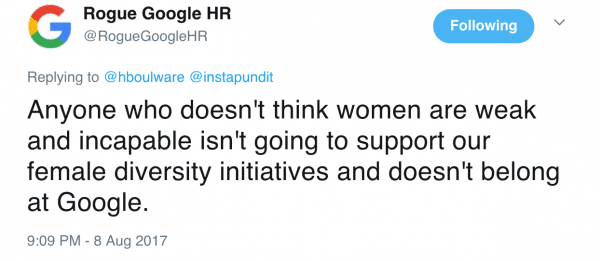
It’s interesting, though parts of it (it dates back to 1983) are thoroughly obsolete. In particular, he makes a great deal of the middle class’s insecurity — compared to the confident upper-middle and upper classes — about status, and ideology. But it seems to me that today — see, e.g., the latest Google affair, and the endless round of campus auto-da-fes, — that these days it’s the upper-middle and upper classes that are nervous about ideology and eager to practice a defensive conformity. I suspect (and this is where I’m going with this project) that this is because of the increased influence of a largely conformist higher educational system.
“Proles and animals are free.” says O’Brien in 1984, while members of the Party — especially the Outer Party — are highly circumscribed. That seems to be where we are now.
A design studio that tried to “reclaim” the swastika by selling shirts emblazoned with rainbow versions of the Nazi symbol has pulled its products after weeks of backlash, including from a national anti-Semitism group.
KA Design first pushed out its idea for “The New Swastika” in a July 12 Facebook video that reviewed the swastika’s long history.
For thousands of years, the video noted, the swastika had been used in numerous cultures to symbolize peace, love, luck, infinity and life.
“but one day Nazism,” text in the video noted, in one of the clip’s many capitalization-challenged semi-non sequiturs. “they stigmatized the Swastika forever. they won / they limited our freedom / or maybe not? the Swastika is coming back. . . . introducing the new Swastika.”
The video then showed an array of swastikas set against a rainbow background and the words “PEACE,” “LOVE” and “ZEN.”
“Wear the freedom,” the video declared, closing with the design studio’s motto: “Questioning Boundaries.”
Get one step closer to the dystopia predicted in Woody Allen’s Sleeper.
It had long been assumed that the hormone’s role was limited to reproduction. F.S.H. stimulates the production of eggs in women and sperm in men.
Researchers knew that blood levels of F.S.H. soar as women’s ovaries start to fail before menopause. At the same time, women rapidly lose bone — even when blood levels of estrogen, which can preserve bone, remain steady.
Dr. Zaidi reasoned that F.S.H. could be a culprit in bone loss. So he and his colleagues created an antibody that blocked F.S.H. in female mice whose ovaries had been removed.
Since the mice were making no estrogen at all, they ought to have been losing bone. Indeed, the bone marrow in such mice usually fills with fat instead of developing bone cells. Much the same happens in women: That’s why their bones become less dense.
But in Dr. Zaidi’s lab, the mice that received the antibody did not developed fat-filled bone marrow — and, to his enormous surprise, they lost large amounts of fat.
TROTSKY & HUTCH: After reading Kyle Smith’s “Channing Tatum’s Anti-Communist Manifesto,” at NRO over the weekend, I watched the first two episodes of Comrade Detective on Amazon Prime last night, which is a sort of mash-up of Woody Allen’s What’s Up Tiger Lily, Police Squad, Gorky Park, and SCTV’s Soviet broadcasting parody segment, as Smith explains:
According to an earnestly delivered prologue, what we’re watching is found footage: An actual Romanian buddy-cop TV show from the 1980s. The look and feel of the show (which was actually shot last year) are absolutely dead-on recreations, exactly what you’d expect if you happened to be watching prime-time state TV in Bucharest circa 1988. The actors are Romanian, the mustaches are thick, the art direction is lavishly gray. Everything is played with a completely straight face, and the series was actually filmed in Eastern Europe, which apparently still features lots of locations suffering from Soviet Bloc hangover. If you turned off the sound, you’d swear you were actually watching the Romanian Simon & Simon.
What makes Comrade Detective a comedy is the (intentionally ungainly) dubbing: Channing Tatum and Joseph Gordon-Levitt provide the voices of the mismatched detectives, Gregor Anghel and Iosif Baciu (played impeccably onscreen by Romanians Florin Piersic Jr. and Corneliu Ulici), and such familiar actors as Chloë Sevigny, Daniel Craig, Jake Johnson, Kim Basinger, Jenny Slate, and Mahershala Ali dub supporting characters. Nick Offerman, voicing the crusty, no-nonsense police chief, is especially fine.
* * * * * * * *
Explaining the board game Monopoly, which plays a surprising role in the plot, devolves into pained disbelief: “The more rent you get paid the more money you make,” says an expert on the West. “You’re telling me that the purpose of this game is to drive your fellow citizens into poverty so that you may get rich?” says one of the cops. Black-market racketeers inspire a near-riot amid desperate demand for their wares and protect themselves with machine guns . . . in the process of selling Jordache jeans. Because we’re watching Iron Curtain propaganda, a visit to the U.S. embassy reveals that average Americans are eating huge piles of hamburgers at all times, even at the office. Looming offscreen like the Emperor in Star Wars or Voldemort in Harry Potter, the ultimate source of bone-chilling unease is . . . Ronald Reagan.
Read the whole thing. And maybe even watch the whole thing as well. At nearly an hour each segment, it’s not laugh-a-minute funny, but almost every scene is punctuated by a laugh-out-loud take on either Soviet propaganda or American detective shows – and often both. Of the two Romanian leads, the senior detective is a sort of hardscrabble version of David Soul’s appearance (complete with funky leather sports jacket and sunglasses) on Starsky & Hutch, and his junior partner is the spitting image of young Leon Trotsky.
Based on the first two segments I watched, highly recommended.
The problem wasn’t that Burr was advising people to make passwords that are inherently easy to crack, but that his advice steered everyday computer users toward lazy mistakes and easy-to-predict practices. Burr’s eight-page password document, titled “NIST Special Publication 800-63. Appendix A,” advised people to use irregular capitalization, special characters, and at least one numeral. That might result in a password like “P@ssW0rd123!” While that may make it seem secure on the surface (neglecting, of course, that “password” is a bad password), the issue is that most people tend to use the same exact techniques when crafting these digital combo locks. That results in strings of characters and numbers that hackers could easily predict and algorithms that specifically target those weaknesses.
Even worse, Burr suggested people should change passwords regularly, at least every 90 days. This advice, which was then adopted by academic institutions, government bodies, and large corporations, pushed users to make easy-to-crack passwords.
I had been assured that the password science was settled.
JOHN HAWKINS AT TOWNHALL: IT’S BETTER TO BE HATED BY LIBERALS THAN HAVE THEIR “HELP.”
He was also a guitarist with exceptional chops, who had a lengthy career with L.A.’s “Wrecking Crew” group of first-call session musicians before becoming a country music and TV variety star.
InstaPundit is a participant in the Amazon Services LLC Associates Program, an affiliate advertising program designed to provide a
means for sites to earn advertising fees by advertising and linking to Amazon.com.