
Archive for 2017
March 23, 2017
THERE ARE NONE SO BLIND… Five Days and Two ‘Known Wolf’ Terror Attacks, Yet No Apparent Concern from Western Governments.
BUT THE NARRATIVE! Trump Is 100% Vindicated On Wiretapping, and 7 Other Things You Should Know.

21ST CENTURY RELATIONSHIPS: How a lack of sex is making women ANGRY. “While Corrine’s mood swings may bear some resemblance to the symptoms of pre-menstrual tension or mild anxiety, they are completely unrelated to her hormones or mental state. Her crushingly low spirits are caused by something else altogether: when she last made love. Too long without sex, and she becomes miserable and fractious. . . . Dr Geoff Hackett, a leading expert in sexual medicine and former chairman of the British Society for Sexual Medicine, believes if we carry on like this, sex is in danger of being a lost art. ‘The domestic set-up in the Fifties, for example, seemed to positively encourage sex,’ he says. ‘But nowadays there’s not enough focus on it.'”
Hey, maintenance sex isn’t just for men.
And it reminds me of this from Caitlin Flanagan over a decade ago:
It turns out that the “traditional” marriage, which we’ve all been so happy to annihilate, had some pretty good provisions for many of today’s most stubborn marital problems, such as how to combine work and parenthood, and how to keep the springs of the marriage bed in good working order. . . .
Nowadays, American parents of a certain social class seem squeaky clean, high-achieving, flush with cash, relatively exhausted, obsessed with their children, and somehow—how to pinpoint this?—undersexed.
If I Don’t Know How She Does It, a book about a working woman who discovers deep joy and great sex by quitting her job and devoting herself to family life, had been written by a man, he would be the target of a lynch mob the proportions and fury of which would make Salman Rushdie feel like a lucky, lucky man. But of course it was written by a with-it female journalist, so it’s safe, even admired. Allison Pearson, we have been given to understand, is telling it like it is. And what she’s telling us, essentially, is that in several crucial aspects the women’s movement has been a bust, even for the social class that most ardently championed it.
Indeed. Hey, maintenance sex isn’t just for men.
21ST CENTURY PROBLEMS: The FBI is still struggling to employ hackers because they’re all smoking weed.
In its latest published report on the nation’s cyber security strategy (2015), the US department of justice found that 40 per cent of FBI cyber security positions were unfilled.
The report found that:
The FBI did not hire 52 of the 134 computer scientists for which it was authorised; and five of the 56 field offices did not have a computer scientist assigned to that office’s Cyber Task Force.
The gap between candidates and job postings is only likely to grow, given the predicted boom in cyber security jobs that consultants Frost and Sullivan claim will outstrip the number of qualified experts by 2020.
A draft of a new executive orders on cyber security was published in the Washington Post, ordering a review of ‘Workforce Development’ which focused on changes to the education curriculum and the department of Education.
Two things are clear: 1) Hackers don’t work in the field or need to carry weapons, and; 2) Marijuana doesn’t seem to be much of an impediment to hacking, given the huge Venn overlap between Successful Hackers and Pot Smokers.
But as a legal matter, this is something Congress will have to address.
TIME MAGAZINE DOES FOR TRUTH IN THE 21st CENTURY WHAT THEY DID FOR GOD IN THE 1960s: Time’s latest cover is an update of their infamous, Nietzsche-inspired 1966 cover, “Is God Dead?” That issue was published the year before Henry Luce, its then-recently-retired conservative founder, who was the son of Christian missionaries, died, and the magazine was well on its way to abandoning Luce’s original vision and readers. This week, Time asks, with the same portentous all-black background and giant red text, “Is Truth Dead?”
If the truth is dead, Time has certainly spent the last decade trying to strangle the life out of it:
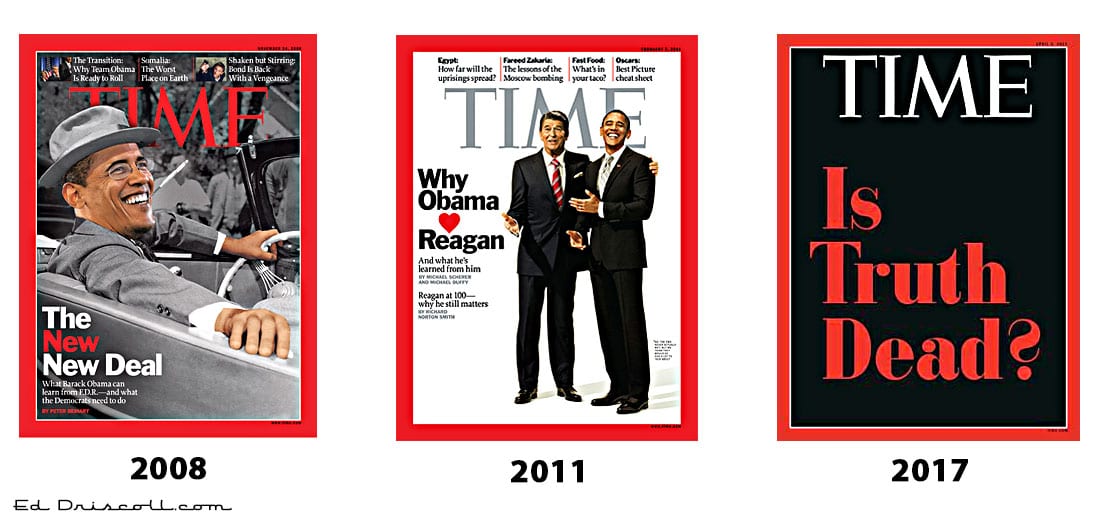
A post today at Adweek quotes Michael Scherer, Time’s Washington bureau chief, boasting about how difficult it was to recreate the font of the 1966 cover, before claiming, “Trump has discovered something about epistemology in the 21st century. The truth may be real, but falsehood often works better.” As the above covers illustrate, only for a Time, if you’ll pardon the pun.
ARE YOU NOW, OR HAVE YOU EVER BEEN, a member of the Federalist Society?
IT’S ON! Democrats Choose Stupidity: They Will Filibuster Neil Gorsuch Nomination.
Now we’ll see if Mitch McConnell has what it takes to go Full Harry Reid.
IN THE MAIL: by Johan Kalsi (Author), Vox Day (Editor), Corrosion.

Plus, today only at Amazon: Up to 60% Off Swarovski Jewelry.
And, also today only: Ehang GHOSTDRONE 2.0 Aerial with 4K Sports Camera, iOS/Android Compatible, $284.99 (29% off).
Also, Bell + Howell Taclight Lantern (Pack of 2), $29.99 (50% off).
And, don’t forget, brand new Lightning Deals, updated every hour.
JON GABRIEL has thoughts on transgressive political “art.” “We should celebrate art that only requires the ability to cut and paste images from Google search. Not only that, taxpayers should fund billboards that mock their beliefs. That way, I won’t have to con some alternative art gallery into paying for my ad space. God knows I’m not going to use my own money. Because money is bad.”
I’M SORRY DAVE, BUT THE DEEP STATE CAN’T ALLOW YOU TO DO THAT: Time to Investigate Obama, not Just Trump, Roger Simon writes.
OBAMA DIDN’T STOP NORTH KOREA’S NUKES: Last week SecState Tillerson called North Korea an imminent threat.
CHAOS ON CAPITOL HILL: House Intel Chairman Gives Trump New Collection Revelations, Sparking Committee Feud.. “Nunes says reports show possibly legit but bothersome surveillance; Schiff calls Nunes’ move ‘a profound irregularity.'”
GEORGE NEUMAYR: The curious silences after London’s terror attack.
One scoured most of the British press in vain for any reporting on the identity or motivation of the attacker. The euphemisms for his motivation were a little better in other foreign outlets. The French press agency, among others, attributed the attack to assumed “Islamist-related terrorism,” citing British counterterrorism official Mark Rowley.
But almost nobody was playing that up. The average reader would have to work pretty hard to find even that comment. By almost the end of Wednesday, the New York Times hadn’t included it in its “what we know and don’t know” story. That story quotes Rowley but only to say that the “working assumption” is that the attacker was motivated by “international terrorism.” Is that really what he said? The French press agency had quoted him saying, “Islamist-related is our assumption.” Why didn’t that appear in the New York Times story?
When a normally garrulous and gossipy media turns taciturn, the explanation is usually political correctness. In this case, an extreme sensitivity to Islam has a chastening effect on reporters who would typically exert themselves for a scoop. Even many hours after the mayhem, few of their stories contained any descriptions of the attacker from witnesses.
Political correctness kills.
WALTER RUSSELL MEAD: Europe Is Eroding from the South.
The insight here is that people looking at the elections in Netherlands and France and finding hope for the future are looking at things wrong. The erosion of the European project isn’t happening yet in the north, which by and large benefits from the euro; It is the south where the twin impacts of slow growth and feckless migration policy are corroding once rock-solid support for the EU.
Italians used to look to Europe as a kind of savior: the Italian state was corrupt and inept, but Brussels would set a higher standard, and by loyal support for the EU, Italy could rise above its own problems. These days, the EU looks more like an anchor than a lifejacket, as a recent Italian poll bears out. Not only is the anti-establishment Five-Star Movement Italy’s most popular party, but the combined support for Five-Star, Lega Nord, and Forza Italia—all hostile to varying degrees to the current euro project and to the German vision behind it—totals nearly 60%. That is significant by any measure, indicating a dramatic shift in perceptions that portends serious danger for the European project today.
Well, Europe’s political class is even worse than ours, and the EU structure gives it more power.
HMM: Reports of Deep Cuts to Russia’s Defense Budget Have Been Grossly Exaggerated.
If you read a recent report by IHS Jane’s that Russia is cutting its defense budget by over 25 percent—supposedly the “largest cut to military expenditure in the country since the early 1990s”—then you might be given the impression that Moscow’s military is finally succumbing to economic woes. But reports of the death of Russia’s defense budget have been grossly exaggerated. Simply put, it’s not true.
Not only did Jane’s get the story largely wrong about Russia’s defense budget, claiming that Russia’s defense budget would fall from 3.8 trillion rubles, or $65.4 billion, to 2.8 trillion, but deep reductions in spending are also unlikely for Russia’s next State Armament Program, known as GPV. At least for the foreseeable future, Russian armed forces will continue to expand in size, create new unit formations, and deploy new or modernized equipment.
NATO had best keep its powder dry — and keep lots of powder, as the wise man once said.
CLAIM: Customer Service Chatbots Are About to Become Frighteningly Realistic.
Soul Machines has already created an assistant avatar called Nadia for the Australian government. It’s voiced by actor Cate Blanchett and powered by IBM’s Watson software. It helps people get information about government services for the disabled. IBM has prototyped another avatar, Rachel, that helps with banking.
The movements of Soul Machines’s digital faces are produced by simulating the anatomy and mechanics of muscles and other tissues of the human face. The avatars can read the facial expressions of a person talking to them, using a device’s front-facing camera. Sagar says people talking to something that looks human are more likely to be open about their thoughts and be expressive with their own face, allowing a company to pick up information about what vexes or confuses customers.
The company’s avatars can also be programmed to react to a person’s facial expressions with their own simulated facial movements, in an attempt to create the illusion of empathy.
If they’re realistic enough, you won’t know to be frightened.
WHY IS IT THAT NOBODY EVER RECOMMENDS REDISTRIBUTING CHAIRED PROFESSORSHIPS? Psychology Professors: If babies were randomly allocated to families would racism end?
PC IS A DISEASE, AND SHOULD BE ERADICATED RUTHLESSLY: Publicly-Funded War Memorial Gets PC Treatment, Causing Fury Among Veterans.
AT AMAZON, Hot New Releases Freshly Updated Each Hour.
Plus, Save Big on Amazon Bestsellers by Category.
And don’t miss Big Savings in the Kindle Daily Deals.
SHOCKINGLY, NOT AN ALT-RIGHT TRUMP SUPPORTER FROM MISSISSIPPI: Hoaxer behind Jewish Community Center threats arrested: 18-year-old U.S./Israeli dual citizen.
But, of course, the media won’t walk back all the hysteria because the hysteria was useful to the narrative.
UPDATE: John Nolte on Twitter: “Trump was right about Obama wiretapping him. Trump was right about these false flags.”
TRUMP VERSUS NORTH KOREA’S NUKES: Strategic patience is over. Pyongyang better get ready.
RIGHT VS RIGHT: Where Conservative Groups Stand on TrumpCare.