SMART DIPLOMACY: More foreign spies in US than ever.
The 1980s called, and they want their foreign policy back.

SMART DIPLOMACY: More foreign spies in US than ever.
The 1980s called, and they want their foreign policy back.
TEACH WOMEN NOT TO MURDER: Mom, Daughter Describe Killing Family Members With Anti-Freeze in Never-Before-Seen Interrogation Tapes. “She said she poisoned her son Shaun because he was a significant burden to her.”
IN THE MAIL: From Vox Day & Dominic Saltarelli, On the Existence of Gods.
Plus, today only at Amazon: Save up to 63% on select Dremel rotary tools and accessories.
And, also today only: Up to 39% Off Philips Wake Up Lights.
TAXPROF ROUNDUP: The IRS Scandal, Day 1057.
HIGHER EDUCATION BUBBLE UPDATE: College Admissions Debates Miss the Mark.
It’s elite college admissions season, which means that it’s also the season for elite media handwringing about how stressful it for high school students to compete for the vanishingly small number of spots available in the Ivy League. These concerns are understandable, of course—any young person who has recently gone through this process, or any parent who has watched—knows that it can be agonizing and arbitrary. But most elite commentary on the subject—which imagines that the best way to slow down the rat race is for admissions offices to de-emphasize academic achievement and instead emphasize character traits like kindness and generosity—misses the mark by a rather wide margin. . . .
The report, which goes on to make the case for a more ‘holistic’ admissions system, is clearly well-intentioned. But there is very little reason to think that its proposed solution—once again, entrusting elite admissions officers (the same admissions officers who wrote the report) to make detailed judgments about students’ degree of selflessness and empathy—will do much to ameliorate the worst parts of the system. After all, the number of slots at Harvard would stay the same; the only thing that would change is the rules of the competition. And anyone who has interacted with upper-middle class America knows that changing the rules for getting into an Ivy won’t make anxious students and parents compete any less intensively. . . .
Part of this change would need to be cultural: elites, and the institutions they run, would need to put less weight on fancy degrees. But there are also policy steps that could help encourage this shift. For example, a standardized or semi-standardized testing regime for college seniors would help ambitious graduates of the Nebraska state system, for example, compete on equal footing with Yalies.
Another, complementary reform: The elite schools that students are climbing over each other to get into should be making efforts, as WRM has written, “to clone themselves,” either by admitting more students, expanding online offerings, or setting up satellite campuses. There is no reason why the quality of education offered by Stanford or Princeton should not be scalable, and yet the number of slots at most of these institutions has held steady for decades, despite the extraordinary resources they have at their disposal.
The horribleness of the Ivy League admissions for 17-year olds is just one small symptom of a higher education landscape that is distorted all around. To fix it, we will need to come up with more creative and ambitious solutions than simply asking colleges to put more emphasis on this or that character trait as they cull 95 out of 100 students from the pile. And those solutions won’t always be the same as the ones preferred by the gatekeepers themselves.
The best thing that could happen would be for elite college degrees to matter less.
MISTER, WE COULD USE A MAN LIKE WARREN HARDING AGAIN: What the GOP Should Know NOW About Warren G. Harding’s Presidential Win in 1920.
THIS WILL END WELL: Civilian-Military Divide Continues To Grow As Force Size Shrinks.
THE EVITABLE CANDIDATE: Clinton moves goalposts again; girds for New York battle.
When Hillary Clinton lost the New Hampshire primary to Bernie Sanders in February, Robby Mook, her campaign manager, took the long view and declared the nomination would “very likely be won in March, not February.”
The campaign is now taking an even longer view, with April now being the month they hope to put Sanders away. It’s an optimistic projection, with Sanders support far from fading and the Vermont senator vowing to compete in primaries and caucuses through June 7 in California, and possibly to the Democratic convention.
Even though Clinton aides say her lead in pledged delegates is “almost insurmountable,” they are now doing something they never expected: Investing considerable time and money to the April 19 New York primary.
Who could have foreseen Clinton having trouble beating back a challenge from a male Senator clobbering her from the left?
NUTRITION NEWS: Vegetarian diet ‘raises risk of heart disease and cancer.’
AT AMAZON, fresh deals on bestselling products, updated every hour.
Also, coupons galore in Grocery & Gourmet Food.
Plus, Kindle Daily Deals.
And, Today’s Featured Digital Deal. The deals are brand new every day, so browse and save!
MAKE BATHROOMS GREAT AGAIN! “Here is one issue where I really wish Donald Trump would show up and comment.”
PAST PERFORMANCE IS NO GUARANTEE OF FUTURE RESULTS:
Reagan agreed with these old conservatives about communism and other things. But he transformed their movement from a past- and loss-oriented movement to a future- and possibility-oriented one, based on a certain idea about America. As early as 1952 during a commencement address at William Woods College in Missouri, Reagan argued, ”I, in my own mind, have always thought of America as a place in the divine scheme of things that was set aside as a promised land.”
Reagan described America as a driving force through history, leading to the empire of liberty. He seemed to regard freedom’s triumph as a historical inevitability. He couldn’t look at mainstream American culture as anything other than the delightful emanation of this venture. He could never feel alienated from middle American life, or see it succumbing to a spiritual catastrophe.
So of course he was an optimist; he knew how the human story ended. While others regarded the Soviet Union as permanent, he couldn’t. ”My idea of American policy toward the Soviet Union is simple and some would say simplistic. It is this: ‘We win and they lose,’ ” he once said.
—David Brooks, June 10th, 2004: “Reagan’s beliefs fueled his optimism.”
● “David Brooks Praises Trump for Crushing the ‘Dying Husk’ of Reaganism.”
—Rick Moran, PJ Media, yesterday. As Rick writes, “Trump didn’t destroy the ‘dying husk’ of Reaganism. That’s because Reagan’s ideas are timeless. His basic message of limited government, individual liberty, and free markets have been with us since the Founding. Reagan only reminded us of their importance.”
And conversely, regarding today’s elites such as Brooks and the man in the oval office whose pants he creases, “Fallacies do not cease to be fallacies because they become fashions,” as G.K. Chesterton once said. Most conservatives understand this intuitively; the fact that Brooks doesn’t speaks volumes.
DETROIT TEACHER: $1 MILLION IN BRIBES IS ONLY ‘A LITTLE BIT UNETHICAL.’
Actually, considering what Hillary makes in terms of campaign contributions for each “speech” to Goldman Sachs and Obama dresses his kids in $20,000 outfits, she may have a point.
But why are Democrat-controlled institutions such cesspits of corruption in the first place?
WILL HILLARY BE THE NEW O.J.?, Roger Simon asks.

ACTUALLY, IT’S TURNING INTO A BOOMING BUSINESS: The cottage industry of campus grievance culture.
Someone said something you don’t like? Report them.
Someone you don’t like flirted with you? Report them.
Regret that drunken hookup? Report the other person.
The elevation of life’s minor indignities to full blown crimes of sexual harassment and assault have created a cottage industry on college campuses. Millions of dollars are being spent by universities hiring “lawyers, investigators, case workers, survivor advocates, peer counselors, workshop leaders and other officials to deal with increasing numbers of these complaints,” according to a report from the New York Times.
Notice how police and due process advocates are missing from the list of hires. Make no mistake, the lawyers aren’t being hired for the students involved in these disputes, they’re being hired to protect the schools from lawsuits arising from these disputes (although at least one school, Columbia University, does provide legal advice to accusing and accused students).
“The expansion of Title IX bureaucracies — often at great expense — is driven in part by pressure from the federal government, which recently put out a series of policy directives on sexual misconduct on campus,” the Times’ Anemona Hartocollis wrote.
Title IX is a federal statute banning sex discrimination on college campuses. It was originally intended to help female athletes, but over the past few decades it has morphed into a weapon being used to punish students for minor offenses. The American Association of University Professors recently released a 56-page report on Title IX overreach, which has expanded definitions of sexual harassment and sexual assault to include anything a student finds objectionable. These expansions, AAUP notes, have led to an evisceration of due process and free speech on campuses.
Note that when universities try to save money, they cut faculty, not these educrats.
UNEXPECTEDLY: Report: New Obamacare enrollees sicker and costlier.
“Correction: sicker and pricier than YOU expected,” Iowahawk responds to CNN’s coverage of the same report.
As a reminder, in the fall of 2009, CNN featured a choir of school kids harmonizing in service of our Glorious Leader and the Obamacare wonders to come.
PARTYING LIKE IT’S 1939:
● Shot: Top German Journalist Admits Mainstream Media Is Completely Fake: “We All Lie For The CIA.”
● Chaser: Associated Press willingly cooperated with the Nazis, new report shows.
As Tom Blumer writes in response to the AP story, “The lesson for current news consumers is that one should never presumptively trust ‘news’ coming from areas controlled by authoritarian and totalitarian regimes. Sadly, the Associated Press itself, in how it has covered events and news in North Korea, Cuba, Venezuela and other areas hostile to press and personal freedoms, has demonstrated and continues to demonstrate the need to heed that lesson.”
Personally, I would have shortened to simply, “one should never presumptively trust ‘news.'”
IT’S COME TO THIS: University Cancels ‘Vagina Monologues’ Because a White Lady Wrote It:
Cancelling performances of “The Vagina Monologues” has become a bit of a trend on college campuses these days. For example, just last year, all-women’s Mount Holyoke College canceled its own performance on the grounds that the production was not “inclusive” enough to people who identify as women but do not have actual vaginas.
Earlier: Berkeley students call for “an occupation of syllabi in the social sciences and humanities,” demand Marx and Foucault dropped from curriculum, along with other philosophers, not because they’re far leftists, but because they’re “white men. The syllabus did not include a single woman or person of color.”
As Ray Bradbury predicted in Fahrenheit 451, books will be burned as much to protect everyone’s feelings as much as to block the ideas within them.
EVERYTHING SEEMINGLY IS SPINNING OUT OF CONTROL: Why Do Americans Feel So Miserable?
(Classical reference in headline.)
PEACE PRIZE UPDATE: Pentagon Confirms New North Korean ICBM.
The new missile is called the KN-14 by the Pentagon and is a longer-range variant of the KN-08 road-mobile ICBM first made public in 2012.
Both the KN-08 and the new KN-14 have not been flight tested. But defense officials familiar with reports on the weapons said both systems have been tested in all other aspects of their development.
“It’s a KN-08 on steroids,” said one official of the new KN-14.
No word yet on range or payload capacity.
CULTURE OF CORRUPTION: Clinton superdelegate disbarred while awaiting prison sentencing.
THE POLITICS OF DANCING:
● This Guatemalan rapper thinks hip-hop can unite all women.
—Pri.org, Tuesday.
● Get ready for ‘Hip-Hop Hillary.’
—The Washington Post, February 11th.
ALL THE PRESIDENT’S POSTMODERNISTS: In “The day Trump killed the fact,” the Washington Post’s Alexandra Petri displays a rather short — and selective — memory:
It’s Tuesday, March 29, 2016, and facts are dead.
They had a good run.
It used to be that when people said “Who are you going to believe, me, or your own eyes?,” they were joking. Not the Donald Trump campaign. It remains stubbornly impervious to reality.
“But we have video footage of this happening,” you can say. “Look, here it is!”
“Ah,” the Trump campaign says, bending eight spoons and then vanishing into a telephone, “but what if the whole world exists only as a figment of our minds?”
The Trump campaign has been an ongoing test of how few things people are willing to Google.
But long before the rise of Donald Trump’s political career, the Washington Post has also had a casual, elastic relationship with capital-T truth. Let’s take a look at couple of their more recent lapses into postmodernism. In 2010, in response to Richard Armitage being ignored in Fair Game, Sean Penn’s film version of Valerie Plame’s memoirs, Post film critic Ann Hornaday sniffed and responded ¯\_(ツ)_/¯ :
In Washington, watching fact-based political movies has become a sport all its own, with viewers hyper-alert to mistakes, composite characters or real stories hijacked by political agendas. But what audiences often fail to take into account is that a too-literal allegiance to the facts can sometimes obscure a larger truth.
* * * * * * *
Thus, the movies about Washington that get the right stuff right — or get some stuff wrong but in the right way — become their own form of consensus history. “Follow the money,” then, assumes its own totemic truth. Ratified through repeated viewings in theaters, on Netflix and beyond, these films become a mutual exercise in creating a usable past. We watch them to be entertained, surely, and maybe educated. But we keep watching them in order to remember.
Hornaday’s article is titled “Washington-set films may fudge facts, but good ones speak to larger truths.”
That same year, Matt Yglesias, then writing columns for the pre–Bezos Post before joining GE-backed Vox.com tweeted:
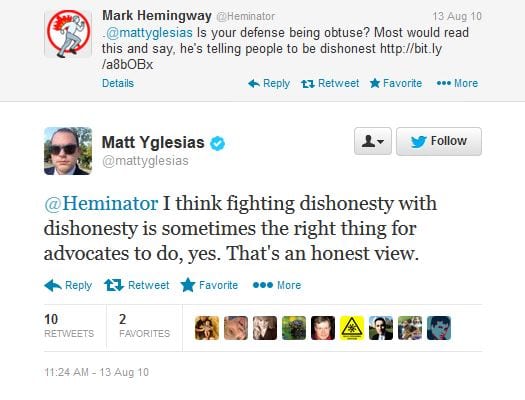
And there’s that whole Watergate thing and the origins of legendary Post mole “Deep Throat,” aka disgruntled FBI agent Mark Felt, and how he was shielded for decades by the Post.
“As a famous Soviet dissident joke put it: ‘In the Soviet Union, the future is known; it’s the past which is always changing,’” Dennis Prager once wrote, and reality has been equally fungible at the Post as well. Having argued in favor of postmodernism for years, and having aggressively defended two presidents in recent memory who lived by that philosophy*, they’ve failed to notice that facts in the MSM in general and the Post specifically died long before Tuesday, March 29, 2016. Perhaps if the Post had defended truth more rigorously when it was abused by administrations that its Democrat operatives with bylines supported, the newspaper would be in a better position to complain when a presidential candidate its staff collectively loathes comes along to make a hash of it.
* To the point where Newsweek, then-owned by the Washington Post spiked its exclusive by Michael Isikoff on Bill Clinton’s oval office dalliance with Monica Lewinsky at the start of 2008, thus inadvertently fueling the meteoric rise of the Drudge Report, and at the start of 2009, perhaps declaring its own obituary before being offloaded soon after by the Post a $1.00, famously declared “We Are All Socialists Now” on its cover.
Related flashback: Washington Post cartoonist Ann Telnaes depicts children of Hispanic presidential candidate as monkeys.
InstaPundit is a participant in the Amazon Services LLC Associates Program, an affiliate advertising program designed to provide a means for sites to earn advertising fees by advertising and linking to Amazon.com.