
ROGER SIMON: Nikki Haley Misses an Opportunity on Women.
Archive for 2016
January 13, 2016
JOHN SCHINDLER: Obama’s Persian Debacle: Saber Rattling in the Gulf.
AT AMAZON, up to 85% off on Kindle Books.
COOL: A 14-year-old girl from New York City is dominating the world of rock climbing. Well, Isabelle Patissier retired and took up rally car driving.
IRAN RELEASES SAILORS AFTER U.S. PROMISES ‘NOT TO REPEAT SUCH MISTAKES.’
Remember in 2008, when Democrats with bylines were all cranking out their worshipful spin predicting which legendary president Obama was going to be most like? I wonder what they think about January in his last year in office resembling the last Januaries of the administrations of both Jimmy Carter and Lyndon Johnson?
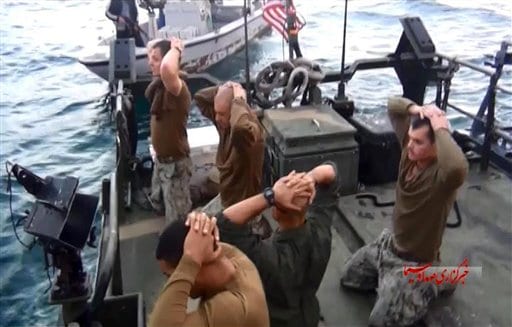
UPDATE: Iran’s Humiliation Of Barack Obama Is Now Complete.
With a year in his administration to go, do you really want to tempt fate like that?
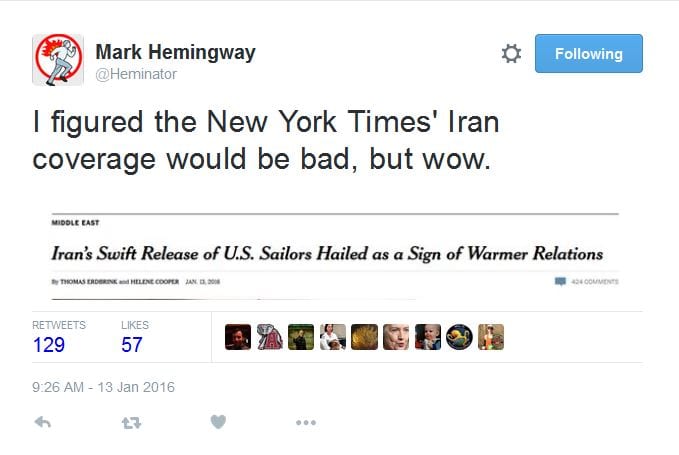
MORE: Wow, the Gray Lady turned into Vox.com so slowly, I hardly even noticed:
MIKE GONZALEZ: America Used To Know How To Assimilate Immigrants. That was before our institutions were taken over by people who didn’t much like America.
DAVID FRENCH: Iran’s Propaganda Victory In One Illegal Image.
On the other hand, Daniel Drezner says if you’re unhappy it’s because you’re engaged in “macho foreign policy posturing.”
WHAT DIFFERENCE DOES IT MAKE? APPARENTLY, A LOT: Clinton Vulnerable to Attack Ads Among Millenials. A Republican research firm conducted a randomized-controlled trial with over 1,000 18-to-34-year-old respondents, seeking to determine how effective anti-Hillary attack ads were among young voters. A “treatment group” was shown an anti-Hillary attack ad, and a placebo-control group saw a non-political Coca-Cola commercial. The firm then asked the young participants to “vote” for President. The results were fairly significant.
After viewing just one attack ad, support for Hillary Clinton slipped 5, 7, and 8 points with millennial voters in matchups against Donald Trump, Marco Rubio and Ted Cruz.
Control Attack Impact Trump 34.6% 39.4% 4.8% Cruz 37.7% 46.0% 8.4% Rubio 43.8% 50.6% 6.8%
Here’s the video:
The takeaway from the research firm?
Younger voters were key to Barack Obama’s victories, of course, and Adam Schaeffer, chief science officer of Evolving Strategies, said Clinton appears to be surprisingly vulnerable with that demographic, especially given that the ad used in the test “was pretty lame and muddled in my opinion, but was the best thing out there.” . . .
We already know that younger voters favor Clinton’s Democratic primary rival Sen. Bernard Sanders by large margins – and that millennials don’t reliably turn out to vote.
But Schaeffer argues that the findings should concern the Clinton campaign because she will need those voters to win. The attack ad used in the test, which was sponsored by the Stop Hillary PAC, focuses on Clinton’s handling of the deadly attack on the U.S. consulate in Benghazi — an issue that isn’t particularly potent with younger voters, who generally aren’t as concerned about terrorism as older voters. . . .
[Because Clinton is already very well known], she should be more impervious to an attack that this one test suggests she might be. “It’s hard to move an incumbent, and we thought Clinton would test much more like an incumbent,’’ given how long she’s been on the national stage, Schaeffer said.
I don’t see any indications that Hillary Clinton will motivate young people enough to vote. I think it’s safe to say that she has lost that portion of the Obama coalition.
But do such attack ads make a difference with middle aged or older voters who lean independent or even toward the Democrats? That’s the question.
IN THE MAIL: The Demon in Democracy: Totalitarian Temptations in Free Societies.
Plus, today only at Amazon: 20% Off Smartypants Multi-Vitamins.
And, also today only: T-fal P25107 Stainless Steel Dishwasher Safe PFOA Free Pressure Cooker, $45.50 (54% off).
DOUBLEPLUSGOOD CHOCOLATE RATION THIS WEEK, COMRADE! Variety defines Golden Globes’ 4% ratings decline as a ‘climb’ thanks to Ricky Gervais.
TAXPROF ROUNDUP: The IRS Scandal, Day 979.
21st CENTURY HEADLINES: The man with a bionic penis will lose his virginity to a dominatrix who ran for parliament.
JOE PAPPALARDO: A report from the Dallas world premier of 13 Hours. “Some of you dear readers may want a plot synopsis, others a recap of the event, some may want a movie review, and a bunch of you will want a spoiler-filled fact check. So here’s all of it, in that order.”
Plus: “As is the case with many battles, this one was lost before it began. The CIA operation in post-Gaddfy Libya was high risk and played for high stakes, but the Obama administration bungled it with half measures. By the time the bullets and mortar shells started flying, the grim outcome was already ordained. If they had extra security on the ground, air power on call or less concern with the optics of post-regime change Libya, this event — and this movie — would have ended differently.”
WALTER RUSSELL MEAD: The China Bubble: It’s probably bursting, one way or another. And the world hasn’t figured out what to do about it.
China’s slowdown is having knock-on effects around the world. Here at TAI, we have been following the commodity crash story for some time—and not just as a piece of economic news mostly interesting to financial market speculators. This is a political and a geopolitical story as well. Falling commodity prices matter to everything from the security of Putin’s power base to the ability of the oil-dependent Nigerian state to wage an effective war against Boko Haram; the fate of democracy in countries like Brazil and South Africa is complicated by the prospective fallout from the commodity crash; Venezuela may implode into chaos as a result of the oil crash, and fears for Venezuela’s future were a major consideration in Cuba’s decision to respond to the Obama Administration’s normalization overtures. In other words, significant shifts in world commodity prices can tilt the balance of power, undermine the stability of some governments, and boost the prospects of others.
But the story may be getting still bigger. We may be looking at something more serious than the unwinding of a commodity boom; we may be looking at the bursting of a bubble that could dwarf what happened in 2008. The China Bubble is bigger than the real estate bubble, and its liquidation could pose bigger risks for world politics than the subprime implosion.There’s a difference between China and the China Bubble. China is a middle-income developing country bumping up against the limits of a growth model built on massive exports of manufactured goods. There are lots of bubbles inside China, largely because both national and local governments have pursued a mix of stimulative policies even as the health of the underlying growth model deteriorated. Massive over-investment in real estate, infrastructure and manufacturing capacity, overvalued stock prices and poorly priced financial assets have created an increasingly toxic and dangerous economic situation inside China, and a rattled government is doing its best to keep the system from imploding. The government is hoping to achieve a ‘soft landing’ as China switches away from growth led by manufacturing for export to growth led by services and internal consumption. We shall see; China’s regulators and managers are skilled and have a lot of ammunition. But this is a difficult maneuver to execute and as Chinese society and the Chinese economy both become more complex, the task of running the country keeps getting harder.
The China Bubble on the other hand is an international phenomenon. All over the world, the producers of commodities and manufactured goods have bought into the idea that Chinese demand is a perpetual growth machine.
Something that can’t go on forever, won’t.
ST. LOUIS RAMS RETURNING TO L.A., Chargers have option to join. “If the Chargers decline, the Oakland Raiders, another former L.A. tenant, can link up with the Rams, sources said.”
Though as Reason’s Anthony L. Fisher noted last week, “Never finance billionaires’ vanity projects with public money:” Three NFL Teams Wait in Limbo, Possibly Moving to LA. But Why Would LA Want Any of Them?
WHEN DAVID BOWIE ATTEMPTED TO MEET CAMILLE PAGLIA:
Oh, lord, that was one of the biggest fiascos of my checkered career! I have no idea what passages he had in mind. A woman called my publisher and said that David Bowie wanted my telephone number. When this was relayed to me, I laughed out loud and hooted, “That takes the cake! Right—David Bowie wants my phone number!!!” I was on TV a lot during that period of the culture wars, and there was always some crazy thing happening, with fans sending gifts or trying to finagle a meeting. We tried repeatedly to authenticate the request, but everything was so vague and shadowy. It made no sense—why would a major star not be communicating via a manager or major entertainment agency? Well, I didn’t know until decades later that Bowie had fired his entire corporate management structure after he went to Berlin in the 1970s and that he interacted with the world through a small cadre of old, trusted friends. I did eventually learn that he was an admirer of my work—for example, he put Sexual Personae on a published list of his favorite books. It’s not surprising, really, considering how profoundly he had influenced me. No wonder he felt at home with my ideas—he was sensing himself mirrored back! Evidently, the suggestion that I write the gender essay for the V&A catalog came ultimately from him, but we never met in person. Nor would I have wanted to, I think. With artists of such towering stature, it’s best to keep a respectful distance.
At the very least, the resultant meeting certainly would have been a fun celebrity-meets-celebrity interview, ala Capote meets the Stones, and William S. Burroughs meets Jimmy Page. And the two certainly had a lot more in common than Bowie and Bing Crosby.
I THINK THAT’S A BAD SIGN: What If Bernie Sanders Is The Democrats’ Best Bet?
AT AMAZON, fresh deals on bestselling products, updated every hour.
Also, coupons galore in Grocery & Gourmet Food.
Plus, Kindle Daily Deals.
And, Today’s Featured Digital Deal. The deals are brand new every day, so browse and save!
JONAH GOLDBERG: Did anyone else notice that Obama rhetorically conceded that immigrants reduce wages?
NIKKI HALEY’S RESPONSE TO DONALD TRUMP. …And, oh, yeah, Barack Obama’s State of the Union speech:
[Haley’s] speech was only incidentally about Barack Obama’s State of the Union. Well, maybe a bit more than ‘incidentally;’ but this speech was primarily to let Donald Trump know that after Iowa and New Hampshire comes South Carolina. And that Nikki Haley has no intention whatsoever to make life easy for Donald Trump while he’s down there.
Read the whole thing.
TOMORROW’S FINANCIAL MELTDOWN, TODAY! From Subprime to Sub-Subprime, as charted by Kevin D. Williamson:
Homeownership isn’t right for everybody. For one thing, enormous debt isn’t right for everybody, and homeownership without equity (3 percent, indeed) is nothing more than that. What’s more, as National Review’s Reihan Salam has shown, the social benefits associated with homeownership — stability, civic engagement, etc. — are present only when there is significant equity held. As Salam and co-author Christopher Papagianis put it: “The traits that enabled households to build up the savings necessary for significant down payments — hard work and the deferral of gratification — were misattributed to homeownership itself.”
Which sound very much like Reynold’s Law:
The government decides to try to increase the middle class by subsidizing things that middle class people have: If middle-class people go to college and own homes, then surely if more people go to college and own homes, we’ll have more middle-class people. But homeownership and college aren’t causes of middle-class status, they’re markers for possessing the kinds of traits — self-discipline, the ability to defer gratification, etc. — that let you enter, and stay, in the middle class. Subsidizing the markers doesn’t produce the traits; if anything, it undermines them.
And once again, the bureaucratic left will need to relearn that lesson yet again, likely the hard way — and possibly soon, when the financial crisis “truly takes a village,” yet again.
RICHARD FERNANDEZ: Stand By For Collision.
CATS AND DOGS (AND A DOG-EATER) LIVING TOGETHER: Obama’s Gun Speech: Roger Kimball is Giving Credit Where Credit Is Due.
CLAUDIA ROSETT: The State of the World? Open Season on America:
To date, the the compounding threats have been playing out largely — though by no means exclusively — beyond America’s shores. That won’t last, as San Bernardino and a growing roster of attacks, plots and threats keep serving notice. With policies that endanger America’s allies abroad, while lining up the likes of Russia, Iran and Cuba as erstwhile partners in forging a new world order, the condition of America is: increasingly under threat. Does Iran fear any serious penalty for seizing 10 American sailors? Anyplace except the marbled corridors of Washington, the question answers itself.
Read the whole thing.
