
RICHER IS GREENER: Watch: How Europe is greener now than 100 years ago.
Archive for 2016
October 9, 2016
JOHN HINDERAKER: Trump Wins. “Some of the rats might want to consider returning to the ship. Donald Trump came through pretty well tonight, mainly because the focus was on the issues. As long as issues are being discussed, Trump wins.”
STEPHEN GREEN’S DEBATE WRAPUP:
(Forgive any typos, run on sentences, bad punctuation, etc. I’m flying without a net and with four (?) bourbon-rocks.)
The Kraken was indeed released.
Now, to be fair, the Kraken had been asleep for a long time, stuck in that watery cage. When the gates finally opened, he didn’t roar right out and smash a bunch of ships or Medusas or whatever.
(Forgive me. I haven’t watched the movie in years.)
Instead, the Kraken hit the snooze button (waterproof, presumably) a couple of times, yawned, choked on some seawater, burped, dog paddled out of the cage, and then looked awkward and sheepish because the Argonauts spent the next ten minutes pointing at his morning wood.
Well.
I think I’ve stretched the Kraken metaphor thinner than Ursula Andress’ toga, so let’s switch gears.
For all the lovely camaraderie of the last couple of minutes, it’s clear that Hillary Clinton and Donald Trump loathe each other. Instead of a 90 minute town hall format, there’s no doubt that both candidates would eagerly agree to a debate held in a Roman Colosseum, to the death.
And, yes, we would be entertained.
But we have to talk about tonight’s debate, which is unlike anything I’ve ever seen, going back to when I was a child barely older than my oldest son, watching Reagan take on Carter.
I’ve seen them all. I’ve drank to most of them. Most have faded into nothingness.
This one, however, might linger.
I’ve never seen one candidate come on so week, then reverse course — in his own limited, almost demented fashion — so strongly.
I’ve never seen another candidate, so thoroughly programed, act as though her various subroutines had been corrupted by one of those nasty Russian viruses.
And all of this was after we began a presidential debate — a debate to determine the next President of the United States! — by talking about the proclivities of a major-party candidate who had once grabbed about grabbing women by…
Well, let’s not go there. We’ve said too much already.
This was not, in the end — or at almost any other point, really — a serious debate on the issues.
But it was a deadly serious contest between two people too unserious to be president.
However.
One of those unserious people demonstrated tonight that he is at least serious enough to recover from his many self-inflicted wounds, and in the most adverse and public circumstances.
Round 3 is ten days from now. I don’t know what to expect, because nothing from the first debate prepared us for anything from tonight’s debate.
But I can tell you this much: As pure entertainment, I’m looking forward, for once, more to the debate than to the cocktails.
Okay, that’s huge.
AT AMAZON, save on Pet Supplies.
Plus, save on bestselling Toys & Games.
IF YOU LIKE YOUR DOCTOR, THEY SAID, YOU CAN KEEP YOUR DOCTOR, THEY SAID: To Keep Obamacare Viable, Insurers Are Restricting Access To Doctors.
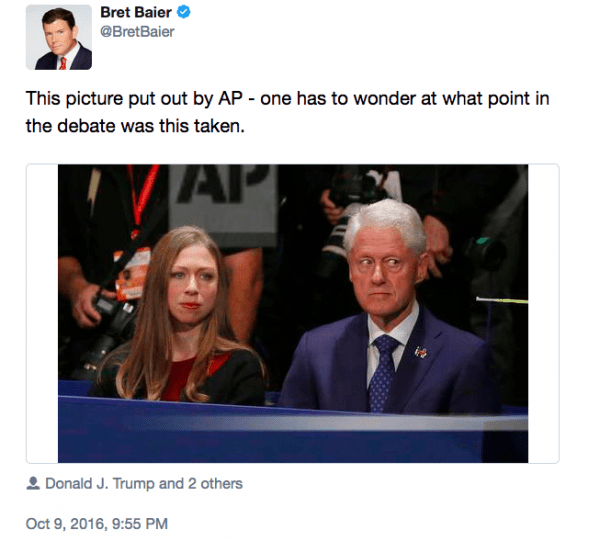
TERRORISTS RUN RAMPANT, RUSSIA AND CHINA ARE EATING OUR LUNCH, BUT HERE’S THE BIG STORY: The coming Trump vs. Clinton sex scandal showdown.
PRAY FOR HIS LIVER AND SANITY: Steve Green is Drunkblogging the Sex, Lies, and WikiLeaks Debate.
ASKING THE IMPORTANT QUESTIONS: Excuse Me, Why Are You Wearing Those Surgical Scrubs Outside The Hospital?
Scrubs are basically socially acceptable pajamas. I’ve considered making them my go-to daywear. But there’s a downside: “Nurses’ scrubs that were tested at the end of a clinical shift tended to turn up bugs, including some scary ones.”
SEMI-RETIRED DOG-EATING PRESIDENT, who hangs with rappers whose album covers feature murdered judges in front of the White House condemns ‘unbelievable’ Trump remarks, calls him ‘insecure.’
WIKILEAKS EXCLUSIVE: Aristophanes and Molière Preview the Coming Debate, and Roger Simon has the transcript.
THE POWER OF PLACEBOS:
Ted Kaptchuk, a professor at Harvard Medical School who ran the experiment, said his colleagues initially thought he was crazy at the beginning of the study. But it worked: He says roughly 60 percent of the subjects in his study reported getting better, even though they knew they were taking a placebo.
A placebo, Kaptchuk explained, is an inert substance, usually something like cellulose, starch or sugar. But the “placebo effect” goes well beyond the actual pill.
“Placebo effect is everything that surrounds that pill — the interaction between patient, doctor or nurse,” Kaptchuk said. “It’s the symbols, it’s the rituals. These are powerful forces.”
Doctors have understood the power of placebos at least since they were first used in clinical trials in the ‘50s, but fake pills work only in certain cases.
“There are a lot of illnesses you don’t give placebos for, [like] cancer, lowering cholesterol,” Kaptchuk said. “Basically the scope where a placebo effect is relevant is any symptom that the brain can modulate by itself.”
In those cases, just making an appointment, going to a doctor and taking a pill suggests something may happen.
Dr. Arthur Barsky, a psychiatrist at Brigham and Women’s Hospital in Boston, says that people will report some symptomatic relief from taking a substance that is not biologically active about 35 percent of the time. “It’s very impressive.”
Yep.
ANSWERING THE IMPORTANT QUESTIONS: What High-Fat Foods Should I Be Eating?
SETH BARRETT TILLMAN: Ex parte Merryman: Myth, History, and Scholarship.
Randy Barnett comments here.
RON RADOSH: The Bush Family Gets its Revenge on Trump.
THINK OF THEM AS DEMOCRATIC OPERATIVES WITH BYLINES AND YOU WON’T GO FAR WRONG: New Email Leak Reveals Clinton Campaign’s Cozy Press Relationship.
CHRISTIAN TOTO: ARE STARS BRAVE FOR QUITTING TWITTER … OR JUST THIN-SKINNED?
The distressing part of it all? Too many stars admit they can’t handle cyber criticism. Now, most of us can’t imagine the negative feedback some stars receive. People can be cruel, particularly when they’re anonymously smiting celebrities from the comfort of their home.
Yet Teigen says she isn’t “strong enough.” Not strong enough to ignore nasty tweets? I bet she’s plenty tough in real life. Teigen is a mom. What’s tougher than being a parent?
So why not use a similar strength to ward off cruel comments?
There’s another side to the story.
Celebrities often dwell in a land where they hear “yes” far more than “no.” They give interviews where they’re rarely pressed on their pet causes. They give speeches at award galas knowing no one will cross-examine them.
On Twitter, any Joe or Jane Sixpack can do just that. It’s likely that’s not very appealing to some thinner skinned stars.
In 2013, when Nick Gillespie had a column titled “Alec Baldwin and the End of the Red Carpet,” Gillespie wrote, “Remember the good old days, not just when there were only three national TV networks and one or two national newspapers, but when Hollywood studios could virtually completely control the image surrounding their contract players like halos on a saint’s shoulders? Those days are over, Baby Jane.”
As I asked in response, who’s forcing Alec Baldwin onto Twitter and other social media?
Doesn’t Baldwin have a manager, an agent, a PR person — a wife — who can say to him, “Maybe the instantaneous nature of Twitter isn’t for you, Alec?” Despite its recent ratings woes, NBC, where Baldwin’s low-rated 30 Rock seemed to run for a decade to a tiny audience of Baldwin’s fellow coastal arch-leftists is certainly a solid platform for publicity, via the Today and Tonight Shows. (Though even on that circuit Baldwin’s raging inner fascist emerges from time to time.) I’m sure Baldwin’s manager can demand to see a puff-piece before it runs in Time-Warner-CNN-HBO’s People magazine, or Jann Wenner’s Us. Or hire a ghost Tweeter.
It’s like something out of Lost Weekend or Michael Keaton’s Clean and Sober movie: What exactly is the narcotic power of Twitter that makes Baldwin return again and again to a medium that has so badly damaged his reputation?
The same applies to the celebrities that Toto quotes in his article today. Who’s forcing them on there, and why stay on a medium that you no longer enjoy?
Earlier: Gillespie talks with Glenn Reynolds in a half-hour podcast on his Twitter suspension and why he effectively left that medium, with the exception of automated links back to Instapundit.com.
THEY’RE ALWAYS IN THE LAST PLACE YOU LOOK: As hunt for sterile neutrino continues, mystery deepens.
QUESTION ASKED: “So why is that tape — which to me just sounds like Trump being Trump — the straw that broke the camel’s back?”
Or the one that seems to be, anyway. So many people seem honestly surprised that he said those things. Is the surprise a pose? If so, why this, why now? It’s a very offensive tape, but to me it’s not more offensive than so many of the other things he’s said, the things that at first made me think his candidacy was a joke, and later made me think I was in a nightmare from which I couldn’t wake up. This is the candidate who said, “I could stand in the middle of 5th Avenue and shoot somebody and I wouldn’t lose voters” — and I’d begun to believe he was right, that he was popular because he said outrageous and offensive things and refused ever to back down.
Why is this different? Why would it change anyone’s mind about Trump? If, like me, you see this as “just more of the same,” why do you think other people are reacting to it as if it’s different? Is it because his comments were about sex? Is that the ultimate American taboo?
Why was Mitt Romney’s perfectly defensible 47 percent comment the straw that broke his campaign? Because the media coordinated its distribution as part of a massive simultaneous carpet bombing. Recall the moment in Citizen Kane when Orson Welles’ Hearst-inspired character asks one of his editors, “Mr. Carter, here’s a three-column headline in the Chronicle. Why hasn’t the Inquirer a three-column headline?”, and is told, “The news wasn’t big enough.” As Kane replies, “if the headline is big enough, it makes the news big enough.”
Scott Adams wrote yesterday that “I assume that publication of this recording was okayed by the Clinton campaign. And if not, the public will assume so anyway. That opens the door for Trump to attack in a proportionate way. No more mister-nice-guy. Gloves are off. Nothing is out of bounds. It is fair to assume that Bill and Hillary are about to experience the worst weeks of their lives.”
But as a newspaper cartoonist, he of all people should know that Bill and Hillary’s DNC-MSM enablers buy their ink by the boxcar load, unlike Trump’s. And they’re perfectly prepared to cut their conscience to fit this year’s fashions* if it serves the party’s interest.
FASTER, PLEASE: A new kind of treatment is working better than chemotherapy in some lung cancer patients. “The drug, marketed as Keytruda, is one of a new set of drugs called immunotherapy. The drug targets the programmed cell death 1 (or PD-1) receptor and allows the body’s own immune system go after the cancer cells.”
I WON’T BE HAPPY UNLESS THIS LEADS TO THE MANNSCHENN DRIVE: Physicists just created the world’s first time crystal.
MY SUGGESTION WOULD BE TO FIX THE TOO-LOUD, TOO-BASS-HEAVY AUDIO THAT RUINS SO MANY MODERN MOVIES: Restoring the Allure of the Movie Theater.