
ICYMI: ‘Supreme Court to Government: No, ‘Good Intentions’ Don’t Give You a License to Censor Speech’. Good piece by the Institute for Justice’s Evan Bernick.
Archive for 2015
June 25, 2015
GLASS HALF FULL PART 2 – Yesterday I made the easy case for optimism: Americans of all income levels will have more access to law and legal services in the twenty-first century. Today I tackle the harder case: after a wrenching period of change the legal profession and law schools will be improved.
The profession will benefit greatly from smaller law classes filled with students with a realistic idea of what lawyers actually do and earn. Current law students come in spite of a headwind, rather than because they are history majors with no other plans, and as such are much likelier to enjoy law school and law practice. One of the hidden causes of rampant lawyer unhappiness is that too many lawyers were not thoughtful about coming to law school and are later disappointed with their choice. The college graduates who do not go to law school will also be better off, pursuing careers for which they are better suited. Fewer law graduates means less competition for the remaining jobs.
The actual job of being a lawyer will also improve. The best of times for Big Law profits has been the worst of times for the lawyers themselves. Big Law has led a boom in both remuneration and misery. The changes ahead will force “alternative billing” for many projects, encouraging creativity and efficiency rather than the grind of maximizing hourly billing. Much of the less interesting work will be computerized or outsourced, leaving only the most challenging and interesting work.
Competition from Axiom and other virtual law firms will allow creative lawyers flexibility in the terms and conditions of their employment, allowing some lawyers to do Big Law type work on their own schedules. Surveys have regularly shown that Big Law lawyers would take less money in return for more free time and autonomy.
The same trends will make the small firm and solo practitioners who survive better off. First, some portion of Big Law will separate from the most profitable firms and fall back to the pack, possibly rejoining what now resembles two separate professions (Big Law and everyone else).
Second, while much legal work will be lost, the work that remains will be more challenging and interesting. At every level of the profession, entrepreneurialism and creativity will be required. Lawyers will not be able to count on hanging a shingle and serving clients who have to see them. Instead, the lawyers that survive will be the lawyers that can demonstrate the value of their insight and services. This will be hard, but satisfying for the lawyers who make it.
It will be a galvanizing time for the profession and that will draw all lawyers together, putting other concerns into perspective. It seems likely that in ten years the managing partners of large law firms and the deans of American law schools will gather over drinks to discuss with bemusement the rankings and other silliness that obsessed the profession during the 1990s and 2000s.
THE SUPREME COURT SAVES THE OBAMACARE SUBSIDIES. Here’s the PDF. The Chief Justice writes the opinion.
ADDED: I haven’t read the opinion yet (of course), but I’d just like to console Republicans with the observation that they are better off. If it had gone the other way, they’d have to scramble and do something legislatively — probably save the subsidies themselves. This way, they can stand on whatever principle they like. Also, in the run up to the 2016 presidential election, they’ll fare much better on the old question of who do you want appointing the next Supreme Court justice.
AND: The Chief alludes to Nancy Pelosi’s “we have to pass the bill so that you can find out what is in it.” He quotes an old Frankfurter article — “Some Reflections on the Reading of Statutes, “47 Colum. L. Rev. 527, 545 (1947) — that described a cartoon “in which a senator tells his colleagues ‘I admit this new bill is too complicated to understand. We’ll just have to pass it to find out what it means.'”
That’s at the end of a paragraph where he blames Congress for “inartful drafting,” for writing “key parts of the Act behind closed doors, rather than through ‘the traditional legislative process,'” and for using the “reconcilation” process instead of leaving the bill open to debate and amendment.
MASSACRES AND MAGICAL THINKING: The urge to ‘do something’ after the Charleston church attack inspires the latest round of half-baked proposals, Jacob Sullum writes at Reason.
Yesterday on Twitter*, the hashtag #liberalsnextban started trending; naturally the left’s response, as anticipated last year by this all-purpose Photoshop by Jon Gabriel of Ricochet was:
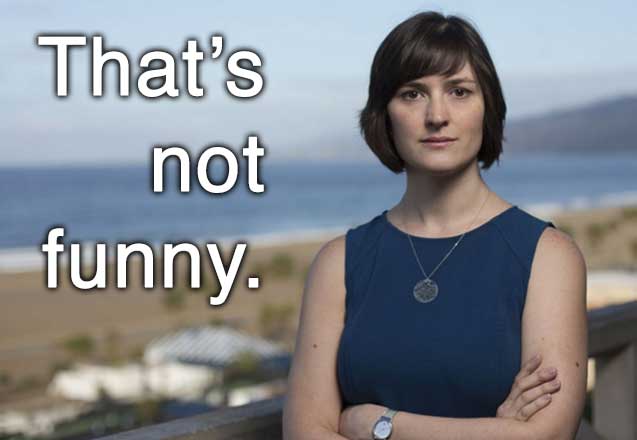
But then, they’ve already banned humor — just ask Jerry Seinfeld. But what will be the left’s next ban? Leave your thoughts in the comments – at least until they’re banned, too!
* Follow me there – while there’s still time…
CONGRATULATIONS TO TODD ZYWICKI: The new Executive Director of the Law & Economics Center at George Mason University School of Law.
Right Wing News: The 20 Hottest Conservative Women in New Media.
AT AMAZON, fresh deals on bestselling products, updated every hour.
Also, coupons galore in Grocery & Gourmet Food.
Plus, Kindle Daily Deals.
And, Today’s Featured Digital Deal. The deals are brand new every day, so browse and save!
HOUSE GOP REVOLT GROWS: House rebels warn of blowback for Boehner. Matt Fuller over at Roll Call reports on the intensifying revolt by House Freedom Caucus members against Speaker John Boehner:
The House Freedom Caucus has a secret it wants to share with Democrats.
“If the Democrats were to file a motion to vacate the chair and were to vote for that motion unanimously, there probably are 218 votes for it to succeed,” one member of the House Freedom Caucus told CQ Roll Call Tuesday night, as he exited an meeting in the basement of Tortilla Coast.
If that’s true, Democrats could certainly use a vote to remove SpeakerJohn A. Boehner as leverage in any number of upcoming battles: the Export-Import Bank, a highway bill, all sorts of spending measures. But absent any real talk from Democrats, the official response from Boehner’s communications director, Kevin Smith, was simply to dismiss CQ Roll Call’s reporter. . . .
The HFC looks ready for war, as does GOP leadership and more moderate Republicans who are sick and tired of conservatives voting against the team — and that could signal more retaliation to come from both sides.
Rep. Jim Jordan, the HFC chairman, and Raúl R. Labrador, one of the founding members of the secretive conservative group, had plenty to say to CQ Roll Call Wednesday about leadership’s recent moves against members who voted against the rule for Trade Promotion Authority.
“The reason this is happening is pretty clear,” Labrador said of Meadows’ demotion and the dismissal of other HFC members from the whip team. “The leadership is afraid.”
Labrador said GOP leaders sense their influence slipping, as 34 Republicans defied Boehner and others on the TPA rule. “And they know that that 34 is really not 34,” Labrador said. “They know that that number is really much larger.”
I admire these Freedom Caucus members for standing on their principles. It would be in the best interests of Speaker Boehner to find a way to welcome and work with these GOP members rather than treating them like the enemy. His inability to do this evinces a failure of leadership. Boehner seems more interested in working with President Obama these days than his own party.
RELATED: Boehner doles out new GOP punishment. According to The Hill, The latest victim of Boehner retribution is Ken Buck (R-CO), who “could be stripped of his title as GOP freshman class president on Thursday morning.”
Buck told reporters a freshman colleague approached him on Tuesday night and gave him a choice: Resign or get ousted by his peers. When Buck refused to step down, his colleague issued a threat: “Well, then we’re going to call a meeting.”
Later that evening, the chief of staff to Rep. Mimi Walters (R-Calif.), the freshman liaison to leadership, sent out an email asking for freshman members to gather at 8:30 a.m. Thursday.
In a brief interview, Walters declined to disclose exactly what the meeting would be about. But in a statement, she said, “a majority of the freshman class has expressed concerns I share regarding the leadership of our class president.”
Rep. Tim Huelskamp (R-Kan.) joked that he’s “still got the record for being kicked off two committees.” House GOP leaders removed him from the Budget and Agriculture panels in 2012 as payback for repeatedly bucking the party line.
He accused the GOP leadership of having misplaced priorities.
“Leaders unite, they don’t divide. That’s been the Republican concern about President Barack Obama, that he’s a divider. And we have our leadership doing the same thing,” he said.
Exactly.
EXPUNGING WOODROW WILSON FROM OFFICIAL PLACES OF HONOR. As I indicated in my post yesterday, I support Governor Nikki Haley’s initiative to remove the Confederate battle flag from government buildings. Now that we are expunging the legacy of past racism from official places of honor, we should next remove the name Woodrow Wilson from public buildings and bridges. Wilson’s racist legacy — in his official capacity as President — is undisputed. In The long-forgotten racial attitudes and policies of Woodrow Wilson, Boston University historian William R. Keylor provides a useful summary:
[On March 4th, 1913] Democrat Thomas Woodrow Wilson became the first Southerner elected president since Zachary Taylor in 1848. Washington was flooded with revelers from the Old Confederacy, whose people had long dreamed of a return to the glory days of Washington, Jefferson, Madison, and Monroe, when southern gentlemen ran the country. Rebel yells and the strains of “Dixie” reverberated throughout the city. The new administration brought to power a generation of political leaders from the old South who would play influential roles in Washington for generations to come.
Wilson is widely and correctly remembered — and represented in our history books — as a progressive Democrat who introduced many liberal reforms at home and fought for the extension of democratic liberties and human rights abroad. But on the issue of race his legacy was, in fact, regressive and has been largely forgotten.
Born in Virginia and raised in Georgia and South Carolina, Wilson was a loyal son of the old South who regretted the outcome of the Civil War. He used his high office to reverse some of its consequences. When he entered the White House a hundred years ago today, Washington was a rigidly segregated town — except for federal government agencies. They had been integrated during the post-war Reconstruction period, enabling African-Americans to obtain federal jobs and work side by side with whites in government agencies. Wilson promptly authorized members of his cabinet to reverse this long-standing policy of racial integration in the federal civil service.
Cabinet heads — such as his son-in-law, Secretary of the Treasury William McAdoo of Tennessee – re-segregated facilities such as restrooms and cafeterias in their buildings. In some federal offices, screens were set up to separate white and black workers. African-Americans found it difficult to secure high-level civil service positions, which some had held under previous Republican administrations.
A delegation of black professionals led by Monroe Trotter, a Phi Beta Kappa graduate of Harvard and Boston newspaper editor, appeared at the White House to protest the new policies. But Wilson treated them rudely and declared that “segregation is not a humiliation but a benefit, and ought to be so regarded by you gentlemen.”
The novel “The Clansman” by Thomas Dixon – a longtime political supporter, friend and former classmate of Wilson’s at Johns Hopkins University – was published in 1905. A decade later, with Wilson in the White House, cinematographer D.W. Griffith produced a motion picture version of the book, titled “Birth of a Nation.”
With quotations from Wilson’s scholarly writings in its subtitles, the silent film denounced the Reconstruction period in the South when blacks briefly held elective office in several states. It hailed the rise of the Ku Klux Klan as a sign of southern white society’s recovery from the humiliation and suffering to which the federal government and the northern “carpetbaggers” had subjected it after its defeat in the Civil War. The film depicted African-Americans (most played by white actors in blackface) as uncouth, uncivilized rabble.
While the National Association for the Advancement of Colored People publicly denounced the movie’s blatant appeals to racial prejudice, the president organized a private screening of his friend’s film in the White House for the members of his cabinet and their families. “It is like writing history with lightning,” Wilson observed, “and my only regret is that it is all so terribly true.”
Here is the exchange between Wilson and Trotter:
Mr. Monroe Trotter. Mr. President, we are here to renew our protest against the segregation of colored employees in the departments of our National Government. We [had] appealed to you to undo this race segregation in accord with your duty as President and with your pre-election pledges to colored American voters. We stated that such segregation was a public humiliation and degradation, and entirely unmerited and far-reaching in its injurious effects. . . .
President Woodrow Wilson. The white people of the country, as well as I, wish to see the colored people progress, and admire the progress they have already made, and want to see them continue along independent lines. There is, however, a great prejudice against colored people. . . . It will take one hundred years to eradicate this prejudice, and we must deal with it as practical men. Segregation is not humiliating, but a benefit, and ought to be so regarded by you gentlemen. If your organization goes out and tells the colored people of the country that it is a humiliation, they will so regard it, but if you do not tell them so, and regard it rather as a benefit, they will regard it the same. The only harm that will come will be if you cause them to think it is a humiliation.
Mr. Monroe Trotter. It is not in accord with the known facts to claim that the segregation was started because of race friction of white and colored [federal] clerks. The indisputable facts of the situation will not permit of the claim that the segregation is due to the friction. It is untenable, in view of the established facts, to maintain that the segregation is simply to avoid race friction, for the simple reason that for fifty years white and colored clerks have been working together in peace and harmony and friendliness, doing so even through two [President Grover Cleveland] Democratic administrations. Soon after your inauguration began, segregation was drastically introduced in the Treasury and Postal departments by your appointees.
President Woodrow Wilson. If this organization is ever to have another hearing before me it must have another spokesman. Your manner offends me. . . . Your tone, with its background of passion.
Mr. Monroe Trotter. But I have no passion in me, Mr. President, you are entirely mistaken; you misinterpret my earnestness for passion.
A swell guy, eh? After resigning from the Socialist Party to support Wilson, W.E.B Dubois was appalled at Wilson’s racist policies:
President Wilson’s initial policy measures were so stridently anti-black, Du Bois felt obliged to write “Another Open Letter to Woodrow Wilson” in September 1913. Du Bois was blunt, writing that “[I]t is no exaggeration to say that every enemy of the Negro race is greatly encouraged; that every man who dreams of making the Negro race a group of menials and pariahs is alert and hopeful.” Listing the most notorious racists of the era, including “Pitchfork” Ben Tillman,** Du Bois wrote that they were undoubtedly encouraged since “not a single act” or “a single word” from Wilson “has given anyone reason” to believe that he will act positively with respect to African Americans citing the removal of several black appointees from office and the appointment of a single black whom was “such a contemptible cur, that his very nomination was an insult to every Negro in the land.” Altogether the segregationist and discriminatory policies of Wilson in his first six months alone were judged by Du Bois to be the “gravest attack on the liberties” of African Americans since Emancipation.
In a tone that was almost threatening Du Bois wrote the president that there exist “foolish people who think that such policy has no limit and that lynching “Jim Crowism,” segregation and insult are to be permanent institutions in America.” Pointing to the segregation in the Treasury and Post Office Departments Du Bois wrote Wilson of the “colored clerks [that] have been herded to themselves as though they were not human beings” and of the one clerk “who could not actually be segregated on account of the nature of his work” who, therefore, “had a cage built around him to separate him from his white companions of many years,” he asked President Wilson a long series of questions. “Mr. Wilson, do you know these things? Are you responsible for them? Did you advise them? Do you know that no other group of American citizens has ever been treated in this way and that no President of the United States ever dared to propose such treatment?” Like Trotter later Du Bois ends by threatening Wilson with the complete loss of black votes for any of his future electoral quests or that of his Democratic Party. Du Bois relied on questions to hammer home his point. “1. Do you want Negro votes? 2. Do you think that ‘Jim Crow’ civil service will get these votes? 3. Is your Negro policy to be dictated by Tillman and Vardaman? . . . “
(**As Justice Thomas notes, Democrat Senator “Pitchfork” Ben Tillman of South Carolina was the author of the earliest campaign finance “reform,” the Tillman Act that barred corporations from contributing directly to federal candidates.)
In response to these outcries, in 1914, Wilson told The New York Times, “If the colored people made a mistake in voting for me, they ought to correct it.” It would be a valuable educational experience today to correct this mistake, and the historical record, by having a candid conversation about the racist legacy of Woodrow Wilson. And racism was not his only sin. The Wilson administration prosecuted and jailed many antiwar activists for sedition, including Socialist Party presidential candidate Eugene Debs for having made an antiwar speech. (Debs was later pardoned by Republican President Warren Harding.)
No doubt there are others whose names should also be expunged. But because of his record of official racism and betrayal,Wilson’s name should be first on any such list. Those who oppose its removal from government buildings should explain exactly why whatever principle of tolerance they apply to so extreme a purveyor of racist policies as Wilson should not be applied equally to memorials to other historical figures as well.
RELATED: Historian Paul Rahe on Progressive Racism:
Wilson, our first professorial president, . . . was the very model of a modern Progressive, and he was recognized as such. He prided himself on having pioneered the new science of rational administration, and he shared the conviction, dominant among his brethren, that African-Americans were racially inferior to whites. With the dictates of Social Darwinism and the eugenics movement in mind, in 1907, he campaigned in Indiana for the compulsory sterilization of criminals and the mentally retarded; and in 1911, while governor of New Jersey, he proudly signed into law just such a bill.
STILL MORE on The Menacing Mr. Wilson:
Wilson’s racist views were hardly a secret. His own published work was peppered with Lost Cause visions of a happy antebellum South. As president of Princeton, he had turned away black applicants, regarding their desire for education to be “unwarranted.” He was elected president because the 1912 campaign featured a third party, Theodore Roosevelt’s Bullmoose Party, which drew Republican votes from incumbent William Howard Taft. Wilson won a majority of votes in only one state (Arizona) outside the South.
What Wilson’s election meant to the South was “home rule;” that is, license to pursue its racial practices without concern about interference from the federal government. . . . But “home rule” was only the beginning.
[Cross posted at The Volokh Conspiracy]
IS BERNIE SANDERS THE HOWARD DEAN OF THIS ELECTION CYCLE?
In 2004 Dean got a bunch of techie people eager to make their bones – and who were convinced that you could squeeze all the moneys out of the Internet. So they convinced the Dean campaign to let them try, and proceeded to raise ridiculous amounts of cash, using techniques that every campaign has more or less adopted since.
The difference, of course, between that krew and Clinton’s is that Hillary’s people know that without their patron, they are nothing. If Hillary is not the nominee, then they will have spent the last decade making enemies in a town that never forgets a grudge. So Hillary must be the nominee. She must. Even if she loses, she will be able to be de facto party head for… a while. Long enough.
It’s all very sad. …Well, I assume that it’s all very sad. Objectively speaking, somebody must find this exercise in applied karma to be unfortunate.
Driving to dinner last night in San Jose’s Santana Row complex, I saw multiple Sanders supporters waving BERNIE! placards at the corner of Stevens Creek and Winchester. I assume eventually, they’ll succumb to Hillary’s advice in 2004, as quoted back then by Tina Brown in the Washington Post:
“You don’t have to fall in love,” Hillary Rodham Clinton reportedly reproved a top Democratic fundraiser who was recently moaning about Kerry’s lackluster performance as a candidate. “You just have to fall in line.”
Of course that didn’t work out very well for anyone, either.
Other than in recent months, the Iranian mullahs, that is.
ROGER SIMON: 90% of the Racism in America Comes from the Democratic Party and the Left:
I am uniquely positioned to say this because I spent most of my life on the Left and was a civil rights worker in the South in my early twenties. I was also, to my everlasting regret, a donor to the Black Panther Party in the seventies.
So I have seen this personally from both sides and my conclusion is inescapable. The Left is far, far worse. They are obsessed with race in a manner that does not allow them to see straight. Further, they project racism onto others continually, exacerbating situations, which in most instances weren’t even there in the first place. From Al Sharpton to Hillary Clinton, they all do it.
Barack Obama is one of the worst offenders in this regard. Recently, in reaction to the horrid actions of the deranged, but solitary racist Dylann Root, the president claimed racism is in our DNA.
How could he possibly utter such nonsense and who was he talking about? The majority of Americans are from families that came to this country after slavery existed. Many of those were escaping oppression of their own. In my case my family was fleeing the pogroms of Eastern Europe. Many of the members of my family who stayed behind ended up gassed in Auschwitz or starved to death in Treblinka.
Read the whole thing.
PAKISTAN HEAT WAVE KILLS 1,000: “By Thursday, the death toll from the oppressive heat wave in Sindh province topped 1,000,” CNN reports. “Daily power outages, as the city tries to keep up with the demands of 16 million residents, mean the cold storage unit that houses bodies is hot and sticky.”
Back in 2012, the New York Times tut-tutted from their air-conditioned Eighth Avenue skyscraper, “Is it a good goal for everyone in the world to have access to air-conditioning — like clean water or the Internet? Or is it an unsustainable luxury, which air-conditioned societies should be giving up or rationing?” So presumably, they’re OK with the death toll in Pakistan, right?
In sharp contrast, in her syndicated column this week Michelle Malkin writes, “Unlike Pope Francis [and Pinch Sulzberger’s cohorts – Ed], I believe that air-conditioning and the capitalists responsible for the technology are blessings to the world:”
While the pope blames commercial enterprises and the “global market economy” for causing “environmental degradation,” it is a worldwide commercial enterprise made in America that solved the human-caused degradation of, and environmental damage to, the Vatican’s most prized art and assets.
If the pontiff truly believes “excessive consumption” of modern conveniences is causing evil “climate change,” will he be shutting down and returning the multi-million-dollar system Carrier generously gifted to the Vatican Museums?
If not, I suggest, with all due respect, that Pope Francis do humanity a favor and refrain from blowing any more hot air unless he’s willing to stew in his own.
EARLIER: Unabomber or Pope Francis? Take the quiz!
And as Tom Harris of the International Climate Science Coalition asks at PJM, “The Pope’s Climate Letter Urges ‘Dialogue with Everyone,’ So Why Did Vatican Single Out and Harass Us?”
THE GREAT POLLING HOAX: Will GOP candidates be excluded from debates based on flawed methodology in the polls? “Regardless, this focus on early polls, even if they were comparable, is misplaced,” political analyst Arnold Steinberg writes at PJM. “We know about volatility from so many past presidential primary elections. Using polls to exclude very closely clustered candidates seems arbitrary, and the exclusion of some candidates will appear inherently unfair.”
JEB BUSH PICKS WOODY JOHNSON AS FINANCE CHAIRMAN. Am I the only one who thinks it is a bad idea to put the owner of the New York Jets in charge of stuff?
CAN’T SLEEP? WANT SOME VIDEO INFOTAINMENT? Then check out this FIRE interview with Steven Pinker on taboos, political correctness, and dissent:
June 24, 2015
THE IRS SCANDAL, DAY 776: Previous link earlier today went to article that Paul Caron, the Tax Prof linked to. This link has his own take.
HAS APPLE JUMPED THE SHARK? Early reactions to HomeKit and Apple’s new streaming service suggest the answer is “Yes.”
REACTIONARY PRESIDENT’S HIGHLY PROBLEMATIC PLAYLIST: April 10, 1865: President Lincoln Asks the Band to Play “Dixie.”
PBS ACCUSES HENRY LOUIS GATES JR. OF “IMPROPER JUDGMENT” for coddling Ben Affleck who was “embarrassed” to learn that he had slave-owning ancestors. Why couldn’t Affleck have used the opportunity to show us how America should process and respond to the legacy of slavery? It was all just shallow vanity, and Gates accommodated the little man, because he was such a big man, in the realm of pop culture.
HOW DOES IT FEEEEEEEELLLLL? Mark Steyn on Bob Dylan:
When he emerged in the early Sixties, he was supposedly a drifter who had spent years on the backroads of America picking up folk songs from wrinkly old-timers, and who provoked Robert Shelton of The New York Times to rhapsodize about “the rude beauty of a Southern field hand musing in melody on his porch.” Actually, he’d toiled instead at the University of Minnesota – a Jewish college boy, son of an appliance store manager. The folk songs he knew had been picked up not from any real live folk, but from the records of Ramblin’ Jack Elliott. Ramblin’ Jack had rambled over from Brooklyn, dropping his own Jewish name – Elliott Adnopoz – en route. “There was not another sonofabitch in the country that could sing until Bob Dylan came along,” pronounced Ramblin’ Jack, with a pithiness that belies his sobriquet. “Everybody else was singing like a damned faggot.” It’s one of the more modest claims made on Dylan’s behalf.
His first album was composed almost entirely of traditional material. But by the second he was singing his own compositions, pioneering the musical oxymoron of the era, the “original folk song”: No longer did a folk song have to be something of indeterminate origin sung by generations of inbred mountain men after a couple of jiggers of moonshine and a bunk-up with their sisters. Now a “folk song” could be “A Hard Rain’s A-Gonna Fall” or “The Times They Are A- Changin'”. I’m reminded of that episode of, appropriately enough, “The Golden Girls”, when Estelle Getty comes rushing in shouting, “The hurricane’s a-comin’! The hurricane’s a-comin’!”
“Ma!” Bea Arthur scolds her. “A-comin’?”
With Dylan, the songwriting styles they were a-regressin’, the slyly seductive archaisms and harmonica obbligato designed to evoke the integrity of American popular music before the Tin Pan Alley hucksters took over.
“Without Bob the Beatles wouldn’t have made Sergeant Pepper, the Beach Boys wouldn’t have made Pet Sounds,” said Bruce Springsteen. “U2 wouldn’t have done ‘Pride in the Name of Love’,” he continued, warming to his theme. “The Count Five would not have done ‘Psychotic Reaction’. There never would have been a group named the Electric Prunes.”
But why hold all that against him? If rock lyrics wound up as clogged and bloated as Dylan’s pericardial sac, that’s hardly his fault. Bob, for his part, has doggedly pursued his quest to turn back the clock. He’s on the new Sopranos soundtrack CD, singing Dean Martin’s “Return To Me”, complete with chorus in Italian. Just the latest reinvention: Bob Dino, suburban crooner.
When I began my obsession with rock as a kid in the 1970s, my father had literally thousands of big band records, including LPs, 78s and ultra-rare shellac “transcriptions” of radio recordings (from when AM radio meant Glenn Miller, not Rush Limbaugh), reel-to-reel tapes and cassettes of the big bands stored in the finished basement of our suburban home. With the oldest material I was listening being from the middle of the previous decade, it seemed so bizarre at the time to think he was listening to music that was recorded prior to World War II, stuff that was 30 or 40 years old. It sounded so alien, melodies, chord progressions and sentiments trapped from behind the pre-rock Berlin Wall of pop culture.
Earlier this month when I was on the East Coast, I stopped by the house of the other guitarist in my college-era rock band. We played drums and bass in his basement home recording studio behind his son (named Dylan), now 17, as he and his girlfriend harmonized beautifully on Beatles tunes such as “Dear Prudence” and “I Want to Hold Your Hand.” He’s a high-tech kid; we discussed various Photoshop applications, video making on Adobe After Effects, and multitrack recording on Apple’s Garage Band app.
But if it seemed strange to me as a teenager to hear my old man’s tunes from 30 years ago, how is it that kids today think nothing of listening to music from a half century ago? It’s fascinating that even as audio and video production technology advances ever-forward, the Internet has completely fractured mass culture, and the pre-Internet icons such as the Beatles, Dylan and the Stones, and at the movies, Batman, Superman, the Marvel Comics gang, Star Wars, Star Trek and James Bond continue to hold sway. How else can Hollywood and what’s left of the major record labels continue to reliably sell to large audiences? But how long will pop culture remain so freeze-dried?
THERE’S SO MUCH RELIGION in the statement Dzhokhar Tsarnaev made in court today — just before he got the death sentence — but there’s one thing that is glaringly absent: any glimmer of an understanding that within his religion, what he did was wrong. To my ear, he said: I’m empathetic about the death and the suffering, but it was all part of a difficult mission I was called upon to carry out. And that got got me thinking about the way Dylann Roof sat in the prayer study for an hour with 9 Christians who were “so nice” to him that he “almost didn’t go through with it.” But he killed them anyway, because, he said, he had a “mission.” Maybe Tsarnaev truly felt (or now feels) the humanity of his victims, and he’s sorry they had to suffer, but he could still believe that he did the right thing, carrying out a mission. There is nothing in the transcript — I’ve combed it — that excludes my interpretation.
AT AMAZON: More beautiful things.
THE CASE FOR MIKE FLYNN, Republican Candidate for Illinois’ 18th District: “The first New Media candidate, the first Republican Congressmen — God willing — who really understands the new media environment, because it’s been his day job for six years.”