Archive for 2015

THE EVOLUTION OF GOOGLE SLOGANS:


Heh, indeed, to coin a couple of Insta-slogans.

BIG ANNOUNCEMENT: NEW DOCUMENTARY ABOUT HOW OUTRAGE CULTURE IS KILLING COMEDY. I am excited to announce that FIRE, the DKT Liberty Project, and director Ted Balaker and Korchula Productions have been working on a feature documentary titled Can We Take a Joke? about how outrage culture, political correctness, and the language police are threatening comedy. The documentary pays particular attention to how students are learning this behavior on college campuses and how, as I argue in the documentary, Lenny Bruce would not survive for a second on the modern college campus. The documentary already features interviews with Adam Carolla, Gilbert Gottfried, Penn Jillette, Jim Norton, Lisa Lampanelli, Heather McDonald, Karith Foster, me, Jon Ronson, Chris Lee, Ron Collins, Bob Corn-Revere, and Jonathan Rauch. Read more about it over at Ricochet.

“THIS WAS THE DEPARTMENT OF JUSTICE TARGETING SPEECH BECAUSE IT COULD”:  DoJ’s Gag Order On Reason Has Been Lifted — But The Real Story Is More Outrageous Than We Thought. Virginia posted on this earlier but it deserves a second link. Plus this reaction by Reason’s editor Nick Gillespie.

This episode invites pessimism. But Nick Gillespie suggests that it should encourage us, because it showed how difficult it has become for the government to get away with silencing us. “We’re in a better place in terms of free speech than we’ve ever been as a country,” he says, citing both culture and technology. “It’s harder and harder for the government to shut down the conversation.” Certainly things didn’t go the way the government hoped here.

The challenge is to use Reason’s fifteen days of enforced silence as a catalyst, not a deterrent. Technology is only as effective as the people who wield it. We need to be committed to watch for, examine, and report on abuses of power like these. More people need to tell their stories of encounters with it. “No one knows how often this happens, or who is the target,” said Gillespie, who emphasized that we ought to be worried about anyone getting a gag order, not just a professional journalist.

“Unless people speak up, and unless people repeat the story, we won’t have a good sense of how this power is abused.” We also need to resist the temptation to filter our vigilance through partisanship. Many people have responded to this story with comments about the Obama Administration, a purely fatuous reaction, as though Obama has time between his golf outings and Steve Wonder concerts to censor a small magazine — but the danger will remain no matter what flavor of politician is in charge. “Power is nonpartisan,” says Gillespie.

Yes, but the difference is that if a Republican administration did this, Reason would not be standing alone among its media brothers and sisters.

TWO APs IN ONE: Past performance is no guarantee of future results:

A year since that fateful Saturday morning when Giffords was severely wounded during a shooting rampage in her home district, the Arizona congresswoman resigned on Wednesday with a plea for civility — and a hint that she’ll be back on the national stage. For now, the 41-year-old said, her movements and speech still halting, she needs to focus on her recovery.

For all the kind words showered on her, Giffords reflected in her resignation letter about a level of respect that seems like an aberration these days in a bitterly divided Washington.

In her five years in Congress, she said, “Always I fought for what I thought was right. But never did I question the character of those with whom I disagreed. Never did I let pass an opportunity to join hands with someone just because he or she held different ideals.”

Associated Press wire report, January 25, 2012.

Evidently, AP has forgotten the calls for civility from Giffords and Obama, as well as the pledges from their fellow left-leaning media mavens in early 2011 to avoid unnecessary gun metaphors — to the point of treating them like the N-word, as an MSNBC guest suggested to Chris Matthews’ approval, when they’re reduced to accepting the following photo for their wire service, composed by AP photographer Charlie Neibergall:

In response to the well-deserved firestorm last night, “the AP’s director of media relations Paul Colford released a statement explaining the photograph, but not apologizing,” as Mediaite notes today

Presidential candidate Ted Cruz was shown in a series of 14 photos taken by an Associated Press photographer at a ‘Celebrate the 2nd Amendment’ event Saturday afternoon, held at a shooting range in Johnston, Iowa. Five of the photos published by AP included images of guns seen on a wall in the background so that it appeared a pistol was pointed at Sen. Cruz’s head. The images were not intended to portray Sen. Cruz in a negative light.

Uh-huh. Of course in reality, all of that posturing from the left in 2011 really was just a modified limited hangout to browbeat the first GOP House since 2006. As Jonah Goldberg wrote in August of 2011 after the media ignored Joe Biden, Tom Friedman and others were referring to that Republican Congress as “terrorists” without a hint of media scolding, “To Hell with You People.”

UPDATE “Imagine Hillary Clinton were confronted by pro-life protesters, some of them carrying gory images of aborted babies, and one press photographer decided to frame a shot composed of nothing more than her face side by side with one of those gory posters in the near background. How do you suppose that image would go down with the left’s abortion warriors? Safe bet: We’ll never find out.”


DAVID FRENCH: Don’t tear down the Confederate flag.

It is telling that the South’s chosen, enduring symbol of the Confederacy wasn’t the flag of the Confederate States of America — the slave state itself — but the battle flag of the Army of Northern Virginia, Robert E. Lee’s army. Lee was the reluctant Confederate, the brilliant commander, the man who called slavery a “moral and political evil,” and the architect — by his example — of much of the reconciliation between North and South. His virtue grew in the retelling — and modern historians still argue about his true character — but the symbolism was clear. If the South was to rebuild, it would rebuild under Lee’s banner.

Since that time, the battle flag has grown to mean many things, including evil things. Flying it as a symbol of white racial supremacy is undeniably vile, and any official use of the flag for that purpose should end, immediately. Flying it over monuments to Confederate war dead is simply history. States should no more remove a Confederate battle flag from a Confederate memorial than they should chisel away the words on the granite or bulldoze the memorials themselves.

One cannot erase painful history by pretending it doesn’t exist, and trying to wipe out all reminders thereof. England had slavery until 1833, so should we consider the Union Jack a symbol of slavery and racism, too? Of course not. A flag symbolizes many aspects of a culture and society, not one aspect that has been long-since abolished.

RELATED: Memorial to Confederate soldiers in downtown Charleston is vandalized with spray painting that reads, “Black Lives Matter.” So apparently now, all historical “reminders” of the Confederacy are microaggressions that must be stamped out.

JUSTICE KAGAN EMBRACES THE SPIDER-MAN SLOGAN. In today’s majority opinion in Kimble v. Marvel Entertainment:

What we can decide, we can undecide. But stare decisis teaches that we should exercise that authority sparingly. Cf. S. Lee and S. Ditko, Amazing Fantasy No. 15: “Spider-Man,” p. 13 (1962) (“[I]n this world, with great power there must also come—great responsibility”). Finding many reasons for staying the stare decisis course and no “special justification” for departing from it, we decline Kimble’s invitation to overrule Brulotte.

WHY THE “PLAN B” ADMINISTRATIVE FIXES TO OBAMACARE EXCHANGES ARE ILLEGAL:  A new Federalist Society white paper by Josh Blackman: The Legality of Executive Action after King v. Burwell:

This article will assess the legality of executive actions that the Administration may take after King v. Burwell to continue paying subsidies in these thirty-four states. I will not discuss the merits of the case, predict how the Court should construe the statute or IRS rule, or propose congressional modifications to the ACA.  Rather, this analysis is premised on potential administrative fixes HHS could employ following an adverse ruling in King v. Burwell.

There are two possible approaches HHS could take that would continue the payment of subsidies in some or all of the thirty-four states using the federally-facilitated exchange. First, HHS could unilaterally deem several of these states as having tacitly established an exchange, without the state’s subsequent cooperation. Specifically, HHS could construe the fact that fourteen states perform certain functions that overlap with the ACA—what is known as “plan management”—as evidence that they in fact intended to establish an exchange. This post-hoc recognition of an establishment would drastically alter the terms on which states accepted certain responsibilities. Each of the fourteen states at issue notified HHS that it was only performing certain limited functions, and expressly declined to establish a state-based exchange. Retroactively and unilaterally declaring that these states in fact established a state exchange would distort political accountability, and disregard the considered judgments of the sovereign states, in violation of the principles of federalism. If HHS issued this interim rule without notice and comment, litigation would likely immediately follow by the King plaintiffs and the states. These suits, however, would face an uphill battle to stop the unlawful payment of subsidies. The administration could also attempt to limit the judgment in King v. Burwell to the four named plaintiffs, but that effort to evade the Court’s judgment would be met with further litigation.

Second, HHS can streamline the process to fast-track the process for states seeking to establish an exchange. The threshold inquiry is whether a state has the appropriate authority to establish an exchange. The ACA requires that before a state can elect to establish an exchange, the state shall “adopt and have in effect . . . a state law or regulation that the Secretary determines implements the standards within the State.” Eighteen of the thirty-four states enacted the “Healthcare Freedom Act,” which would require an act of the legislature, or even a constitutional amendment, in order to allow the creation of an exchange. In the remaining exchanges, it is feasible that a governor’s executive order would satisfy the Secretary of HHS that the state has established an exchange. Even with this speculative authority, it is unlikely that the state would be able to complete all of the necessary steps to establish an exchange in 2015. However, a state could possibly deem the federally-facilitated exchange as state-established. This approach would be inconsistent with the text and history of the ACA, and would likely be challenged by further litigation.

A ruling against the federal government in King v. Burwell, even if stayed until the end of the tax year, would leave the Administration and the states with very limited options of how to respond quickly. Resorting to dubious administrative fixes to continue the payment of subsidies would invite an immediate court challenge. The path to amend the ACA must go through Congress.

This is not a blog post and does not argue the merits of King. It is a detailed and technical examination of what the statute says about the establishment of exchanges, made accessible to serious readers. Anyone covering this case in the press or blogosphere should read it before the spin begins.

Assuming, of course, that the Court in King holds that what the statute says actually matters.

HENRY ROLLINS: Iron & Soul.

OVERTURNING A NEW DEAL INSTITUTION, the Supreme Court frees growers from the government-enforced cartels that gave us the California Raisins.

[youtube Kka0jDxzzQo]

Walter Olson has been tracking this case at Overlawyered.

TEACHING STUDENTS TO FIGHT CAMPUS SPEECH CODES: Despite literally dozens of successful anti-speech codes lawsuits over the years, most colleges that we at the Foundation for Individual Rights in Education (FIRE) survey maintain codes that make a mockery of First Amendment standards. But there is something you can do about it. If you know a college student, tell them to attend FIRE’s Student Network conference this summer in Philadelphia, where we teach students how to fight back. Now featuring Radley Balko and Nadine Strossen! Conference is free and includes a travel stipend. Only a week left to apply! https://www.thefire.org/student-network/conference/

OF COURSE HE DID: Emails reveal Obamacare architect Jonathan Gruber worked closely with the White House. According to the Washington Examiner:

[I]n 2013 Gruber referred to the “stupidity of the American voter” and the “huge political advantage” the healthcare legislation’s lack of transparency would provide in getting the bill passed.

The ensuing public furor against Gruber for his comments caused the Obama administration to distance themselves from the former adviser.

But the 20,000 pages of emails provided by the House Oversight Committee to The Wall Street Journal paint a different picture.

The emails show Gruber kept HHS abreast of his conversations with health reporters and lawmakers: He let them know when a conversation went well and a story would post; when he got pushback about his undisclosed contract he revealed only their description of his activities; and that he worked to convince Sen. Mary Landrieu to support the bill.

“There’s no doubt [Gruber] was a much more integral part of this than they’ve said,” said Rep. Jason Chaffetz, R-Utah), chairman of the committee that released the emails, reported the Wall Street Journal. “He put up this facade he was an arm’s length away. It was a farce.”

He was undoubtedly the White House’s academic frontman. And his attitude about the “stupidity” of Americans wasn’t aberrational, but shared by his compatriots in the Obama Administration. And you know what? He was right, because the Democrats in Congress fell for numerous Obamacare lies hook, line and sinker.  

GIANT HOLE BURSTS THROUGH THE MAP.

That’s where I’m blogging from… I’d just like to say, as I reappear here at Instapundit. (A genuine, unretouched screenshot of the radar satellite map at Weather Underground.)

MORE OUTRAGEOUS THAN WE THOUGHT: Ken White of Popehat, who broke the story in the first place, is spitting mad about what how the U.S. Attorney’s Office for the Southern District of New York abused its power to go after Reason.com commenters.

What, you might ask, could be more outrageous than the United States Department of Justice issuing a questionable subpoena targeting speech protected by the First Amendment, and then abusing the courts to prohibit journalists from writing about it?

The answer lies in the everyday arrogance of unchecked power.

Throughout this story some people have suggested that there may be hidden facts, unknown complications, that justify the government’s conduct. Now that Reason’s journalists can speak, we can see that there’s no there there….

Saturday I interviewed Mike Alissi, publisher of Reason, who confirmed that Velamoor never suggested that he had any basis to view these as true threats. In fact, he seemed uninterested in the distinction between protected speech and true threats, and refused to narrow the subpoena to carve out the patently non-threatening “special place in hell” commenter. There is no secret ticking time bomb, no wizard with a woodchipper, no classified justification.

This was the Department of Justice targeting speech because it could.

And this:

The commenters targeted in the subpoena are probably worried about a knock on the door. That knock may come. I don’t think it will be accompanied by an arrest warrant, but it will be accompanied by petty thuggery and the threat of power, banal or not. Commenters: shut up. Ask to talk to a lawyer.

And drop me a line: there are many defense attorneys outraged by this, and we’ll find you counsel, pro bono if needed.

Read the whole thing. This story is bigger than Reason or Velamoor.

I AM OLD ENOUGH TO REMEMBER ALL OF THESE: Seven Liberal Pieties That Only the Right Still Believes:

  1. The Right to Offend
  2. The Value of a Liberal Education
  3. Government Should Stay Out of the Bedroom
  4. Live and Let Live
  5. Support for Israel
  6. Support for Human Rights
  7. The Dignity of the Working Man

The irony is that the “liberals” of my youth won this culture war — then switched sides (or at least yielded the field to the Left)! It is almost enough to undermine the libertarian trope that the left and the right are equally objectionable, just in different ways.

PLUS THIS:

Think of it as the rise of what you might call the “liberal right”: a lot of people upholding ideas that once upon a time would have made us liberals in good standing—yet finding that this gets us designated as right-wingers today. And the list above is just a start. I could (and in the future probably will) add other former liberal pieties like the value of wealth and prosperity, the rejection of genetic determinism, judging people based on the content of their character rather than the color of their skin, or the old-fashioned notion that putting on blackface is really offensive.

Read the whole thing.

HIGHER ED BUBBLE AND LAWYERS PART 1 – Readers of Instapundit are well apprised of the higher ed bubble, and especially the law school version.  My book is called Glass Half Full, and I swear the last third of the book is optimistic, but the first chunk lays out the current wave of bad news for lawyers and law schools.

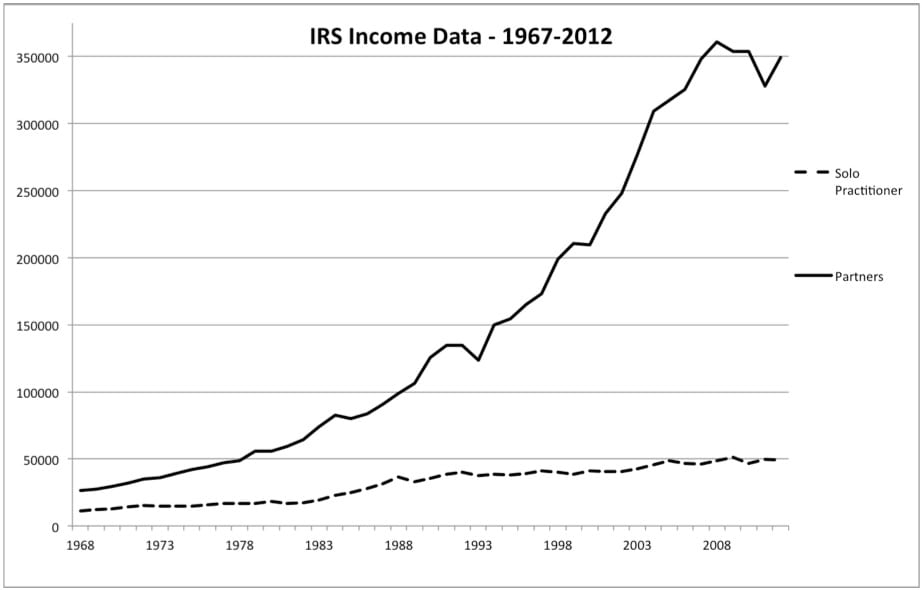
The easiest way to describe it is with my favorite graph from the book.  I love this graph because it tells you everything you need to know about the business of law over the last 45 years.  Every year since 1967 the IRS has collected and released data about the tax returns of two different groups of lawyers: solo practitioners and law firm partners.  The categories are a little wonky, because “law firm partner” includes two person partnerships in Ames Iowa and wall street mega firms, but this type of longitudinal data is a goldmine even if it has a few warts.  Here are the different earnings (in nominal terms) from 1967 to 2012:

irs data jpeg

The first thing to note is that life has sucked for solo practitioners for years.  The press treats 2008 as the start of the downturn for lawyers because that is when BigLaw started to hurt a little, but if you’re an “ordinary” lawyer you’ve been swimming upstream since at least the 1980s.  Adjusted for inflation, in 1967 American solo practitioners earned an average of almost $75,000.  In 2012 that number had fallen to $49,130, a 34% decrease!  Most of the erosion has come in the last 25 years.

And $49,130 is not the starting salary for those lawyers.  It is the average income of all of the 354,000 lawyers that filed as solo practitioners in 2012, including those that had practiced law their whole lives.  In 2009 the Alabama Bar Association polled their members on their earnings.  37% of Alabama lawyers earned under $50,000 and a shocking 23% earned under $25,000 a year!  Almost a quarter of the lawyers surveyed, who had practiced for an average of 15-20 years, earned less than $25,000.  To put these numbers into perspective, the average starting salary of a 2012 college graduate was $44,000 and the median household income in the U.S. was over $51,000.  Blech.

Yeah, I know, boo hoo for the poor lawyers, but still.  These lawyers are on the front lines of the higher ed bubble: they went to law school (and paid an ever growing amount of tuition) on the understanding that lawyer unemployment was low and that lawyers earned, at a minimum, a healthy middle class income.  Not so true these days.

SERIOUSLY, KARL?: Karl Rove: Violence will continue until the Second Amendment is repealed. During the Sunday airing of Fox New Sunday, host Chris Wallace asked Karl Rove how America can stop violent attacks like the one the country witnessed in Charleston, South Carolina. Rove responded:

So, we have come a long way. Now, maybe there’s some magic law that will keep us from having more of these. I mean, basically, the only way to guarantee that we would dramatically reduce acts of violence involving guns is to basically remove guns from society, and until somebody gets enough oomph to repeal the Second Amendment, that’s not going to happen. I don’t think it’s an answer.

No wonder so many conservatives mistrust the GOP Establishment. Geez, Karl, get a grip; you sound like Hillary. 

SINCE WE’RE HEARING A LOT ABOUT CHARLESTON’S HISTORY OF SLAVERY, it’s worth noting that New York Had A Lot Of Slaves: “To all those who think slavery was a ‘Southern thing,’ think again. In 1703, 42 percent of New York’s households had slaves, much more than Philadelphia and Boston combined. Among the colonies’ cities, only Charleston, South Carolina, had more.” What bastion of right-leaning southern-excuse-making is this from? The Nation.

Related: NYC to Acknowledge It Operated a Slave Market for More Than 50 Years.

Also: Slave Traders in Yale’s Past.

Yale relied on slave-trading money for its first scholarships, endowed professorship and library endowment. It honored slave traders when choosing figures to chisel as “Worthies” on the tower at the center of its campus, and only 40 years ago chose the names of slave traders when it was naming some colleges. According to documents these scholars have unearthed, in 1831 Yale officials led the opposition that ultimately stopped construction in New Haven of what would have been the nation’s first black college, saying that such an institution in the same city would be “incompatible with the prosperity, if not the existence,” of Yale.

There’s history all over, but only some of it is useful for allowing Acela Corridor residents to condescend. Meanwhile, here in East Tennessee — which was pro-Union during the Civil War — we have this to say: “Now that we’re re-fighting the Civil War, is it too much to ask Yankees not to leave us East Tennesseans hanging for three years this time?”

If you’re going to fight the Battle Of Fort Sanders again, please let me clean out my desk first.

A (BLACK) CHURCH, A (KOSHER) SUPERMARKET: My Bloomberg View column on what the praiseworthy rhetoric of common humanity leaves out