
YEAH, BUT WE DON’T HAVE TO WORRY, BECAUSE GOOGLE’S MOTTO IS “DON’T BE EVIL,” YOU GUYS. Google’s New All-Seeing Satellites Have Huge Potential—For Good and Evil.
Archive for 2014
June 12, 2014
AT AMAZON, deals on bestsellers in Kitchen & Dining.
Also, coupons galore in Household Supplies.
Plus, last chance deal: Up to 49% off on “Twilight Forever: The Complete Saga Box Set” on DVD and Blu-ray.
TESLA MOTORS: All Our Patent Are Belong To You.
HIGHER EDUCATION BUBBLE UPDATE, WEALTH REDISTRIBUTION EDITION: The surprising winners of Obama’s student-loan program.
Students who took out big loans for graduate school and those with higher incomes stand the most to gain financially under President Obama’s expansion of the federal government’s loan forgiveness program.
Lawyers, doctors and other highly trained professionals who utilized federal loans throughout their post-high school education could walk away with most or all of their graduate school debt forgiven by the federal government under the program, say experts.
So basically it’s a subsidy program for Gentry Liberals.
SHE’S HAVING A BAD WEEK: Hillary Clinton Attacks Radio Host In Defensive, Testy Gay Marriage Interview.
Plus, how inconsiderate of those ISIS terrorists in Iraq to upstage her roll-out.
ROGER KIMBALL: Catholics And Capitalism. “Here’s the bottom line: Capitalism is the greatest engine for the production of wealth the ingenuity of man has ever invented. Are you interested in helping the poor? Embrace capitalism. Do you want to help clean up the environment? Embrace capitalism. Are you interested in obliterating the scourge of malnutrition or some ghastly African disease or illiteracy or [fill in your personal do-good desideratum here]: yep, embrace capitalism. The global poverty rate, Kevin reminds us, has been cut in half in the last 20 years. Think about that. Then think about the sorrowful history of our species up to about 1830. How much progress against widespread — really, near total — poverty had there been from the beginning of time until then — until, that is, capitalism started to take off? Not much.”
Other -isms have much poorer track records.
K-12 IMPLOSION UPDATE: School cancels reading program rather than promote “hacker culture.”
READER BOOK RECOMMENDATION: In case you missed it, Sarah Hoyt recommends Dave Freer’s Stardogs.
TERRY ANDERSON: Hot Air On Climate Change.
IN THE MAIL: From P.C. Hodgell, The Sea of Time (Kencyrath).
Plus, today only: Up to 57% off Rockport Men’s Dress Shoes. I have Rockports and like ’em. They’re much comfier than the ridiculously expensive Church’s handmade English shoes I bought back when I was a rich lawyer.
And, also today only: Chamberlain Belt-Drive Garage Door Opener, 1/2 HP 36% off.
TAXPROF ROUNDUP: The IRS Scandal, Day 399.
DAVID BOAZ: Big Business vs. Libertarians In The GOP.
This clash between politically minded businessmen and free-market libertarians is an old one. Adam Smith wrote “The Wealth of Nations” to denounce mercantilism, the crony capitalism of his day. Milton Friedman wrote, “There’s a common misconception that people who are in favor of a free market are also in favor of everything that big business does. Nothing could be further from the truth.”
T. J. Rodgers, the outspoken CEO of Cypress Semiconductor, worries about the corrupting interplay between business and the Republican establishment: “The political scene in Washington is antithetical to the core values that drive our success in the international marketplace and risks converting entrepreneurs into statist businessmen….Republicans claim that their party stands for free markets, but they have proven [in the Bush years] to be as big spenders as are the Democrats.”
That’s what the liberty movement is trying to change, and business leaders who try to purge libertarian-minded office holders just confirm their suspicions.
Indeed. Though to be fair, spending in the Bush years wasn’t a patch on what’s happened since. For most of Bush’s second term, deficits were falling sharply, and were at levels that today would seem amazingly low.
MEGAN MCARDLE: Cantor’s Loss Wasn’t About the Money.
This is possibly the most resounding argument ever made against the notion that wealthy people can simply buy themselves representation in Congress. David Brat was outspent 40 to 1 and still managed a devastating primary upset.
This is not quite as surprising as you might think; the literature on campaign spending tends to show that there’s probably some effect, but it’s not nearly as clear or as large as most people think. And it seems entirely possible that in primaries — where the electorate is whittled down to a much smaller group of highly motivated voters — money might have even less influence than it does on the general election.
Still, if you’re someone who worries a lot about the Citizens United decision making it impossible for the little guy to get a voice in politics, this should put you a little more at ease.
I doubt those folks will be cheering much though. But, then, all the talk about “money in politics” is really a cover for trying to keep Republican money out of politics.
THIS MUST MEAN HOLDER THINKS THEY CAN FIND A TEA PARTIER TO BLAME SOMEWHERE: F.B.I. Begins Criminal Inquiry in V.A. Scandal.
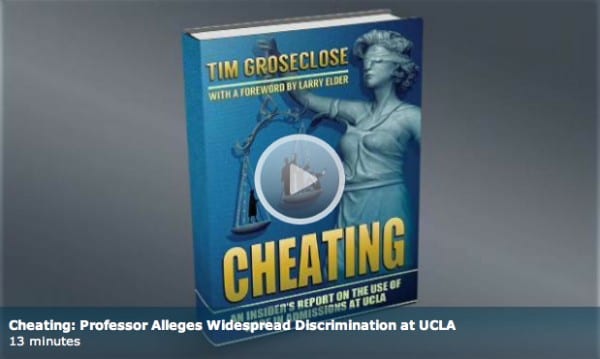
INSTAVISION: I talk with UCLA Professor Tim Groseclose about his new book, Cheating: An Insider’s Report on the Use of Race in Admissions at UCLA.
CNN: 80% of School Shootings Claimed By Bloomberg Group Are Bogus. You know, it seems as if gun-control folks just can’t make their arguments without lying.
BEAUTIFULLY FALLING APART: U.S. Said to Rebuff Iraqi Request to Strike Militants.
Related: Iraqi Militants Aiming For Baghdad.
Perhaps the real centerpiece of the Obama/Clinton/Kerry mideast strategy is just an aim to get as many Arabs killing each other as possible.
IF I WERE HER, I DON’T THINK I’D WANT TO TALK ABOUT FOREIGN POLICY: Clinton’s women-centric approach to foreign policy could shape her campaign.
UPDATE: The Benghazi Attackers Reported to Their Bosses Using Stolen State Department Phones. Competence.